
There are roughly 300 million bottles of Champagne sleeping beneath the rolling hills of northeast France right now. Not stored in warehouses. Not stacked in a cellar under someone’s house. Sleeping in ancient chalk tunnels — some carved by the Romans — at a depth where the temperature never changes and the silence is total.
This is not a romantic exaggeration. It is the literal reality of how Champagne is made. And most people who drink it have no idea it exists.
The Caves That Made Champagne Possible
The chalk hills around Reims and Épernay sit above a geological accident that changed drinking history. Beneath the surface lies soft white chalk — the same material that forms the White Cliffs of Dover. It holds a near-perfect temperature of around 10–12°C year-round. Humid enough to keep corks from drying out. Cool enough to slow the ageing process to exactly the right pace.
The Romans quarried these chalk hills for building stone, and the tunnels they left behind became the foundation of an industry. By the 18th century, the great Champagne houses had realised something important: these caves were not just useful storage. They were irreplaceable.
Moët & Chandon alone has 28 kilometres of tunnels beneath Épernay. Taittinger uses the 13th-century chalk cellars beneath the former Saint-Nicaise Abbey in Reims — caves that once held the bodies of Benedictine monks and now hold millions of ageing bottles. Ruinart, founded in 1729 and the oldest Champagne house still operating, sits above a network of crayères that descend eight storeys below ground.
A crayère is what the French call these ancient chalk pits. Some are cathedral-like in scale — tall, vaulted, and carved by hand over centuries. Walking into one for the first time feels like entering a different world entirely.
What Darkness Does to Wine
Light is the enemy of Champagne. UV exposure triggers a chemical reaction that creates sulphur compounds — the same ones responsible for an unpleasant smell known as goût de lumière, or the taste of light. Champagne bottles are often dark green or amber glass to reduce this risk, but no glass is completely light-proof.
In the caves, there is no light at all. Bottles rest in complete darkness for months, sometimes years, sometimes decades. During that time, the wine undergoes its second fermentation inside the sealed bottle — a deliberate process that creates the bubbles Champagne is famous for.
Before corking, a small amount of yeast and sugar — called the liqueur de tirage — is added to the still wine. The yeast consumes the sugar and produces carbon dioxide. Trapped inside the glass under pressure, that gas dissolves into the wine. When you open a bottle and the pressure releases, the gas forms bubbles that rise to the surface. Each one is a trace of that long, patient darkness underground.
Non-vintage Champagne must age for at least 15 months in the bottle. Vintage Champagne requires at least three years. Prestige cuvées — such as Dom Pérignon or Krug’s Clos du Mesnil — often age for a decade or more before release. Time, darkness, and chalk do the work that no technology can replicate.
The Human Ritual Nobody Talks About
For centuries, every bottle had to be turned by hand.
The process is called remuage in French — riddling in English. Each bottle is placed in an angled wooden rack called a pupitre at 45 degrees. Over six to eight weeks, a skilled worker — the remueur — visits each bottle, gives it a precise quarter turn, and slightly increases the angle. The goal is to coax the sediment — dead yeast cells left over from fermentation — down into the neck of the bottle.
A skilled remueur could riddle 40,000 bottles a day. Their hands developed a muscle memory so precise they could work entirely by touch in complete darkness. It was one of the most physically demanding jobs in the French wine industry.
Once the sediment has collected in the neck, the bottle is disgorged. The neck is briefly frozen, the temporary cap removed, and the plug of frozen sediment shoots out under pressure. A small amount of wine and sugar called the dosage is added to top up the bottle, and the final cork goes in. The whole journey from grape to glass can span a decade.
Enjoying this? 7,000 France lovers get stories like this every week. Subscribe free →
The Avenue That Changed the World
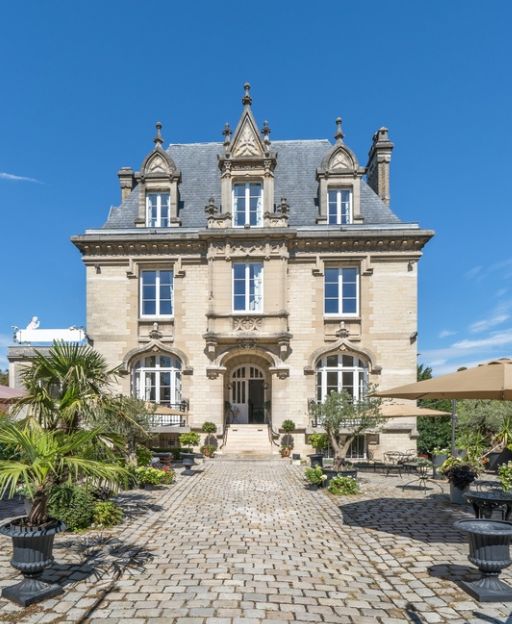
Épernay’s Avenue de Champagne is one of the most quietly extraordinary streets in France. On the surface, it looks like a handsome 19th-century boulevard lined with grand mansions and clipped hedges. Most visitors stop to admire the architecture, take a few photographs, and move on.
What they are standing above is billions of euros worth of wine.
The caves beneath the Avenue run for kilometres in every direction. Some descend 30 metres below street level. The houses that line the road — Moët & Chandon, Pol Roger, Perrier-Jouët, de Castellane — are the visible tops of vast underground empires. UNESCO recognised the Champagne hillsides, houses, and cellars as a World Heritage Site in 2015.
The Avenue itself is only about a kilometre long. You can walk the whole thing in fifteen minutes. But you could spend an entire afternoon underground, moving between houses, tasting different styles, learning the difference between blanc de blancs and blanc de noirs. Each house has its own character, its own blend, and its own interpretation of what Champagne should taste like.
What a Cellar Visit Actually Feels Like
Walking through a Champagne cellar changes how you think about the bottle.
You enter through a low stone door and the temperature drops immediately. The air is damp and cool. The smell is of chalk and wine and time. Row after row of bottles lines the walls, each one resting at an angle, each one in the middle of a process that has months or years still to run.
The guide explains the riddling racks, the disgorgement line, the dosage. You begin to understand that what looks like a casual celebration drink is the result of extraordinary patience and craft. Every bottle you have ever opened had a journey like this.
The Champagne region sits just 90 minutes from Paris by train. If you are planning your trip to France, it is worth adding. The landscape is quieter than the Loire or Provence. The villages are smaller. The pace is slower. And everywhere you look, the chalk hills hold their secrets.
For a broader look at France’s wine country, from Burgundy to Bordeaux, The Best Wine Regions in France for Visitors gives a clear overview of what each region offers. And if you want to understand how winemaking communities actually live — the villages inside the estates, the rhythm of harvest, the people behind the labels — The Forgotten Villages Living Inside Bordeaux’s Greatest Wine Estates tells that story well.
The next time you open a bottle of Champagne, you will think about the chalk, the darkness, and the hands that turned it a hundred times in the cold underground. That thought makes it taste different. Better, somehow.
Join 7,000+ France Lovers
Every week, get France’s hidden gems, seasonal guides, local stories, and the art of la vie française — straight to your inbox.
Love more? Join 65,000 Ireland lovers → · Join 43,000 Scotland lovers → · Join 30,000 Italy lovers →
Free forever · One email per week · Unsubscribe anytime
Love France? So Do We.
Join our free newsletter and get the best of France — travel tips, hidden villages, food traditions, and cultural stories — straight to your inbox every week.
Free. No spam. Unsubscribe anytime.
📥 Free Download: France Travel Planning Guide
Itineraries, insider tips, and the places you must not miss on your next trip to France.
Leave a Reply