
There is a river in southwest France that most visitors drive along without stopping. They are heading somewhere else — Bordeaux, perhaps, or the Basque coast. But the Dordogne Valley is asking them to slow down. Because hidden along its banks, cut into golden limestone cliffs and reflected in slow green water, are some of the most beautiful villages in the world.
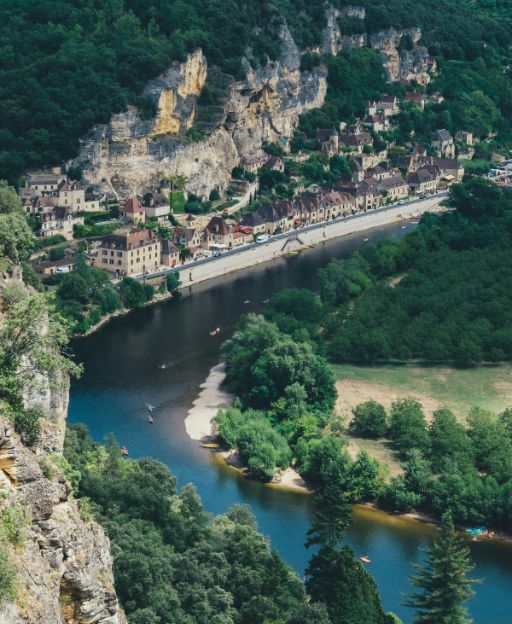
The Dordogne villages have a quality that is hard to put into words. They feel lived-in rather than restored. They feel earned. Stone by stone, century by century, people built their homes into the cliffs above this river, and somehow, most of those homes are still standing. Still inhabited. Still beautiful.
France officially designates its most beautiful villages with a label — Les Plus Beaux Villages de France. The Dordogne Valley has more of these officially recognised villages than almost any other region in the country. That is not a coincidence.
The River That Shaped Everything
The Dordogne River is 483 kilometres long. It rises in the volcanic Massif Central and winds its way west to join the Gironde estuary above Bordeaux. For most of its journey, it passes through farmland and forest. But in a stretch roughly 50 kilometres long in the Périgord Noir region, something extraordinary happens.
The valley narrows. The limestone cliffs rise up on both sides, sometimes 100 metres high, pale and golden in the afternoon sun. And people, over many thousands of years, found that these cliffs were not obstacles. They were shelter. They were home.
The same cliffs that once sheltered prehistoric cave painters at Lascaux and Font-de-Gaume later sheltered medieval lords building châteaux and farmers building villages at their feet. The geology dictated everything — the shape of the towns, the routes of the roads, the position of the markets.
That is why the Dordogne villages look the way they do. They did not choose their locations for beauty. They chose them for survival. The beauty came later, slowly, accidentally.
La Roque-Gageac: The Village That Lives in a Cliff
La Roque-Gageac may be the most striking village on the entire river. It stretches along the waterfront in a single, unbroken line of honey-coloured stone, pressed so tightly against the overhanging cliff that some houses appear to grow from the rock itself.
In winter, the cliff acts as a heat trap. The south-facing rock absorbs sunlight all day and radiates warmth through the night. This microclimate is warm enough that exotic plants — banana trees, bamboo — grow against the cliff face right in the heart of the Dordogne. It is one of those small French details that makes you stop and look twice.
The village was built starting in the 12th century and was considered one of the most important ports on the Dordogne throughout the medieval period. Flat-bottomed boats called gabarres carried wine, walnut oil, and salt down to Bordeaux and back. Today, replica gabarres still carry tourists along the same stretch of water. The river has not changed. The view has not changed.
Beynac: When the Châteaux Ruled the River
A few kilometres upriver from La Roque-Gageac, the village of Beynac-et-Cazenac clings to a cliff of a different kind — not horizontal, but vertical. The medieval château at its top once controlled this entire stretch of the Dordogne, sitting 150 metres above the water with unbroken views in three directions.
During the Hundred Years War, the Dordogne was a front line. English-controlled territory began just across the river. Beynac was French. Castelnaud, visible on the opposite bank, was English. For over a century, the two fortresses watched each other from their cliffs, occasionally at war, occasionally at an uneasy truce.
Walk the steep lanes of Beynac today and this history sits just beneath the surface. The stone steps are worn smooth. The archways are low. The windows are narrow. Everything about the village is built for a world where safety meant height, and height meant everything.
If you are planning a visit to this part of France, our full Dordogne travel guide covers everything you need to know about getting there and where to stay.
Enjoying this? 7,000 France lovers get stories like this every week. Subscribe free →
Domme: The Bastide That Watches Over the Valley
High above the river, on a promontory 250 metres up, Domme looks down on the entire valley like a medieval watchtower that never stopped watching. It is a bastide — a planned, fortified town built to a grid — founded in 1281 by Philip III of France. The walls still stand. The original gateway still stands. The view from the cliff edge still drops your jaw.
From Domme’s clifftop esplanade, on a clear day, you can see four or five bends of the river laid out below you, each one framing a different village. It is the kind of view that makes you understand, in a single glance, why people fought so hard over this stretch of water for a thousand years.
Below the central market square, Domme has something unexpected: a network of limestone caves that served as a refuge for 1,200 townspeople during the Hundred Years War. The caves are open to visitors. Inside, you can see carvings made by the people who hid there — proof that even under threat, humans reach for something beyond survival.
Sarlat: The Market Town at the Heart of It All
The largest town in the Périgord Noir, Sarlat-la-Canéda is not a village — but it earns its place in any conversation about the Dordogne’s remarkable built heritage. Its medieval old town is one of the best-preserved in France, a dense maze of hôtels particuliers, Renaissance doorways, and church towers that survived the centuries largely untouched.
On Saturday mornings, Sarlat’s market fills the old town from end to end. Walnut oil, truffle salt, confits de canard, golden prunes, rounds of Cabécou goat’s cheese — everything that defines Périgord cooking appears in one place, all at once.
The market is not a tourist attraction, though tourists come in numbers. It is a genuine working market that has been held here, in this square, for centuries. The same square. The same golden stone. Different hands across the stalls.
When to Come and How to See It Right
July and August bring crowds to the Dordogne. La Roque-Gageac fills with tour coaches. The gabarres queue. Beynac’s car park overflows. The villages are still beautiful, but they belong to everyone in summer, and something quiet is lost.
The Dordogne in May, June, or September is a different experience entirely. The light is softer. The villages are yours. The market in Sarlat still runs, the walnut oil is still there, and you can stand on Domme’s esplanade in the late afternoon and count the bends of the river with no one pushing past you for a photograph.
If you are building a wider trip through France, the France trip planning hub is the best place to start. The Dordogne pairs naturally with Bordeaux to the west or the Lot Valley to the south for a week or two of slow travel through some of the most beautiful countryside in Europe.
The villages along this river have never needed to advertise themselves. They simply exist — golden, ancient, improbable — at the edge of cliffs above slow green water. The people who find them tend to come back. That says everything.
Join 7,000+ France Lovers
Every week, get France’s hidden gems, seasonal guides, local stories, and the art of la vie française — straight to your inbox.
Love more? Join 65,000 Ireland lovers → · Join 43,000 Scotland lovers → · Join 30,000 Italy lovers →
Free forever · One email per week · Unsubscribe anytime
🇫🇷 Want More Hidden France?
Join 7,000+ subscribers who discover France’s best-kept secrets every week.
Subscribe Free — Join the Community →
Free forever · Unsubscribe anytime · No spam
📥 Free Download: France Travel Planning Guide
Itineraries, insider tips, and the places you must not miss on your next trip to France.
Leave a Reply