
There is a saying in Corsica that visitors hear almost immediately: “I am Corsican first, then French.” This is not hostility. It is not rebellion. It is simply fact, spoken with a calm certainty that tells you everything you need to know about this island and its people.
An Island With a Memory Longer Than Any Map
Corsica sits 170 kilometres off the coast of Provence, yet it has never felt like a French suburb. The reason goes back centuries. The island was sold to France by the Republic of Genoa in 1768 — just one year before a local boy named Napoleon Bonaparte was born in Ajaccio. Whether Napoleon counted as French or Corsican was debated even in his lifetime.
Before France, there was Genoa. Before Genoa, Pisan cathedrals still standing in mountain villages. And before all of that, the Corsicans themselves — a people who have been farming, fishing, and feuding in these mountains longer than any republic has existed.
When France formally took control, Corsica did not simply become French. It remained Corsican, and quietly made France come to terms with that.
The Language That Will Not Die
Corsican — corsu — is a language in its own right, closer to Italian than French, shaped by centuries of Genoese rule and island isolation. In the 20th century, it nearly vanished. French became the language of school, law, and ambition. Corsican was the language of grandmothers and shepherds.
But something shifted. By the 1990s, Corsican pride had become a cultural movement. The language returned to schools, to road signs, to music. Today you will find bilingual signs across the island. Corsican identity was not merely surviving — it was insisting.
Local musicians still perform cantu in paghjella, a form of polyphonic village singing listed by UNESCO as intangible cultural heritage. It sounds unlike anything else in Europe — several voices braided together in harmonies that seem to rise from the rocks themselves.
The Maquis and What It Means
Ask any Corsican what the island smells like and they will tell you: the maquis. This dense scrubland of wild rosemary, myrtle, lavender, and cistus covers the hillsides and fills the air with something that cannot be bottled or explained. Napoleon reportedly said he could recognise Corsica with his eyes closed, simply from its scent.
The maquis is more than scenery. During the Second World War, it became the hiding place of the Corsican Resistance — and Corsica became the first French territory to be liberated, in September 1943, largely through the efforts of Corsicans themselves. The word maquis entered French as a synonym for resistance — for those who chose difficult terrain over submission.
That spirit runs deep. Visitors sometimes sense it in the way locals speak about their mountains, their valleys, their particular village. Corsica is not performing its identity. It is simply living it.
Enjoying this? 7,000 France lovers get stories like this every week. Subscribe free →
What Travelling to Corsica Feels Like
This is an island that does not try to please you. The roads are narrow and often unpaved. The villages are quiet, sometimes closed to outsiders. The sea is extraordinary — clear to depths you would not believe possible in the Mediterranean. The mountains rise to over 2,700 metres and hold snow until June.
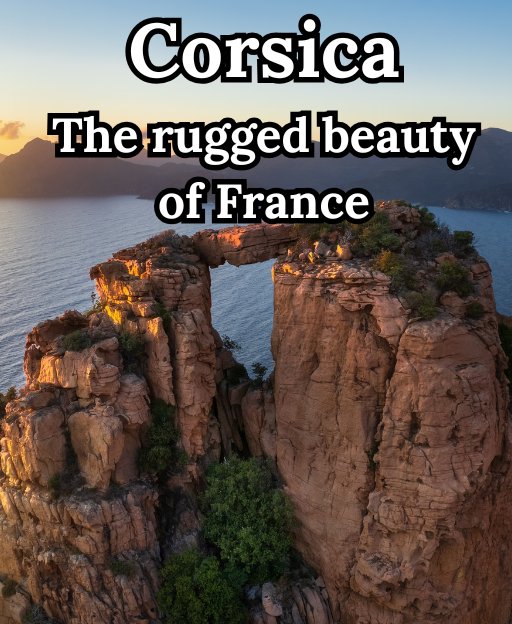
There is no pretence here. No manufactured charm. What you find is what has always been here: granite peaks, wild rivers, chestnut forests, and a coastline that shifts between turquoise coves and sheer pink cliffs without warning.
The food is its own world. Brocciu, a fresh cheese made from sheep’s or goat’s whey, appears in everything from pastries to pasta. Charcuterie from Corsican black pigs — fed on chestnuts and acorns in the maquis forests — has a depth of flavour that most cured meats simply cannot match. Chestnuts were a staple for centuries, ground into flour, brewed into beer, and still central to the island’s autumn identity.
If you are planning a trip to France and want to go beyond the obvious, start with our complete France trip planning guide — it covers how to build an itinerary that actually fits the France you are looking for.
The Pride That Shaped France
It is easy to frame Corsican identity as resistance. But it is more complicated than that. Corsicans have served in the French military, risen through French politics, and shaped French culture. The tension between the two identities — island and republic — has produced something interesting: a people who understand both, and owe everything to neither.
That quality of belonging-without-surrendering is perhaps what makes Corsica so compelling to visitors. Here is a place that has decided, after centuries of history and considerable noise, exactly who it is.
If regional identity fascinates you, it is worth reading about Alsace — the French region that changed countries four times in a single lifetime. The parallels between border regions and island regions are striking, and the history is just as compelling.
Stand on any ridge above the Corsican sea. Smell the maquis rising from the valley below you. You will understand, very quickly, why this island has never once felt the need to explain itself.
Join 7,000+ France Lovers
Every week, get France’s hidden gems, seasonal guides, local stories, and the art of la vie française — straight to your inbox.
Love more? Join 65,000 Ireland lovers → · Join 43,000 Scotland lovers → · Join 30,000 Italy lovers →
Free forever · One email per week · Unsubscribe anytime
🇫🇷 Want More Hidden France?
Join 7,000+ subscribers who discover France’s best-kept secrets every week.
Subscribe Free — Join the Community →
Free forever · Unsubscribe anytime · No spam
📥 Free Download: France Travel Planning Guide
Itineraries, insider tips, and the places you must not miss on your next trip to France.
Leave a Reply