
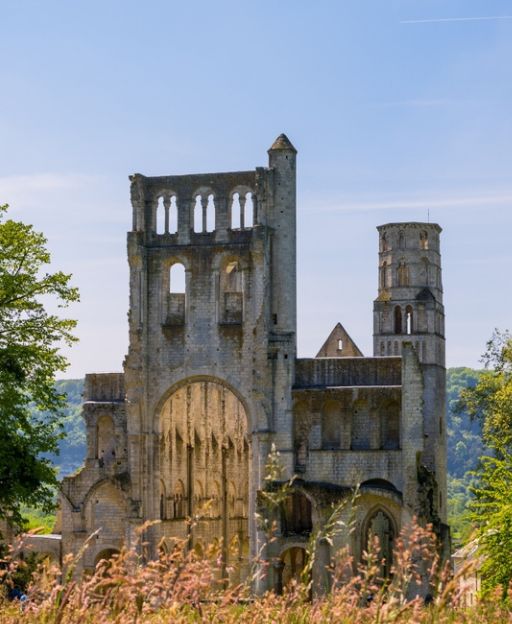
Every town in Normandy has a church. But Jumièges has something rarer — a sky where a ceiling used to be. Walk through the stone gatehouse and two enormous towers rise above you, open to the clouds. This is what happens when history runs out of luck.
What the River Hid for Centuries
Thirty kilometres west of Rouen, the Seine makes a wide loop through forest and farmland. In the seventh century, a monk called Philibert chose this spot to build something that would last for ever. He was right — it lasted over 1,100 years before a timber merchant with gunpowder brought it down.
Jumièges Abbey was founded in 654 AD. Within decades it had drawn hundreds of monks from across France and beyond. At its height, over 900 people lived and worked within its walls. It was one of the great centres of Christian learning in northern Europe.
The Vikings Came Anyway
In 841 AD, Norse raiders sailed up the Seine and torched the monastery. The monks fled with everything they could carry, including the relics of their founding saint. For decades, the ruins sat silent.
Then something unexpected happened. The same people who had burned it decided to rebuild it.
The Normans — descendants of those Viking settlers — rebuilt Jumièges in the tenth and eleventh centuries. The church you see today dates from around 1040. William the Conqueror attended the dedication in 1067. Agnes Sorel, the favourite of King Charles VII, was buried here in the fifteenth century. For 700 years after the rebuild, Jumièges was a place of quiet, deep significance.
Then the Revolution Arrived
In 1791, the Revolutionary government declared all religious property to be national property. Jumièges was auctioned off. The buyer was a timber merchant from Rouen. He had no interest in preservation.
He filled the nave with gunpowder and blew it apart. The rubble was sold off — the stone used in building projects across the region. What had taken monks decades to build was salvaged in years. The roof was stripped. The interior was gutted. The great church that had survived Viking fire was undone by Revolutionary logic.
Enjoying this? 7,000 France lovers get stories like this every week. Subscribe free →
What Writers and Artists Found Here
Victor Hugo visited in 1835 and was so moved by the ruins that he wrote about them at length in his travel journals. Standing before the two west towers — each still over 40 metres tall, still perfectly proportioned — he found a place that felt both sacred and devastating.
Other writers and artists followed. Turner painted the ruins. Flaubert passed through. The ruins became a destination not in spite of their destruction, but because of it. The absence of the ceiling, the grass growing in the nave, the open sky above the altar — all of it gave Jumièges an atmosphere that no intact cathedral could match.
How to Visit Jumièges Today
The village of Jumièges has fewer than 2,000 residents. The abbey stands at its centre, open to visitors year-round. You can reach it by ferry from the opposite bank of the Seine — a five-minute crossing that feels like arriving somewhere time forgot.
Visit on a weekday morning, before the coaches arrive. The early light falls through the empty nave and the stone turns warm. The grass is kept short. The towers are immaculate. And the sky above fills the space where 900 monks once sang.
Jumièges sits along the Normandy river road, one of the most beautiful drives in northern France — past medieval towns, cider orchards, and villages that barely appear on maps. If you want to build a wider France trip around places like this, start with our France planning hub.
Some ruins are interesting. Jumièges is devastating. The proportions of the church are so perfect that the destruction feels personal — like something genuinely precious was lost. And it was. Standing beneath those two towers, open to the sky, you understand something about France that a guidebook cannot quite capture: this country has built extraordinary things, lost them, and kept going. Jumièges is still here. Just not quite the way it was meant to be.
Join 7,000+ France Lovers
Every week, get France’s hidden gems, seasonal guides, local stories, and the art of la vie française — straight to your inbox.
Love more? Join 65,000 Ireland lovers → · Join 43,000 Scotland lovers → · Join 30,000 Italy lovers →
Free forever · One email per week · Unsubscribe anytime
Leave a Reply