
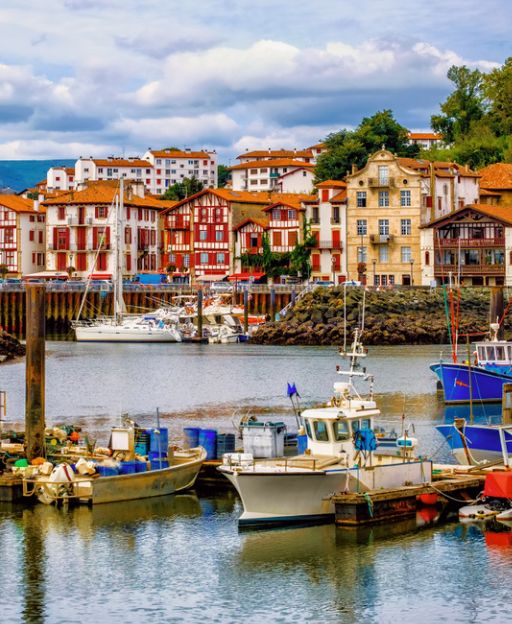
Stand on the seafront at Saint-Jean-de-Luz on a summer evening and you’ll notice something is off. The colours are wrong for France. The language drifting from the next table isn’t French. The architecture, the music, the food — none of it quite fits the Gallic template. You’re in France, technically. But you’re also somewhere else entirely.
A Language France Didn’t Make
The Basque language — Euskara — is one of the most mysterious in the world. It shares no roots with French, Spanish, or any other Indo-European language. Linguists have never fully agreed on where it came from. The Basques, for their part, aren’t too concerned with the question.
They’ve been speaking it for thousands of years. They plan to keep going.
Across the French Basque Country — known locally as Iparralde — you’ll find street signs in two scripts, schools that teach in Euskara, and radio stations broadcasting in a tongue that Napoleon’s empire never managed to extinguish. Around 80,000 people in France speak it today. The number is growing, not shrinking.
The Border That Doesn’t Really Exist
The Pyrenees mark the official line between France and Spain. But for the Basques, that line has always been a bureaucratic inconvenience. Families stretch across both sides. Weddings draw cousins from Bilbao to Bayonne. The traditional Basque greeting — Kaixo — sounds the same in Biarritz as it does in San Sebastián.
There are seven traditional Basque provinces: three in France, four in Spain. The French Basque Country sits in the far south-west corner of France, pressed between the Atlantic coast and the Pyrenean foothills. It is small. It is fiercely proud.
France, for most of its history, preferred not to acknowledge this complexity. The language was banned in schools for a time. Local customs were quietly discouraged. The Basques endured it with the particular stubbornness of people who know they were here first.
The Architecture Tells You Everything
Walk through Bayonne or Espelette and you’ll see it immediately. The houses are painted white with dark red or green shutters and exposed timber frames — a style found nowhere else in France. It is unmistakable. It is not Parisian. It is not Provençal. It is Basque.
The pelota court — the fronton — sits at the centre of every Basque village. It is not just a sports facility. It is a social space, a community anchor, the local equivalent of the village square. Games happen on Sunday afternoons, and half the village turns out to watch.
Pelota itself is older than France as a nation state. It has been played on these courts for centuries. Watching it, you understand that this is not a hobby. It is an expression of identity.
Enjoying this? 7,000 France lovers get stories like this every week. Subscribe free →
Food That Belongs to No One Else
Basque cuisine is its own world. Piperade — a slow-cooked dish of red peppers, tomatoes, and egg — appears on tables from farmhouses to restaurants. Jambon de Bayonne is a salt-cured ham that has been made in this valley for over a thousand years, following methods that French charcuterie never adopted.
And then there is the chocolate. Bayonne has been making it since the 17th century, when Jewish merchants fleeing the Spanish Inquisition arrived here with their knowledge of cacao. The city’s chocolatiers still operate from the same medieval arcade near the river. The smell alone is worth a detour.
The Basque Country also gave the world the beret. France adopted it as a national symbol. The Basques regard this with good humour. It was theirs first.
A Pride That Runs Deeper Than Politics
The Basques don’t wave flags about independence the way some regions do. The feeling here is quieter than that. It’s in the language being taught to children. In the pelota games on Sunday afternoons. In the way the fishermen of Saint-Jean-de-Luz still bring in tuna the way their great-grandfathers did.
It is worth comparing this to Alsace — the French region that changed countries four times in one lifetime — where identity was reshaped by war and borders drawn by others. The Basque situation is different. Nobody redrew the map. Nobody moved them. They simply stayed, and they stayed Basque.
France is a nation that has always tried to absorb its regions into one grand idea of Frenchness. The Basques have spent centuries not quite letting it happen. Not angrily. Just persistently. Just themselves.
If you’re planning a trip and want to explore the south-west, the France planning hub has everything you need to put a route together.
Join 7,000+ France Lovers
Every week, get France’s hidden gems, seasonal guides, local stories, and the art of la vie française — straight to your inbox.
Love more? Join 65,000 Ireland lovers → · Join 43,000 Scotland lovers → · Join 30,000 Italy lovers →
Free forever · One email per week · Unsubscribe anytime
Drive south from Bayonne on a clear morning and the Pyrenees rise slowly before you, snow-capped and immovable. The road signs switch to two languages. The landscape changes. And somewhere between the Atlantic and the mountains, you realise you have crossed into something that France has never fully claimed — and probably never will.
Leave a Reply