
Most people expect old ruins to be cordoned off behind glass. In France, you can walk into a 2,000-year-old Roman arena, find a seat, and watch a concert. The Romans built these places to last. The French never saw a reason to stop using them.
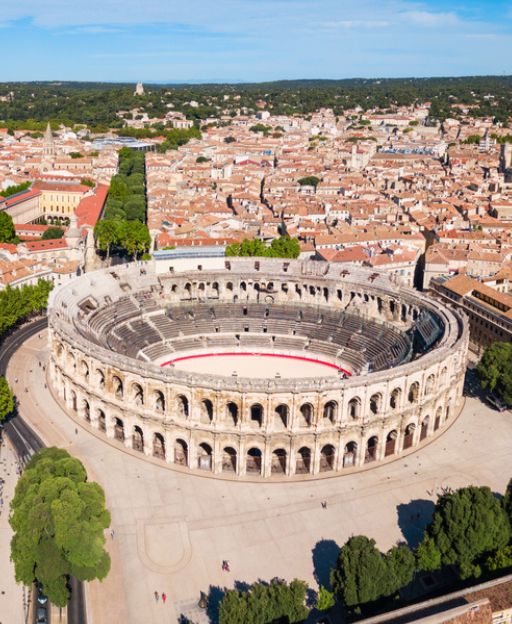
The Arena That Refused to Become a Museum
The Arènes de Nîmes is not a ruin. It is the best-preserved Roman amphitheatre in the world, and it is still in business. Built in the first century AD, it held 24,000 spectators when Rome ruled southern Gaul. Today it holds about the same.
Every summer, the arena fills for bullfights — the corridas de toros that connect this part of France directly to its Roman past. In winter, it transforms again. Heating goes in, the sand floor is covered, and the ancient stone walls echo with jazz, rock, and flamenco.
Nîmes sits in the Languedoc region, close to the Provençal border. If you are exploring the south of France, this city deserves more than a passing glance.
The Theatre That Has Run for Two Thousand Years
Twenty minutes north of Nîmes, the city of Orange has something even more remarkable: a Roman theatre that has been hosting performances almost without interruption since the first century.
The Théâtre Antique d’Orange was built under Emperor Augustus. Its stage wall is 103 metres wide and 37 metres tall — so massive that Louis XIV once called it “the finest wall in my kingdom.” Every summer, the Chorégies d’Orange festival fills the ancient stone seats with world-class opera and classical music.
The acoustics were shaped by Roman engineers who had no microphones or amplifiers. Singers performing there today say the theatre sounds unlike anything else in Europe.
The Arena Hidden in the Middle of Paris
Most visitors to Paris never find the Arènes de Lutèce. It is tucked into the 5th arrondissement, behind apartment buildings, invisible from any main street. Built in the first century AD, it once held 15,000 spectators.
Today it holds retired men playing pétanque. Students eat lunch on the old stone steps. Children chase pigeons across the ancient sand floor. There are no ticket booths, no entrance fees, no explanatory signs. It simply exists in the city, being quietly used.
That is very French. The Romans built something good. The city built itself around it and carried on.
Enjoying this? 7,000 France lovers get stories like this every week. Subscribe free →
Why These Places Never Became Museums
The easy option, when you inherit a 2,000-year-old stone arena, is to rope it off and charge admission for guided tours. France did not do that — at least, not only that.
Part of this is practical. Roman concrete, mixed with volcanic ash, has proven more durable than almost anything built in the centuries that followed. These structures do not need saving. They are fine.
But there is something else at work. The south of France — ancient Occitania, the land of troubadours and Roman roads — has always worn its history differently. This region carries deep historical weight that stretches back long before the Middle Ages. Roman arenas here are not monuments to foreign occupation. They are simply part of the landscape, as ordinary as the plane trees lining the boulevards.
What a Roman Arena Feels Like Today
Standing inside the Arènes de Nîmes on a summer evening, the light turns golden on the upper tiers. The murmur before a performance begins — the shuffling, the low conversation, the anticipation — is not so different from what a Roman citizen experienced here 2,000 years ago.
The stone is worn smooth in the places where hands have touched it for centuries. That worn smoothness is the point. These arenas have not been preserved like museum pieces. They have been touched, walked, sat upon, and lived in across two millennia.
Planning Your Visit
Nîmes and Orange are both easily reached by train from Marseille, Montpellier, or Avignon. For a route that takes in both cities alongside Provençal villages and Roman roads, our Provence travel guide covers regional transport and the best time to visit. If you are still in the early stages of planning, our France trip planning hub is the best place to start.
Two thousand years of concerts, crowds, and ordinary afternoons. The Romans built something permanent. France had the good sense to keep using it.
Join 7,000+ France Lovers
Every week, get France’s hidden gems, seasonal guides, local stories, and the art of la vie française — straight to your inbox.
Love more? Join 65,000 Ireland lovers → · Join 43,000 Scotland lovers → · Join 30,000 Italy lovers →
Free forever · One email per week · Unsubscribe anytime
Leave a Reply