Most people associate the French Alps with ski lifts, thermal suits, and crowded mountain restaurants. But there is a whole other side to these mountains that runs on its own calendar. Between June and October, before the first snowfall transforms the landscape, alpine villages hold festivals that have nothing to do with skiing — and everything to do with who these communities actually are.
A Summer That Belongs to the Locals
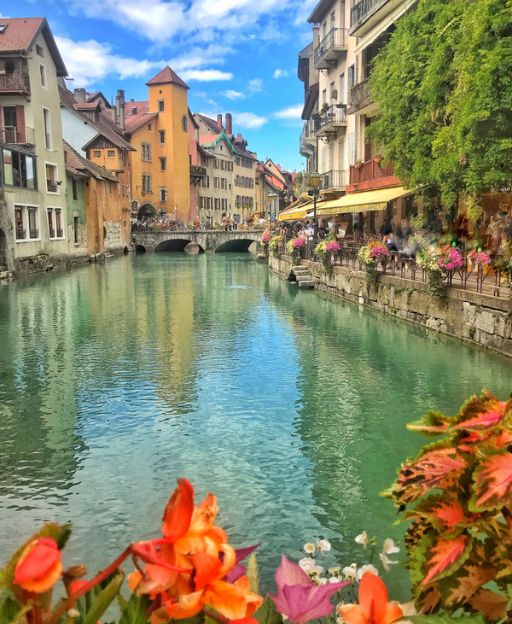
When the winter crowds leave, something changes in the French Alps. The pace slows. The streets feel wide again. Families set up trestle tables outside cafés in Annecy and Megève, and the conversation shifts from ski conditions to cows, cheese, and the harvest ahead.
Summer is when mountain life runs on its oldest rhythms. Farmers who spent winter in the valleys start moving herds up to high pastures — a practice called the estive. It has happened every year for centuries, and many villages still mark it with a festival.
The Return of the Cows
One of the most moving spectacles in the French Alps is the descente des alpages — the return of the cattle from the high summer pastures in autumn. Cows come down the mountain decorated with flowers, bells, and embroidered headbands. The village squares fill with music, food stalls, and crowds of locals who turn out as if it were a national holiday.
In the Beaufortain valley, this tradition has been observed since before anyone can remember. The cheese-making families bring wheels of Beaufort — one of the great French Alpine cheeses — down with them. By midday, the square smells of fondue and woodsmoke.
It is not performed for tourists. It is simply what happens.
Village Fêtes That Run on Their Own Rules
Every French alpine village has a fête votive — a patron saint’s day that anchors the summer social calendar. These vary enormously. Some last three days and involve fireworks, a travelling fair, and a boules competition that runs past midnight. Others are quieter: an outdoor mass, a shared meal, a band playing under the plane trees until the mountains go purple.
In places like Les Gets, Morzine, and Samoëns, summer fêtes draw back the Parisian families who own summer homes there. For a few weeks, the village becomes what it always was before the ski lifts arrived — a living community with its own identity.
Enjoying this? 7,000 France lovers get stories like this every week. Subscribe free →
The Markets That Have Run for Centuries
Alpine market culture in summer is entirely different from the rest of France. Here, the produce is altitude-specific: reblochon and tomme de Savoie alongside jars of wild bilberry jam, bundles of mountain thyme, and carved wooden objects made during the long winter months.
Thonon-les-Bains on Lake Geneva holds one of the oldest markets in the region, dating back to the 13th century. In Annecy, the Saturday market along the canal is a full-on sensory event — the smell of fresh bread mixing with alpine flowers and the cold lake air.
These are not heritage experiences put on for visitors. They are where people actually shop.
What Skiing Changed — and What It Didn’t
Modern ski resorts transformed the economics of these villages completely. A place like Courchevel or Val d’Isère now earns most of its income in four winter months. But the summer calendar — the festivals, the fêtes, the market traditions — has stayed remarkably intact.
Walk through Chamonix in August and you will find street musicians, boulangeries doing their highest daily bread count of the year, and a weekly farmers’ market that has run in some form since the 18th century. The mountains have always drawn people. The skiing is just the newest reason.
How to Find the Festivals
The best way in is small. Skip the big resorts and look for villages in the Haute-Savoie département, the Beaufortain, or the Belledonne range. Tourist offices in towns like Annecy, Albertville, or Bourg-Saint-Maurice maintain summer festival calendars.
The descente des alpages typically runs in late September and early October. Fêtes votives happen throughout July and August. Check the local mairie (town hall) website for exact dates — most villages publish their summer programme in May.
If you are planning a trip to France and considering the Alps, September is worth serious consideration. The summer crowds have thinned. The colours are turning. And the villages are in the middle of their harvest festivals — exactly the season they were built for.
The same ancient instinct plays out in the Pyrenees too — if you want to see what transhumance looks like in southern France, the traditions there run just as deep.
The French Alps hold two lives in one place — the modern world of ski passes and heated outdoor terraces, and the older world of cows with flower crowns coming down from the high pastures. September and October belong entirely to the second one. And it is worth every mile to be there for it.
Join 7,000+ France Lovers
Every week, get France’s hidden gems, seasonal guides, local stories, and the art of la vie française — straight to your inbox.
Love more? Join 65,000 Ireland lovers → · Join 43,000 Scotland lovers → · Join 30,000 Italy lovers →
Free forever · One email per week · Unsubscribe anytime
Leave a Reply