
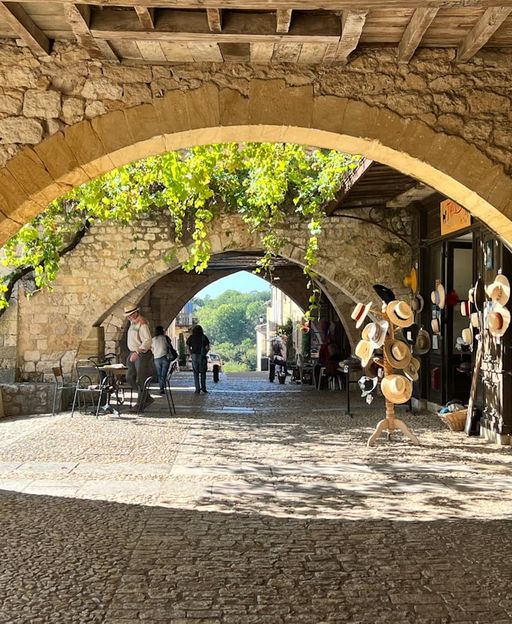
Walk into Monpazier on a quiet morning and you’ll notice something odd. The streets meet at right angles. The central square is lined with covered stone arcades. Everything feels deliberate — not evolved, but designed. Drive to Domme, then push further into Gascony to find Mirande, and the same thought returns. These villages weren’t discovered. They were built from scratch.
Towns Built From a Blueprint
They’re called bastides — from the Occitan word for “building” — and they are among the most extraordinary things hidden in plain sight across southwest France. Between roughly 1220 and 1370, hundreds of these planned settlements were founded across Gascony, the Périgord, and the Quercy.
Not every medieval village just grew. Bastides were designed: a grid of streets, a central market square, standard-sized plots for settlers. A surveyor came first. Then the people.
Why Both England and France Built Them
Here’s the part that surprises most visitors: both French and English kings built bastides — often just a few miles apart, as direct rivals. Gascony at the time was under English rule, and both sides understood the same logic.
Whoever attracted settlers gained tax revenue, military manpower, and political loyalty. So they offered something genuinely radical for the 13th century: rights. A bastide settler received a plot of land, freedom from feudal obligations, and the protection of the town walls. Come here, and you are free.
It worked. Towns like Beaumont-du-Périgord (built by the English in 1272) and Domme (built by the French in 1281) sit barely 20 kilometres apart. Each was a statement of territorial intent, written in stone.
The Grid You’re Walking On
The hallmark of every bastide is its grid of streets meeting at a central market square — the place des cornières. These squares were lined with covered arcades, and on market days, stalls filled the space beneath them. The grid wasn’t built for aesthetics. It was built for control: easier to defend, easier to tax, easier to administer.
In Monpazier — considered the most perfect surviving bastide in France — the grid is so precise that historians believe it has barely changed since the town was founded in 1284. The cornières arcades still stand. The proportions of the central square are unchanged. Walking into it feels less like stepping back in time and more like stepping into a working diagram.
If you’re planning a longer stay in this part of France, our Dordogne Travel Guide covers the best bases for exploring the bastide circuit — including Monpazier, Eymet, and the surrounding valley.
Enjoying this? 7,000 France lovers get stories like this every week. Subscribe free →
The Hundred Years’ War Changed Everything
The Dordogne and Périgord became the front line between English Gascony and French territory — which is why this region has the highest concentration of bastides anywhere in Europe. Some towns switched hands multiple times during the Hundred Years’ War. Beaumont-du-Périgord was English, then French, then contested. Its fortified church — built as a last refuge if the walls were breached — still stands at the edge of the market square.
Many bastides that were founded never fully developed. A few survive as tiny villages of 300 or 400 people, their market square disproportionately large, a reminder of the ambition that founded them. Others grew into proper market towns and still hold weekly marchés in those same cornières arcades.
How to Find Them
Not every bastide announces itself. The best way is to look at a map. That grid pattern — streets at right angles, central square — shows up clearly from above, even when the village itself is quiet and unassuming. Then walk to the square, look for the arcaded walkways, and you’re standing on a 700-year-old town plan.
The most visited are Monpazier, Domme, Eymet, Monflanquin, and Cordes-sur-Ciel. But the lesser-known ones — Villereal, Villefranche-du-Périgord, Castillonnès — are often more atmospheric, less prepared for visitors, and more honestly themselves. For more hidden corners of this part of France, this piece on the Dordogne’s medieval river villages is worth reading alongside.
And when you’re ready to plan the full trip, the France planning guide is the best place to start.
There’s something quietly remarkable about standing in Monpazier on a still morning, in a square laid out by a surveyor in 1284, watching a baker open his shutters. The plan worked. The town endured. The square is still the centre of everything.
Join 7,000+ France Lovers
Every week, get France’s hidden gems, seasonal guides, local stories, and the art of la vie française — straight to your inbox.
Love more? Join 65,000 Ireland lovers → · Join 43,000 Scotland lovers → · Join 30,000 Italy lovers →
Free forever · One email per week · Unsubscribe anytime
Leave a Reply