
There are places in France that are beautiful, and then there are places that make you question how they exist at all. Rocamadour falls into the second category. Perched against the face of a sheer cliff 150 metres above the Alzou canyon, this medieval village looks like something from a fever dream — or a geological argument that no one has ever won.
It is real. It is very old. And most visitors to France have never heard of it.
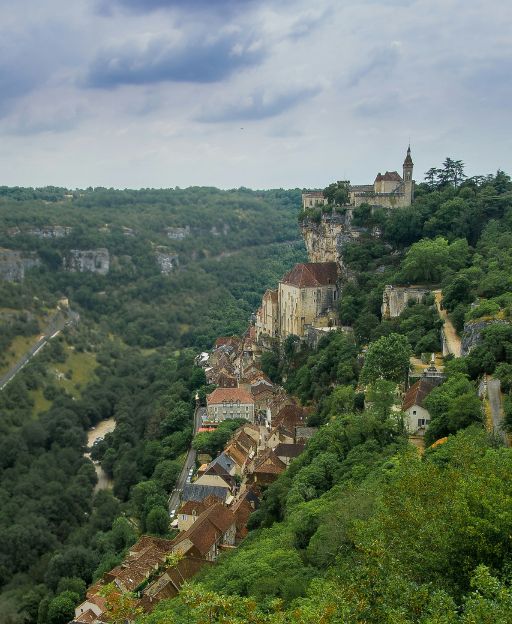
Why Rocamadour Is Where It Is
The town exists because of a saint. Or more precisely, because of a mystery. In 1166, a perfectly preserved body was found beneath the floor of a chapel here. Locals identified it as the remains of Zaccheus — the tax collector from the Gospels who climbed a sycamore tree to glimpse Jesus passing through Jericho.
According to legend, Zaccheus later came to France as a hermit, living out his final years in this wild limestone canyon. Pilgrims came first. Then chapels. Then a town, carved directly out of the cliff face. Rocamadour grew into one of the great pilgrimage sites of medieval Europe — alongside Santiago de Compostela and Rome.
The Steps That Changed Everything
Rocamadour is built on levels. At the bottom sits the old village — medieval houses, walnut oil shops, the smell of old stone and beeswax candles. Then 216 steps upward to the sanctuaries, worn smooth by centuries of feet.
Pilgrims have climbed them on their knees for nine hundred years, pausing at each station. Some still do today. At the top, seven chapels cluster on a narrow rock shelf — including the Chapel of Our Lady, which holds the town’s most famous secret.
Kings made the climb. Henry II of England came here. So did Saint Louis, Blanche of Castile, and Eleanor of Aquitaine. Whatever else was happening in Europe, the faithful found their way to this particular cliff in southwest France.
The Black Madonna at the Heart of It All
The centrepiece of Rocamadour is a small, dark, carved wooden figure: the Black Madonna of Rocamadour. She is thought to date from the 9th century, though no one can say for certain. Sailors prayed to her before long voyages. Crusaders came to the chapel before battle.
The bell that hangs above her is said to have rung on its own — without human hands — each time a ship was saved at sea at the moment sailors called out her name. The bell is still there. Whether you believe the story or not, standing in that small chapel, the weight of nine centuries of faith presses in around you and is very hard to ignore.
Enjoying this? 7,000 France lovers get stories like this every week. Subscribe free →
What the Valley Looks Like at Dawn
Rocamadour draws summer crowds. The French know it well, and coach parties follow the same route every morning in July and August. But arrive before them — at first light, or in spring, or in the slow gold of October — and you find something else entirely.
The Alzou canyon below is carpeted in oak and hawthorn. Goats graze on the limestone cliffs. The air carries the scent of herbs and cool stone. From the château at the very summit, the view stretches across the Dordogne countryside — a vast, green stillness that makes the world feel much less complicated than it did when you arrived.
When morning mist settles in the canyon and Rocamadour catches the first light above it, that view will stay with you for a long time.
How to See Rocamadour Properly
Most visitors walk the main street and climb to the chapels. Few go further. The lower village’s rampart walk is quiet and often almost empty. There is a small museum of sacred art that rarely has a queue. The clifftop gardens are easy to miss and completely worth finding.
The road along the canyon floor gives you the view that medieval travellers first saw: the entire village rising from rock, impossibly tall, impossibly old. That perspective — looking up at the cliff face with the whole town stacked above you — is the one worth seeking.
If you are planning a wider journey through this part of France, the Dordogne river villages that begin just a short drive east are some of the most extraordinary landscapes in the country. You can plan your full route — including how to travel between them — at our France travel planning hub. And if the medieval market towns of the southwest have caught your attention, the story behind every village square in this region is worth understanding before you go.
Nine hundred years of pilgrims found their way here. The cliff has not moved. Neither, it turns out, does the feeling when you finally stand at the top and look out over the world below.
Join 7,000+ France Lovers
Every week, get France’s hidden gems, seasonal guides, local stories, and the art of la vie française — straight to your inbox.
Love more? Join 65,000 Ireland lovers → · Join 43,000 Scotland lovers → · Join 30,000 Italy lovers →
Free forever · One email per week · Unsubscribe anytime
Leave a Reply