
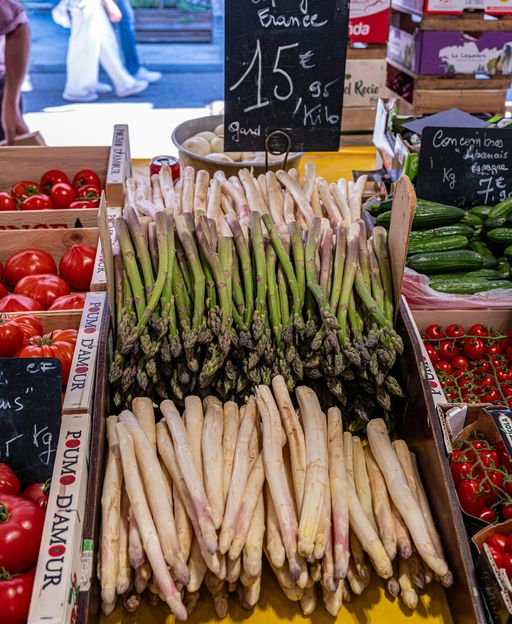
Every April, something shifts in French markets. The usual stalls look different. There are handwritten signs, long queues, and wooden crates lined with straw. At the centre of it all: thick, ivory-white stalks packed tight together, smelling faintly of cool earth.
White asparagus is here. And for the next six weeks, France will talk of almost nothing else.
Hidden From the Light
White asparagus is not a different variety from green asparagus. It is the same plant. The difference is darkness.
French growers heap mounds of soil over the asparagus beds in early spring, burying the shoots before they can emerge and catch sunlight. Without light, there is no chlorophyll. The stalks stay pale, dense, and unusually tender.
Each stalk must be cut by hand — one at a time — just below the surface, before it breaks through the earth and turns green. A skilled harvester works on their knees, feeling for the faint crack in the soil that tells them a shoot is ready. It is slow, physical work. There is no way to speed it up.
The Season That Cannot Be Rushed
The asparagus season in France runs from roughly mid-April to the Feast of Saint Jean on 24 June. That is it. Six weeks, give or take, depending on the weather and the region.
This brevity is the point. The French do not want white asparagus available year-round. They want the rush — the anticipation, the first sighting at the market, the slightly too-high price that somehow feels entirely worth it.
Restaurants put menu asperges signs in their windows. Greengrocers clear space at the front of the shop. Supermarkets feature them in prominent displays. For a few weeks, this pale, earth-grown vegetable becomes the centrepiece of French spring eating. French markets transform entirely during this window — the stalls shift to make room, and regular customers plan their Saturday mornings around the asparagus stand.
Where France Grows Its Best
The three main growing regions are Alsace in the northeast, the Loire Valley in the centre, and the Landes south of Bordeaux. Each produces a slightly different style, shaped by soil and climate.
Alsace is considered the heartland. The region’s sandy, well-drained soils suit the crop perfectly. Visit any Saturday market in Alsace between late April and June and you will find a dedicated asparagus stand — often run by the grower themselves — with stalks sorted by size and price written on a chalkboard in chalk. Alsace is one of France’s most distinct regions, and the asparagus season is a big part of how locals mark the turning of the year.
The village of Schleithal, near the German border in northern Alsace, holds an annual asparagus festival each spring. Growers’ stalls, recipe demonstrations, and cooking competitions take over the village square for an entire weekend. It is not a tourist event. It is a community marking something it genuinely cares about.
Enjoying this? 7,000 France lovers get stories like this every week. Subscribe free →
How the French Actually Eat It
This is where visitors sometimes get confused. The French do not toss white asparagus in olive oil and throw it on a hot grill. That is not the point at all.
White asparagus is peeled entirely — the outer skin is tough and fibrous — then boiled or steamed until just tender. The result is soft, mildly sweet, and faintly bitter at the root end. It is served warm with a sauce alongside, usually on its own as a starter.
The classic pairings are sauce mousseline (a lighter hollandaise, whipped with cream), a sharp vinaigrette with soft-boiled egg crumbled through it, or the Loire’s famous beurre blanc. Some households simply melt good butter and leave it at that.
There is no single rule about how to eat it — hands or fork, both are acceptable. What there is: the expectation that you will stop what you were doing and give it your full attention. Eating white asparagus while scrolling through your phone is, in France, vaguely insulting to the asparagus.
Why France Takes This Seriously
France has a phrase for this kind of eating: manger de saison. Eat what is in season. It is not a trend or a marketing phrase. It is a practical philosophy built over centuries.
White asparagus is the perfect expression of that idea. It cannot be rushed. It cannot be convincingly recreated in December with a heated greenhouse. When you buy a kilo at a spring market, you are participating in something that has happened in that same spot, with those same growers, for generations.
If you are planning a trip to France and your dates fall between mid-April and late June, you are arriving during one of the best windows in the French food calendar. Time your market visit right and you will find asparagus at its freshest — harvested that morning, still slightly cool, with soil still on the tips.
Buy a bundle. Take it back to wherever you are staying. Peel each stalk carefully. Boil them until just tender. Make a simple butter sauce. Sit down and eat them slowly.
That is the season. That is the whole point.
Join 7,000+ France Lovers
Every week, get France’s hidden gems, seasonal guides, local stories, and the art of la vie française — straight to your inbox.
Love more? Join 65,000 Ireland lovers → · Join 43,000 Scotland lovers → · Join 30,000 Italy lovers →
Free forever · One email per week · Unsubscribe anytime
Leave a Reply