If your family name begins with Le or Ker, there is a good chance your ancestors came from Brittany. The French surnames of Brittany are unlike those of any other French region. They carry two thousand years of Celtic identity, Viking raids, feudal estates, and fishing villages in a single word. For millions of French Canadians, Acadians, and Louisianans, a Breton surname is the first thread leading back to ancestral France.
This guide covers the most common surnames from Brittany, what they mean, where they come from, and how they travelled from this wild Atlantic peninsula to the far corners of the world. Whether you are researching your family tree or simply curious about the names on a Breton church wall, this is your starting point.
Why Brittany’s Surnames Are Unlike Any Others in France
France is a country of regional surname traditions. Normandy has its Norse-flavoured names. Alsace has its German-French hybrids. But Brittany stands apart from all of them.
Brittany was never fully absorbed into the Roman linguistic world. While the rest of France gradually shifted to Latin and then to French, Brittany kept its Celtic tongue — Breton. Today, Breton is still spoken by around 200,000 people in the western part of the peninsula, and its influence on Breton surnames has never faded.
The result is a surname system that looks and sounds nothing like standard French. You will find names built from ancient Celtic roots, Breton dialect words, the names of local saints unrecognised anywhere else in Christendom, and compound place-names describing hamlets that no longer exist on modern maps.
There are also two distinct surname traditions within Brittany itself. In the west — Finistère and much of Côtes-d’Armor and Morbihan — surnames follow the Breton-language tradition. In the east — around Rennes and Ille-et-Vilaine — the tradition is more like that of Normandy and the Loire Valley. Historians call the eastern zone Gallo, after the Romance dialect spoken there. Both traditions appear in family trees around the world.
The Most Common French Surnames of Brittany — and What They Mean
Here are twenty of the most significant French surnames from Brittany, with their meanings, origins, and the regions where they are most concentrated.
- Le Goff — From the Breton word gof, meaning blacksmith. One of the most widespread Breton surnames. You will find it concentrated in Finistère and Côtes-d’Armor, and scattered across Quebec and the Acadian communities of Atlantic Canada.
- Le Bihan — From the Breton bihan, meaning small or little. The Breton equivalent of the French Petit. Very common in western Brittany.
- Le Braz — From the Breton braz, meaning large or great. The best-known bearer is Anatole Le Braz (1859–1926), the Breton writer who collected the folklore and legends of the Breton countryside.
- Kerouac — From the Breton compound ker (hamlet or village) plus a place-name suffix. The family of writer Jack Kerouac originated in a Breton hamlet before emigrating to Quebec, where the name was first recorded as Lebris de Kérouac.
- Le Meur — From the Breton meur, meaning great or important. Often given to the head of a household or the most prominent man in a village.
- Tanguy — From the Breton tan (fire) and gi (dog). Saint Tanguy was a Breton martyr whose story is still told in Finistère. The name spread widely through Quebec and the Acadian diaspora.
- Rohan — From the town of Rohan in Morbihan. The Rohan family was one of the most powerful noble dynasties in Brittany for five hundred years. Their motto — Roi ne puis, duc ne daigne, Rohan suis (I cannot be king, I do not deign to be a duke, I am a Rohan) — tells you everything about their sense of identity.
- Conan — From the Breton and Celtic root meaning high or chief. Several Dukes of Brittany carried this name. It remains common in both Brittany and the Breton diaspora.
- Corentin — From Saint Corentin, the first bishop of Quimper and patron saint of Finistère. One of the seven founding saints of Brittany. Surnames derived from saints’ names are common throughout Breton parishes.
- Prigent — From the Latin Peregrinus, meaning pilgrim or traveller. A distinctly Breton surname with almost no presence outside the region and its diaspora communities.
- Cadiou — From the Breton kadiu, meaning little warrior. Concentrated in Finistère, particularly around Brest and Quimper.
- Jézéquel — A Breton form of the Hebrew name Ezekiel. The spelling is unmistakably Breton, making this surname a reliable marker of western Brittany ancestry.
- Stéphan — The Breton spelling of Stephen. The ph instead of v distinguishes it from the Norman and Parisian forms of the same name.
- Morvant — From the Breton mor (sea) and vant (proud or loud). A maritime name from the coastal parishes of Brittany.
- Guéguen — From the Breton personal name Guéguen, derived from Celtic roots. Very common in Finistère and Morbihan. Almost unknown outside Brittany.
- Le Calvez — From the Breton kalvez, meaning calvary — the hill of the cross. Brittany is famous for its enclos paroissiaux, the elaborate parish enclosures with calvary monuments. This surname reflects the deep Catholic heritage of the region.
- Gwenaël — From the Breton gwen (white, blessed) and ael (angel). Saint Gwenaël was a sixth-century abbot in Brittany. The name became a surname in several Breton parishes.
- Péron — From the Breton form of Peter (Pierre). Found throughout Brittany, particularly in coastal communities. Juan Perón, the Argentine president, had a Basque surname, not a Breton one — but the Breton Péron is well-documented in its own right.
- Le Floc’h — From the Breton floc’h, meaning a boy or a young servant. The apostrophe in the middle of the name is a distinctive Breton feature, representing a sound that does not exist in standard French.
- Kerdavid — A compound of ker (hamlet) and the Biblical name David. Brittany adopted many Old Testament names through the early Christian missionaries who arrived from Wales and Ireland in the fifth and sixth centuries.
The Naming Traditions That Make Breton Surnames Unique
Three naming patterns set Breton surnames apart from the rest of France.
The Le/La prefix. This is the most visible marker of a Breton surname. In standard French, le simply means the. When it appears in a Breton surname, it originally described something about the person — their job, their size, their character, or their location. Over time, the descriptive phrase hardened into a permanent family name. Roughly a third of all traditional Breton surnames begin with Le or La, a proportion found nowhere else in France.
The Ker prefix. The Breton word ker means hamlet, village, or house. Many Breton families took their name from the hamlet where they lived. Kerouac, Kergoat, Kerdavid, Kermeur — each one points to a specific place in the Breton countryside. If your surname begins with Ker, you are almost certainly looking at Breton ancestry. To understand more about the region those ancestors came from, the Brittany travel guide gives a good picture of the landscape they would have known.
Saints’ names from the Breton church. Brittany was Christianised not from Rome but from Wales and Ireland, in the fifth and sixth centuries. The missionaries who arrived — Malo, Brieuc, Corentin, Tugdual, Pol Aurélien, Patern, Samson — became the patron saints of Breton parishes. Their names were given to children at baptism, and from baptismal names they became surnames. When you see a surname like Corentin, Malo, or Brieuc, you are looking at the heritage of Brittany’s Celtic Christianity — not the Roman church.
🇫🇷 Enjoying this? 7,000 France lovers get stories like this every week. Subscribe free →
Famous People With Breton Surnames
Breton surnames have appeared in some unexpected places throughout history.
Jacques Cartier was born in Saint-Malo, Brittany, in 1491. He set sail for what would become Canada in 1534 and claimed the territory for France. The surname Cartier — from the French word for a maker of maps or charts — was common throughout Brittany’s port towns. Without a Breton navigator from Saint-Malo, the history of North America would look very different.
Jack Kerouac (1922–1969), author of On the Road, was born to a French-Canadian family in Lowell, Massachusetts. His family’s original name was Lebris de Kérouac — a Breton place-name compound showing his ancestors came from a hamlet in Brittany before emigrating to Quebec. Kerouac spoke French as his first language at home and considered himself Breton-Canadian first, American second.
René Laënnec, the Breton physician who invented the stethoscope in 1816, was born in Quimper, the capital of Finistère. His surname is of Latin origin but his identity was deeply Breton. He is one of many scientists and thinkers whose roots lie in this overlooked corner of France.
These are not curiosities. They are evidence of how a small Atlantic peninsula shaped the world far beyond its coastline.
How Breton Surnames Spread Across the World
Brittany’s fishermen were among the first Europeans to fish the Grand Banks of Newfoundland — possibly even before Columbus reached the Americas. By the early sixteenth century, Breton fishing boats were making regular crossings to the cod-rich waters off what would become Canada. Some of those fishermen stayed.
Jacques Cartier’s voyages of 1534 and 1535 opened the St Lawrence River to French settlement. Many of the early settlers of New France came from Brittany and Normandy. You can trace Breton surnames — Le Goff, Tanguy, Conan, Cadiou — through the parish records of Quebec, Acadia, and Louisiana to this day. For a deeper look at tracing those records, the step-by-step guide to tracing French ancestry covers the archives and online databases in detail.
The Acadians — the French settlers of what is now Nova Scotia, New Brunswick, and Prince Edward Island — included a significant Breton element. When the British expelled the Acadians in 1755, Breton surnames scattered across the Atlantic world, from Louisiana to the Caribbean to the Falkland Islands.
Smaller Breton communities settled in South America, particularly Brazil and Argentina, where Breton fishermen and sailors established themselves in coastal ports during the eighteenth and nineteenth centuries. The Breton diaspora is smaller than the Normandy or Île-de-France diaspora, but it is remarkably widespread.
It is worth comparing the Breton migration story with that of their neighbours. The French surnames of Normandy followed a different path — northward to England with the Normans in 1066, and then outward through the British Empire. Breton surnames went west, across the Atlantic, following the cod and the promise of land.
Finding Your Breton Ancestors Today
If you carry a surname from this list — or any name with a Le or Ker prefix — the records to trace your family almost certainly still exist.
Brittany is divided into four departments: Finistère, Côtes-d’Armor, Morbihan, and Ille-et-Vilaine. Each has its own Archives Départementales, and all four have digitised significant portions of their civil and parish records. Civil registration began in France in 1792. Parish records for many Breton communes go back to the early seventeenth century.
The free websites FamilySearch.org and Geneanet.org both hold large Breton collections. Geneanet is particularly strong for Brittany — it is a French platform and many Breton genealogists have uploaded their research there. You may find that someone has already traced your family line.
If you are searching from Canada, the Société de généalogie du Québec and the Société historique acadienne maintain databases that connect Quebec and Acadian surnames back to their French origins. If your family is Acadian, there is a good chance the earliest records point to Brittany or Poitou.
For in-person research, each Breton department archives office welcomes visitors and most have English-speaking staff. You do not need to be a professional researcher to use them. Bring the oldest date and location you have for your ancestor, and the archivists will help you find the right register.
Places to Visit in Brittany to Connect With Your Roots
Brittany rewards heritage travellers. The landscape has changed less than most of France. The granite churches, the parish enclosures, the medieval port towns — they are still there.
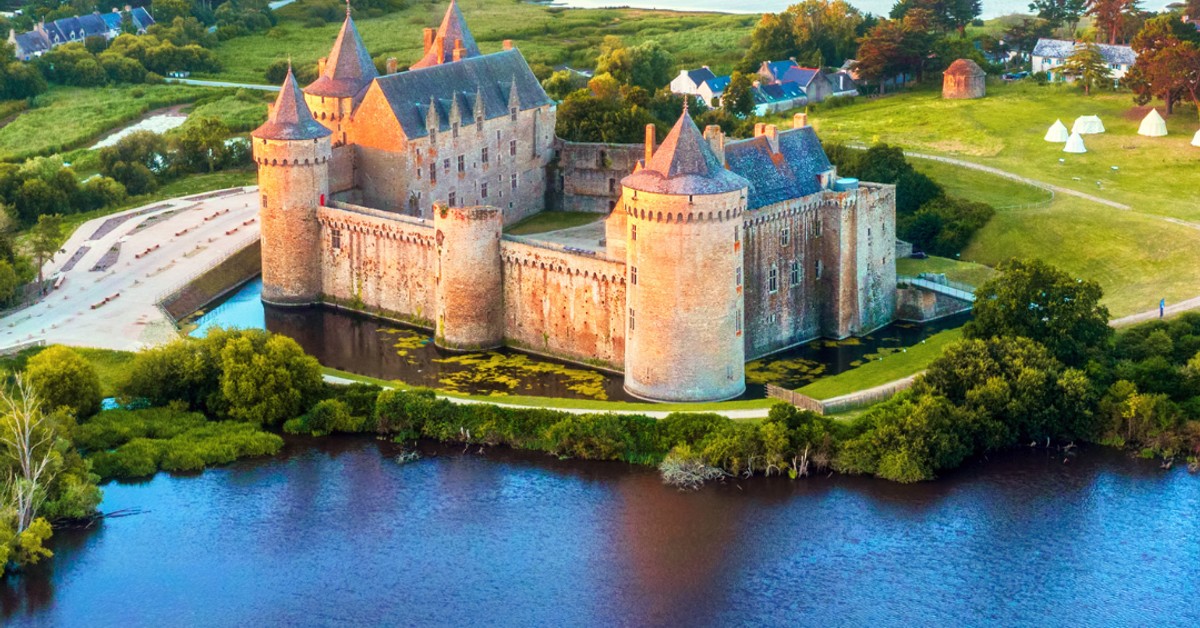
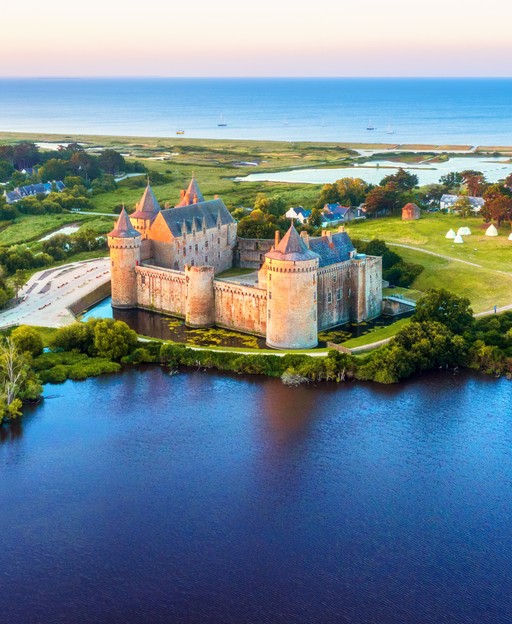
Suscinio Castle in Morbihan was the principal residence of the Dukes of Brittany for three centuries. Standing at the edge of the Rhuys Peninsula with the sea visible behind it, the castle gives you the clearest sense of what independent Brittany looked like before it became part of France in 1532. If your surname connects to the noble families of Brittany — Rohan, Conan, Montfort — this is where their world was centred.
Dinan is one of the best-preserved medieval towns in France. Walking its ramparts, you see the same rooflines that Breton families would have seen in the fifteenth century. The town’s half-timbered houses and cobbled streets feel genuinely old rather than restored for tourists.
Saint-Malo was the home port of Jacques Cartier and one of the great ports of early modern France. The intramural city — rebuilt after severe wartime damage — still feels like a place that sent ships out to change the world. For anyone with Breton-Canadian ancestry, walking the ramparts of Saint-Malo is a genuine homecoming.
Quimper is the cultural capital of Breton identity. The Musée de Bretagne in Rennes and the smaller local museums in Quimper both hold displays on Breton history, language, and migration that put individual surnames in their broader context.
If you are planning a heritage trip to trace your Breton roots, the France trip planning guide covers how to structure your time across the region.
Frequently Asked Questions About Breton Surnames
What does the “Le” prefix mean in Breton surnames?
In Breton surnames, Le or La is a definite article that became permanently attached to a descriptive word. It originally identified something about the person — their occupation, physical appearance, or character. Le Goff means “the blacksmith”, Le Bihan means “the small one”, Le Braz means “the tall one”. About a third of traditional Breton surnames begin with this prefix, which is unique to Brittany among French regions.
What does “Ker” mean at the start of a surname?
The Breton word ker means hamlet, village, or house. Surnames beginning with Ker — Kerouac, Kergoat, Kerdavid — indicate that the family took its name from the hamlet or village where it lived. This is a naming tradition specific to Brittany and is not found in other French regions.
Are Breton surnames common in Quebec and Canada?
Yes. Breton fishermen and settlers were among the earliest European arrivals in New France, and many early Quebec and Acadian families had Breton origins. Surnames like Tanguy, Le Goff, Conan, and Cadiou appear in Quebec parish records from the seventeenth and eighteenth centuries. Jack Kerouac’s family name is a well-known example of a Breton surname that travelled to Quebec and then to the United States.
How can I tell if my French Canadian surname has Breton origins?
The clearest signs are the Le/La prefix, the Ker prefix, the apostrophe in the middle of a name (as in Le Floc’h), and the Celtic sound patterns that produce names like Gwenaël or Jézéquel. If your surname has any of these features, search the parish records of Finistère, Côtes-d’Armor, or Morbihan. The archives of those three departments hold the earliest Breton family records still in existence. If you are unsure how to start, the French ancestry guide walks you through the process step by step.
Which parts of Brittany should I visit to find my ancestors?
It depends on the type of surname. Names with the Ker prefix and strong Celtic forms — Le Floc’h, Jézéquel, Cadiou — point to Finistère and Côtes-d’Armor in the west. Names with a more French character — Guérin, Péron — may originate in the eastern Gallo zone around Rennes and Ille-et-Vilaine. Noble names like Rohan point to Morbihan. Start with the relevant Archives Départementales and then follow the records to the specific commune your family came from.
You Might Also Enjoy
- French Surnames of Normandy: Origins, Meanings and Family Heritage
- How to Trace Your French Ancestry – A Step-by-Step Guide for Canadians and Americans
- The Celtic Language Hidden Inside France That Locals Are Bringing Back
Plan Your France Trip
Thinking about visiting Brittany or another region of France? The France trip planning guide covers everything from itineraries to getting around to the best times to visit each region.
Join 7,000+ France Lovers
Every week, get France’s hidden gems, seasonal guides, local stories, and the art of la vie française — straight to your inbox.
Love more? Join 65,000 Ireland lovers → · Join 43,000 Scotland lovers → · Join 30,000 Italy lovers →
Free forever · One email per week · Unsubscribe anytime
Leave a Reply