
Choosing where to stay in Provence can feel overwhelming. The region stretches from the Rhône Valley to the Italian border, and every corner seems to hide another impossibly pretty village. Lavender fields, Roman ruins, hilltop hamlets, bustling markets — Provence has it all, but the experience changes dramatically depending on which town you use as your base.
The good news is that there is no single “wrong” answer. Whether you want a lively city with excellent restaurants and nightlife, a quiet stone village where the loudest sound is church bells, or a luxurious hilltop retreat with infinity pool views, Provence delivers. What matters is matching the right town to your travel style, budget, and interests.
This guide covers the eight best towns and villages to stay in across Provence. For each, you will find the general atmosphere, price range, who it suits best, and whether you need a car. By the end, you should have a clear shortlist — and quite possibly a booking confirmation open in another tab.
Avignon — The Walled City and Central Base
If you want a single base from which to explore the widest range of Provence, Avignon is hard to beat. This walled city sits on the Rhône, connected by TGV to Paris (2 hours 40 minutes) and within easy reach of the Luberon, the Alpilles, and the Camargue. The Palais des Papes dominates the skyline, and the old town beneath it is a maze of restaurants, galleries, and shaded squares.
Avignon works particularly well for those arriving by train. The TGV station is a short shuttle ride from the centre, and once inside the walls, everything is walkable. During the summer festival season (July), the city comes alive with theatre, music, and street performance — though accommodation prices spike accordingly.
Vibe: Cultured, lively, historic. A proper city with an old-town heart.
Price range: Mid-range. Hotels from €90–€180/night; excellent-value Airbnbs in the old town.
Best for: First-timers, culture lovers, those without a car.
Car needed? No for the city itself. Helpful for day trips to the Luberon, but buses and tours cover the main routes.
Aix-en-Provence — The Elegant University Town
Aix (pronounced “ex”) is Provence’s most polished city. Wide, tree-lined boulevards radiate from the Cours Mirabeau, where locals linger over coffee at pavement cafés. The university gives the city a youthful energy, and the market scene is outstanding — the daily flower market on Place de l’Hôtel de Ville alone is worth the visit.
Cézanne lived and painted here, and the city trades heavily on that connection, with a walking trail linking key sites. Beyond art, Aix is a serious food city: Michelin-starred restaurants sit alongside traditional Provençal bistros, and the calisson (the local almond sweet) makes an excellent edible souvenir.
Vibe: Sophisticated, café-culture, art and food focused.
Price range: Mid to upper-mid. Hotels from €110–€220/night; the old centre commands a premium.
Best for: Couples, food lovers, those who enjoy city life with a Provençal accent.
Car needed? Not within Aix. Useful for exploring Mont Sainte-Victoire and nearby villages.
Gordes — Hilltop Luxury
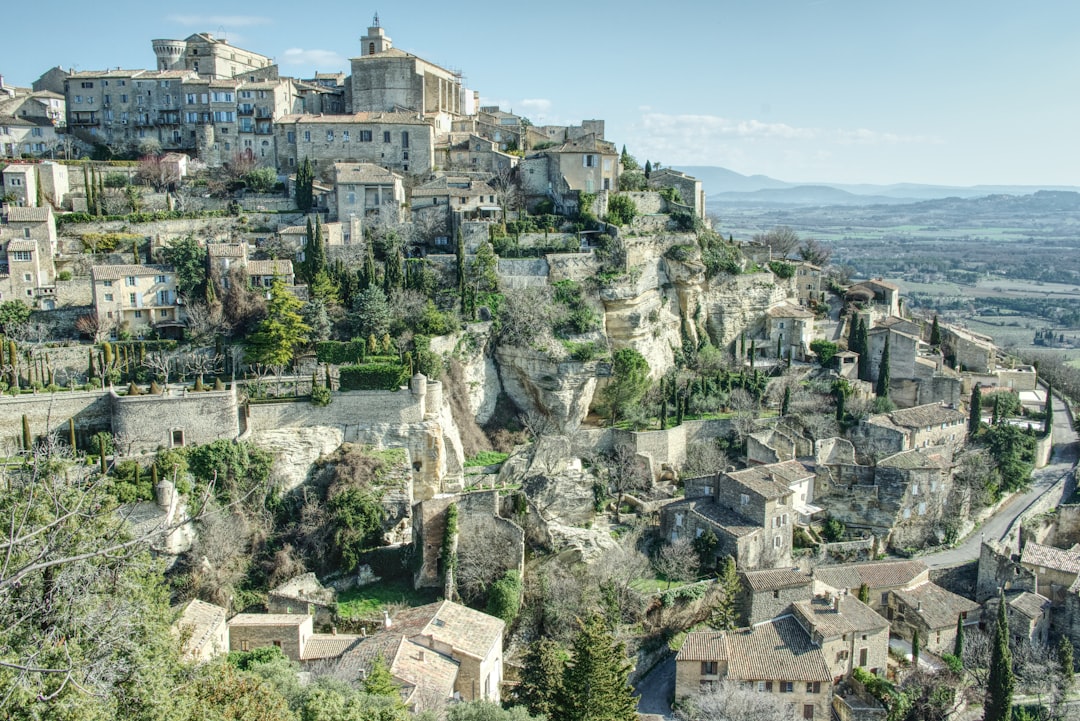
Gordes is the village that launched a thousand Instagram posts. Perched on the edge of the Luberon plateau, its honey-coloured stone houses tumble down the hillside in a cascade that looks almost too perfect to be real. The views from the top — out across lavender fields and olive groves — are spectacular at any time of year.
This is luxury Provence. The village attracts a well-heeled crowd, and the accommodation reflects it: boutique hotels with infinity pools, beautifully restored mas (farmhouses), and high-end holiday rentals. Dining options range from Michelin-starred to simple but excellent village bistros. The Sénanque Abbey, just below the village, is one of Provence’s most photographed sites, especially when the lavender blooms in late June.
Vibe: Aspirational, peaceful, jaw-droppingly scenic.
Price range: High. Hotels from €180–€400/night; villas can run well above that in summer.
Best for: Couples on a special trip, luxury travellers, photographers.
Car needed? Yes — essential. Gordes is poorly served by public transport.
Roussillon — The Ochre Village
If Gordes is honey-coloured, Roussillon is flame-orange. Built on ochre cliffs, the village is a palette of deep reds, burnt oranges, and warm yellows that glow almost supernaturally in the afternoon light. The Sentier des Ocres walking trail winds through the old quarries — wear shoes you do not mind staining.
Roussillon is smaller and quieter than Gordes, with a more relaxed, artsy feel. Galleries and workshops dot the narrow streets, and the weekly market (Thursday morning) is a lovely, manageable affair. It makes an excellent base if you want Luberon village life without the higher price tag of Gordes.
Vibe: Colourful, artistic, quiet and intimate.
Price range: Mid-range. Hotels and B&Bs from €80–€160/night.
Best for: Artists, walkers, those seeking peace and colour.
Car needed? Yes — no realistic public transport option.
L’Isle-sur-la-Sorgue — Antiques and Markets
Known as the “Venice of Provence” (a generous comparison, but the canals are genuinely charming), L’Isle-sur-la-Sorgue is the antiques capital of southern France. The Sunday market is legendary: over 300 dealers set up along the river, selling everything from Louis XV chairs to vintage Provençal fabrics.
Even outside market days, the town has a lovely, laid-back energy. Water wheels turn lazily on the River Sorgue, café terraces line the canals, and the prices are noticeably kinder than the hilltop villages nearby. It also sits at the gateway to the Luberon, making it a practical and affordable base for wider exploration.
Vibe: Charming, market-obsessed, waterside relaxation.
Price range: Affordable to mid-range. Hotels from €70–€140/night.
Best for: Market lovers, antique hunters, budget-conscious travellers who still want charm.
Car needed? Helpful but not essential — the town has a train station with connections to Avignon.
Lourmarin — Quiet Village Life
Lourmarin sits on the southern side of the Luberon, and it feels like a different world from the busier northern villages. This is a place for slow mornings, long lunches, and evening strolls past the Renaissance château. Albert Camus lived here in his final years, and you can visit his grave in the small village cemetery — a quiet, moving spot.
The village is small enough to explore in an hour but interesting enough to hold you for days. Excellent restaurants (the Friday market is a food lover’s dream), a handful of galleries, and an atmosphere that somehow manages to be both lively and peaceful. It is also wonderfully positioned for exploring the southern Luberon, Aix-en-Provence, and the coastal towns.
Vibe: Literary, foodie, authentically village-paced.
Price range: Mid-range. Hotels from €100–€180/night; holiday rentals offer good value for longer stays.
Best for: Writers, foodies, couples seeking authentic village life.
Car needed? Yes — limited public transport.
Arles — Van Gogh and Roman Ruins
Arles is where Provence’s Roman past and artistic present collide. The Roman amphitheatre still hosts bullfights and concerts, and Van Gogh painted over 300 works here — you can follow his trail through the city, standing where he stood for Starry Night Over the Rhône and Café Terrace at Night. More recently, the LUMA Arles complex, topped by Frank Gehry’s twisting tower, has added a contemporary edge.
Arles has a grittier, more authentic feel than Aix or Avignon. It is a working Provençal city with a Saturday market that ranks among France’s finest. The Camargue — with its white horses, flamingos, and wild salt marshes — begins just south of the city, adding a completely different dimension to any stay.
Vibe: Artsy, historic, raw and real.
Price range: Affordable to mid-range. Hotels from €70–€150/night; some fantastic budget options.
Best for: Art lovers, history buffs, photographers, Camargue explorers.
Car needed? No for the city. Yes for the Camargue.
Saint-Rémy-de-Provence — The Market Town
Saint-Rémy is the quintessential Provençal market town: prosperous, pretty, and perfectly sized. The Wednesday morning market fills the old town with colour and scent — olives, lavender honey, goat cheese, rotisserie chicken — and the rest of the week the town settles into a contented rhythm of café terraces, boutique shopping, and long evening meals.
Van Gogh spent a year at the asylum just outside town (now Saint-Paul-de-Mausole, open to visitors), and the Greco-Roman ruins at Glanum are a short walk away. The Alpilles mountains rise immediately to the south, offering walking trails with views across olive groves. Princess Caroline of Monaco has a house here, which tells you something about the calibre of the village.
Vibe: Market-town charm, refined but unpretentious, green and leafy.
Price range: Mid to upper-mid. Hotels from €100–€200/night.
Best for: Market lovers, walkers, those wanting a central Provence base with character.
Car needed? Yes for exploring, though the town itself is entirely walkable.
How to Choose Your Base
The right base depends on three things: your transport situation, your budget, and what you want your days to look like.
Arriving without a car? Start with Avignon, Aix-en-Provence, or Arles. All three have train stations and enough within walking distance to fill several days. From Avignon, day trips by bus or organised tour can reach the Luberon villages.
Renting a car? The Luberon villages — Gordes, Roussillon, Lourmarin, L’Isle-sur-la-Sorgue — open up beautifully. Distances are short (most villages are 20–40 minutes apart), the roads are scenic, and parking is generally straightforward outside July and August. Our guide to driving in France covers everything you need to know.
On a budget? L’Isle-sur-la-Sorgue, Arles, and Roussillon offer the best value. Avoid Gordes in peak season unless your budget is flexible.
Planning a longer trip? Consider splitting your stay between a city base (Avignon or Aix) and a village base (Lourmarin or Saint-Rémy). Our 5 Days in Provence itinerary shows how to combine both beautifully. For broader trip planning, the France trip cost breakdown and getting around France guide are worth reading before you book.
Provence rewards those who take the time to choose their base carefully. Each of these eight towns offers something genuinely different — from the cultural energy of Avignon to the quiet lanes of Lourmarin, from the ochre cliffs of Roussillon to the Roman grandeur of Arles. Pick the one that matches how you want to feel on your holiday, and the rest will fall into place.
Leave a Reply