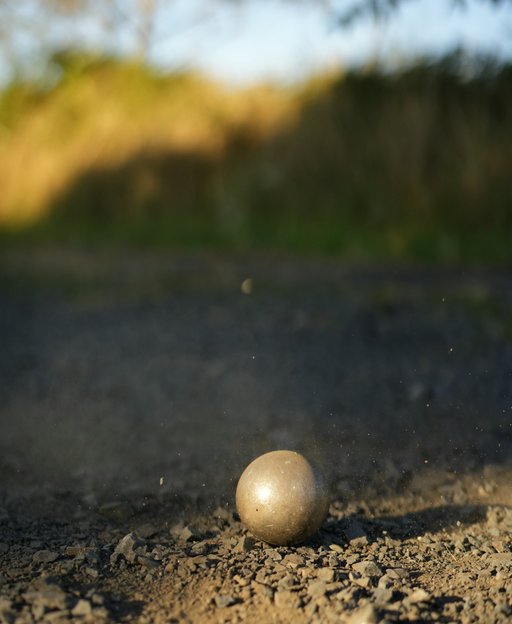
The afternoon light hits the gravel square at half past four. An old man draws a small circle in the dust with the toe of his shoe. Another steps back, squints across the sun-baked square, and swings his arm underhand. The steel ball lands with a crack. A small cloud of white dust rises. Without a word, the game has begun.
The Sound You’ll Hear in Every French Village
There is a sound that belongs to France the way wine belongs to Burgundy. It is the sharp, metallic clank of one boule striking another — and the moment you hear it, you know exactly where you are.
In summer, it drifts out of village squares from the Luberon to the Languedoc, from the Pyrenees to the Var. Under the shade of a plane tree, on a patch of crushed gravel, French men and women have been playing pétanque for over a hundred years. And they show no sign of stopping.
The game looks simple. Throw a metal ball as close as you can to a small wooden target called a cochonnet — literally, a little pig. Whoever gets closest wins the point. Play to thirteen. Shake hands.
But that is like saying the Tour de France is about bicycles.
How Pétanque Was Born in a Southern French Town
The story begins in 1907 in La Ciotat, a port town east of Marseille. A man named Jules Lenoir wanted to play jeu de boules — the older form of the game — but his rheumatism had made running difficult. So a friend marked out a shorter court, and Jules played with his feet firmly planted on the ground.
The name that stuck came from the Provençal expression pèd tanca: feet planted. The game spread quickly across the south. By the 1930s, it had spread across the entire country. Today, France has an estimated seventeen million regular players.
That is more than the number of people who play tennis in France. More than football. And yet outside France, most people have never watched a serious game.
The Two Types of Player — and Why It Matters
Pétanque divides players into two roles, and knowing the difference tells you everything about how French people approach competition.
The pointeur aims to place their boule close to the cochonnet. Gentle, precise, controlled. They are playing for position.
The tireur aims to knock the opponent’s boule out of the way entirely. A hard, high throw that lands with a boom and sends steel spinning across the gravel. They are playing for dominance.
Every team needs both. Every game becomes an argument between patience and force. And that argument, played out in a dusty square between friends, is as French as anything you will find in any guidebook.
Enjoying this? 7,000 France lovers get stories like this every week. Subscribe free →
The Unwritten Rules Every Visitor Should Know
Nobody locks the square. There is no booking system. You simply turn up.
In most villages, a game between locals is open to spectators, and watching is considered perfectly polite. Stand to the side. Do not walk across the court. Do not kick the cochonnet. These are the three things that will earn you a very stern look.
If you want to join, ask. “Est-ce qu’on peut jouer?” — “Can we play?” — is usually met with a shrug and a nod. The shrug is not unfriendly. It is simply French. You will be handed a set of boules and a position on a team before you have finished asking.
Pétanque in France is not a closed club. It is, at its heart, a way of spending an afternoon with other humans. Anyone willing to stand in the circle is welcome. You can read more about this kind of unhurried village culture in our guide to what makes a French village truly beautiful.
Why the French Take This Seriously
Disputes are settled with a tape measure or a piece of string. The measuring of distances is done slowly, carefully, and with the gravity of a legal proceeding. Arguments are common. They are also quickly forgotten.
Nearby, on a low wall or a café terrace, a glass of pastis sits sweating in the afternoon heat. The ice melts. The anise cloud spreads through the yellow liquid. Nobody is in a hurry.
This is, perhaps, the real point. Pétanque is not an escape from French life. It is French life — the version that tourists rarely see unless they slow down enough to notice it.
If you are planning a trip to the south, do not spend every afternoon at a restaurant. Find the nearest village square after lunch. Sit down. Wait. The game will start without you, and then — with any luck — it will include you. Our 5-day Provence guide will help you plan the right stops for exactly these kinds of moments.
And if you want to plan your whole trip around France’s slower rhythms, start with our France travel planning guide — it covers everything from regions to timing to what nobody else tells first-time visitors.
Where Pétanque Lives
Pétanque is played everywhere in France, but it belongs to the south in the way that crêpes belong to Brittany. Provence is its heartland. Go to any village in the Var, the Vaucluse, or the Bouches-du-Rhône on a warm afternoon, and you will find it.
The squares are easy to spot: a flat rectangle of packed gravel, sometimes marked with chalk lines or wire, bordered by benches worn smooth by decades of waiting spectators. There may be a scoreboard nailed to a plane tree. There will almost certainly be a café within sight.
In France, the game is free to play. The square belongs to everyone. The afternoon belongs to whoever shows up.
Go. Show up. Stand in the circle. That sound — steel on steel, dust rising in the golden light — is one of the most French things you will ever hear.
Join 7,000+ France Lovers
Every week, get France’s hidden gems, seasonal guides, local stories, and the art of la vie française — straight to your inbox.
Love more? Join 65,000 Ireland lovers → · Join 43,000 Scotland lovers → · Join 30,000 Italy lovers →
Free forever · One email per week · Unsubscribe anytime
Leave a Reply