
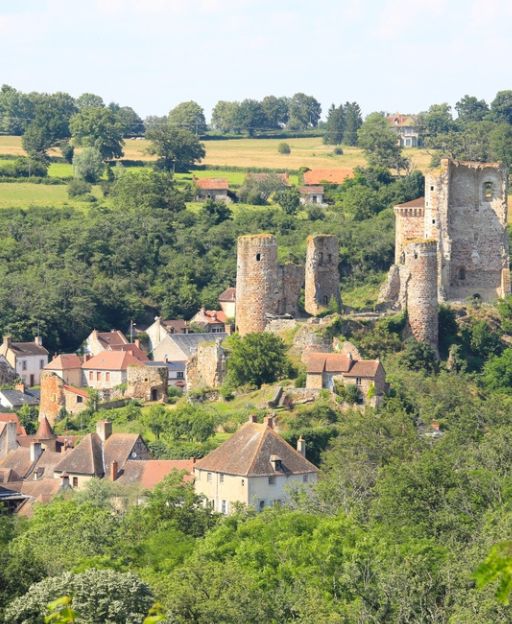
In the Allier department of central France, a village of fewer than 700 people sits beneath the ruins of a medieval castle. Cows graze in the surrounding fields. The main square is quiet. And almost nobody outside France has heard of Hérisson.
That’s a strange kind of obscurity for a place once tied to the most powerful dynasty in European history.
A Fortress Built to Hold a Dynasty
The Bourbons who gave France its kings — Henri IV, Louis XIII, Louis XIV, Louis XV, Louis XVI — didn’t come from Versailles. They came from here. From this part of Auvergne, from the Duchy of Bourbon, from a stretch of central France that most visitors drive straight past.
Hérisson was one of the strategic strongholds of the Dukes of Bourbon, the medieval lords who controlled this region through the 13th, 14th and 15th centuries. The castle that still crowns the hillside above the village was their fortress — built to defend, to dominate, and to signal power to anyone approaching across the plain.
What you see today is what centuries of weather and neglect have left behind. Two towers still stand. The walls have crumbled. But the site, perched high above the village rooftops, still has authority.
How the Dukes Became Kings
The story of how a provincial family from Allier came to rule France is long, and sometimes violent.
The Bourbon line passed through marriage, inheritance and conflict across several generations. In 1589, Henri of Navarre — a Bourbon — became Henri IV, the first Bourbon king of France, and one of the most genuinely liked monarchs in French history. His line continued all the way to Louis XVI and the Revolution.
But by that point, the family’s ancestral base had already been stripped away. The Duchy of Bourbon was absorbed by the French Crown in 1527 after Charles de Bourbon, the Constable of France, chose to fight against his own king. The treason cost him the duchy. Hérisson went from being a seat of power to a footnote in an administrative map.
The Village That Didn’t Notice Being Forgotten
Drive into Hérisson today and you’ll find the kind of France that most visitors never reach.
The medieval street plan is intact. Stone buildings cluster around the church of Saint-Cyr-et-Sainte-Julitte. There’s a small café, a boulangerie, and a local market that runs through the warmer months. The population has barely shifted in decades.
What makes Hérisson unusual isn’t just its history. It’s the way the history sits lightly here. Nobody is marketing it aggressively. There are no queues, no tourist shops, and no laminated menus with photos.
From the village square, you can walk up to the castle ruins in about 20 minutes. At the top, there is nothing but an extraordinary view across the Bourbonnais countryside — fields, forest, and silence stretching in every direction.
Enjoying this? 7,000 France lovers get stories like this every week. Subscribe free →
The Allier — France’s Most Overlooked Department
Hérisson sits in the Allier, one of France’s least-visited departments. It has no coast, no famous wine region, and no obvious tourist hook.
What it has instead is authenticity. This is old France — the France that doesn’t particularly care whether you come or not, and therefore hasn’t changed to suit you.
The department capital, Moulins, was once the actual capital of the Bourbon duchy. Its cathedral contains some of the finest Late Gothic sculpture in France. Like Hérisson, it is almost entirely uncrowded. France’s relationship with its medieval past takes many forms — from the well-known castles of the Loire to remarkable projects like Guédelon, where a medieval castle is being built from scratch today — but the quieter corners, like the Allier, are where that past feels most real.
When to Go and How to Get There
Hérisson is accessible by car from the A71 or A79 motorways, roughly between Moulins and Montluçon. Spring and early autumn are the best times. The path up to the castle can be muddy in winter, and midweek visits in the shoulder season mean you’ll likely have the ruins to yourself entirely.
There are no hotels in the village itself — accommodation means a chambre d’hôte in the surrounding countryside, or a base in Moulins. Either way, it makes a natural addition to a carefully planned trip through central France.
If this kind of off-map discovery appeals to you, France is full of them. The medieval villages of the Lot, a few hours south, offer a similar sense of finding somewhere the guidebooks forgot — and that France has quietly been keeping to itself.
The Bourbons left Hérisson to rule a kingdom. The world followed them to Paris, to Versailles, to revolution. But Hérisson stayed exactly as it was. Which might be the best thing that ever happened to it.
Join 7,000+ France Lovers
Every week, get France’s hidden gems, seasonal guides, local stories, and the art of la vie française — straight to your inbox.
Love more? Join 65,000 Ireland lovers → · Join 43,000 Scotland lovers → · Join 30,000 Italy lovers →
Free forever · One email per week · Unsubscribe anytime
Leave a Reply