
Normandy is one of those rare destinations that rewards every kind of traveller. History runs through its soil — quite literally — but step beyond the battlefield memorials and you will find soaring chalk cliffs, half-timbered harbour towns, some of France’s finest cheese, and a coastline that inspired the Impressionists. This Normandy travel guide covers everything you need to plan a trip that does the region justice, from the D-Day landing beaches to the tidal island of Mont Saint-Michel and well beyond.
The D-Day Beaches: What to See at Each
On 6 June 1944, Allied forces landed on five beaches along the Normandy coast. Today, each one tells a different part of the story, and visiting even two or three of them gives you a far deeper understanding than any single site can provide.
Omaha Beach
The most heavily defended of the five beaches, Omaha saw the highest casualties on D-Day. The wide, flat expanse of sand looks deceptively peaceful today. Walk the length of it at low tide and the scale of what those soldiers faced becomes viscerally clear. The Omaha Beach Memorial at Saint-Laurent-sur-Mer marks the spot, and it is worth pausing here before heading up the bluff to the American Cemetery.
Utah Beach
Utah was the westernmost landing beach, and the assault here went more smoothly than at Omaha — partly because strong currents pushed the landing craft to a less defended stretch of sand. The Utah Beach Museum sits right on the shore in a former German bunker, and it does an excellent job of explaining the airborne operations that preceded the beach landings. The area around Sainte-Mère-Église, where American paratroopers dropped in the early hours of 6 June, is just a short drive inland.
Juno Beach
Juno was the Canadian sector, and the Juno Beach Centre at Courseulles-sur-Mer is run by Canadian veterans and their families. It is one of the most personal and moving museums along the coast. The town itself still has visible remnants of the Atlantic Wall fortifications along the seafront.
Gold Beach
The British landed at Gold Beach, centred on the town of Arromanches-les-Bains. The big draw here is the remains of the Mulberry harbour — the prefabricated portable harbours that the Allies towed across the Channel to create a temporary port. Huge concrete caissons still sit in the sea at low tide. The Arromanches 360 circular cinema on the clifftop shows archive footage projected across nine screens; it is genuinely powerful.
Sword Beach
The easternmost beach, Sword was another British sector. It stretches from Ouistreham to Saint-Aubin-sur-Mer. The Grand Bunker Museum in Ouistreham — a restored five-storey German command post — is one of the most atmospheric sites on the entire coast, and the Pegasus Bridge memorial nearby marks the first action of D-Day, when British glider troops seized the bridge in a daring night operation.
The American Cemetery at Colleville-sur-Mer
Overlooking Omaha Beach, the Normandy American Cemetery holds 9,387 white marble crosses and Stars of David arranged in perfect rows across a manicured lawn. It is, without exaggeration, one of the most moving places in France. The visitor centre provides context and personal stories, but it is the sheer scale of the cemetery itself — and the sound of nothing but wind and birdsong — that stays with you. Allow at least an hour, and come early in the morning if you can.
Pointe du Hoc
Between Omaha and Utah, the clifftop German gun battery at Pointe du Hoc was scaled by US Army Rangers on D-Day morning. The landscape here has been deliberately left as it was — the ground is pockmarked with massive bomb craters, and you can walk into the shattered concrete bunkers. It is a stark, sobering place and one of the most powerful sites on the entire coast. A new visitor centre opened recently with excellent displays.
Caen Memorial Museum
If you want the full context of D-Day and the Battle of Normandy, the Caen Memorial (Mémorial de Caen) is essential. It covers not just the landings but the entire arc of the twentieth century — the rise of fascism, the war, and the long road to European reconciliation. Plan for at least half a day. The museum also runs guided tours to the beaches, which are an excellent option if you do not have a car.
Beyond D-Day: Normandy’s Other Treasures
Mont Saint-Michel
Technically sitting right on the border of Normandy and Brittany, Mont Saint-Michel belongs to Normandy by administrative decree — and the Normans are not about to let that go. The tidal island, crowned by its medieval abbey, is one of France’s most recognisable landmarks and a UNESCO World Heritage Site. Visit at high tide when the sea surrounds the mount, or at low tide when you can walk across the sand flats with a guide. Either way, arrive early — the single narrow street gets crowded by mid-morning. For a fuller guide to planning your France trip, see our Planning Hub.
Bayeux and the Tapestry
The Bayeux Tapestry — actually an embroidery — is a 70-metre-long strip of linen depicting the Norman conquest of England in 1066. It is displayed in its own dedicated museum in the centre of Bayeux, a town that was the first in France to be liberated on D-Day and emerged from the war almost entirely undamaged. The result is one of the best-preserved medieval town centres in Normandy: cobblestone streets, a magnificent Gothic cathedral, and enough crêperies to keep you fuelled for days.
Honfleur
The tiny harbour town of Honfleur, tucked into the Seine estuary, has been painted by virtually every major French artist — Monet, Boudin, Courbet, Dufy. The Vieux Bassin (old harbour) is lined with tall, narrow slate-fronted houses reflected in the water, and it looks almost exactly as it did in those nineteenth-century canvases. The wooden church of Sainte-Catherine, built by shipwrights, is unlike any other church in France. Honfleur makes an excellent base for exploring the Côte Fleurie.
The Étretat Cliffs
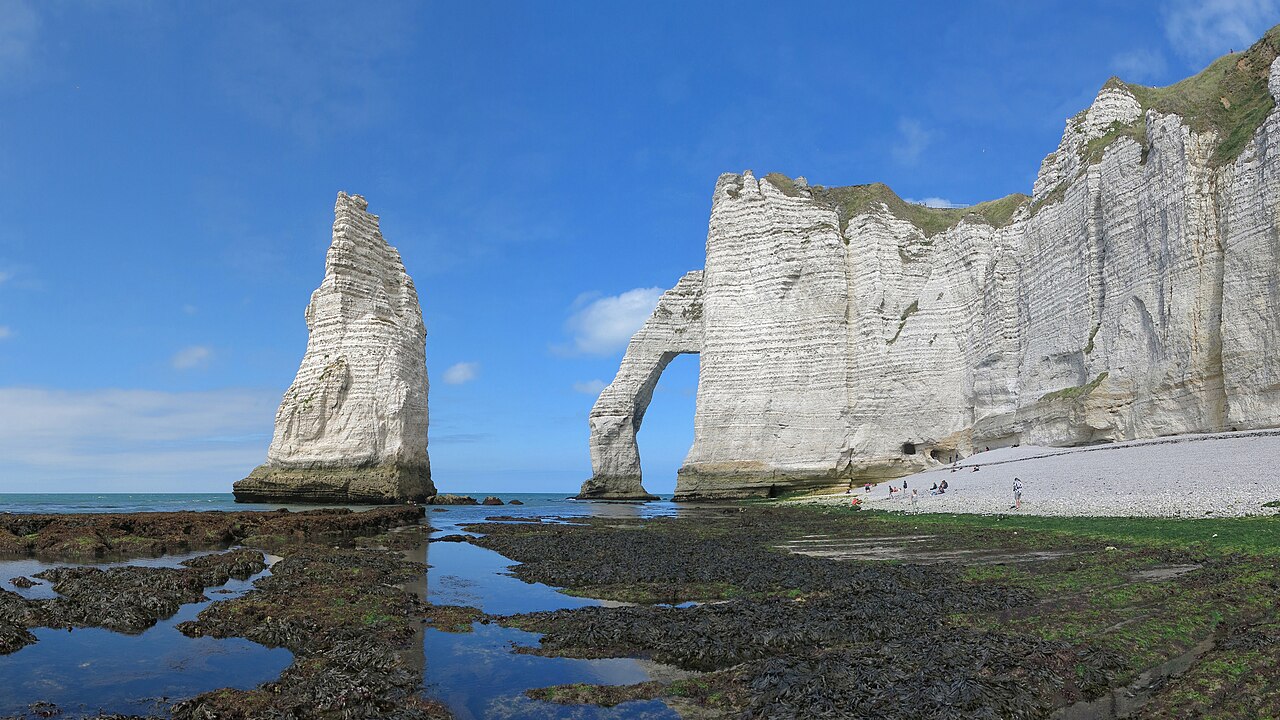
North of Honfleur, the Alabaster Coast culminates in the spectacular chalk cliffs of Étretat. The natural arches and needle-shaped rock stack (the Aiguille) inspired Monet, Maupassant, and Arsène Lupin’s creator Maurice Leblanc. Walk the clifftop path in either direction for dramatic views — the route to the Falaise d’Amont takes you past a chapel perched on the edge, whilst the walk to the Falaise d’Aval leads to the most photographed arch. Come outside July and August if you can; in summer the pebble beach gets packed.
Rouen
Normandy’s capital is a city of spires, half-timbered houses, and a cathedral that Monet painted over thirty times. The Gros-Horloge, a Renaissance astronomical clock straddling a medieval street, is the city’s symbol. The Place du Vieux-Marché marks the spot where Joan of Arc was burned at the stake in 1431, and the modern church built in her honour has extraordinary stained glass salvaged from an earlier building destroyed in the war. Rouen’s restaurant scene is strong — look for duck in all its forms, this being Normandy.
Giverny
Claude Monet’s house and garden at Giverny, on the eastern edge of Normandy, is where the Water Lilies series was born. The Japanese bridge, the weeping willows, the lily ponds — they look exactly as they do in the paintings. The flower garden in front of the house is a riot of colour from April to October. Giverny can be visited as a day trip from Paris (about 75 minutes by train to Vernon, then a shuttle bus), but combining it with a wider Normandy trip makes more sense.
Deauville and Trouville
These twin seaside towns sit either side of the River Touques and could not be more different in character. Deauville is all polished boardwalks, designer boutiques, and grand hotels — the Parisian Riviera. Trouville, just across the bridge, is the working fishing port with a daily market on the quayside and a more relaxed, local atmosphere. Both have excellent wide sandy beaches. The Deauville American Film Festival in September draws major names.
The Cider Route and Camembert
Inland Normandy is a patchwork of apple orchards, dairy farms, and small producers making cider, calvados (apple brandy), and pommeau (a blend of the two). The Route du Cidre in the Pays d’Auge runs through a series of picture-perfect villages — Beuvron-en-Auge is often cited as one of the most beautiful in France. Stop at farms along the way for tastings. And yes, Camembert is a real village. The Maison du Camembert explains the history of the cheese; several farms nearby sell it direct. Pair a round with a bottle of local cider and a baguette and you have one of the finest picnics in France.
Getting to Normandy from Paris
Normandy is one of the most accessible regions from Paris. Here are your main options:
- Train to Caen: Direct from Paris Saint-Lazare, roughly two hours. Caen is the best rail hub for the D-Day beaches and the Caen Memorial.
- Train to Bayeux: Change at Caen; total journey about two and a half hours. Bayeux is the most convenient base for beach-hopping.
- Train to Rouen: About 90 minutes from Paris Saint-Lazare. Good for Rouen itself, Étretat, and Honfleur.
- Car: Strongly recommended if you plan to visit the D-Day beaches, the cider route, or Mont Saint-Michel. Paris to Caen is about 2.5 hours via the A13. Car hire is available at all major stations and airports.
If you do not drive, the Caen Memorial runs excellent guided minibus tours to the beaches, and there are also private tour operators based in Bayeux.
Best Time to Visit Normandy
Normandy is not the south of France — the weather is Atlantic, meaning mild, changeable, and occasionally rainy even in summer. That said:
- May to June is the sweet spot. The weather is generally pleasant, the countryside is green, gardens are in bloom, and the D-Day anniversary commemorations in early June add a powerful dimension to any visit.
- July to August brings warmer weather but also crowds, particularly at Mont Saint-Michel, Étretat, and the seaside towns.
- September to October is excellent — apple harvest season, golden light, thinner crowds, and the Deauville film festival.
- Winter is quiet and can be atmospheric, but some museums and attractions have reduced hours. Mont Saint-Michel in winter fog is unforgettable if you catch it right.
Suggested 3-Day Normandy Route
This itinerary assumes you have a car and are arriving from Paris. It can easily be extended to five days if you want a more relaxed pace.
Day 1: Rouen, Honfleur, and the Coast
Drive from Paris to Rouen (1.5 hours). Spend the morning exploring the cathedral, the Gros-Horloge, and the old town. After lunch, drive to Honfleur (1 hour) and stroll the Vieux Bassin. If time allows, continue to Étretat (45 minutes) for a late-afternoon clifftop walk. Overnight in Honfleur or Étretat.
Day 2: D-Day Beaches and Bayeux
Drive to Bayeux (1.5 hours from Honfleur). See the Bayeux Tapestry first thing — the museum opens at 9am and the earlier you arrive, the better. Then head to the coast: Arromanches (Gold Beach), Omaha Beach, the American Cemetery, and Pointe du Hoc. This is a full day. Overnight in Bayeux.
Day 3: Caen, the Cider Route, or Mont Saint-Michel
You have three strong options for your final day. Option A: the Caen Memorial (half day), then the Route du Cidre through the Pays d’Auge on the way back to Paris. Option B: drive west to Mont Saint-Michel (1.5 hours from Bayeux), spend the morning exploring the abbey, then return to Paris via Caen or Rennes. Option C: a slower morning in Bayeux, then Juno Beach and Sword Beach before heading home via Caen.
Final Thoughts
Normandy is a region that deserves more than a day trip. The D-Day sites alone could fill three days, and once you add the cliffs, the harbours, the cider farms, and the cathedral cities, you begin to understand why so many visitors come back year after year. Whether you are drawn by history, food, landscapes, or all three, Normandy delivers — quietly, powerfully, and with very good cheese.
Planning your trip to France? Start with our Planning Hub for guides, itineraries, and practical advice.
Leave a Reply