
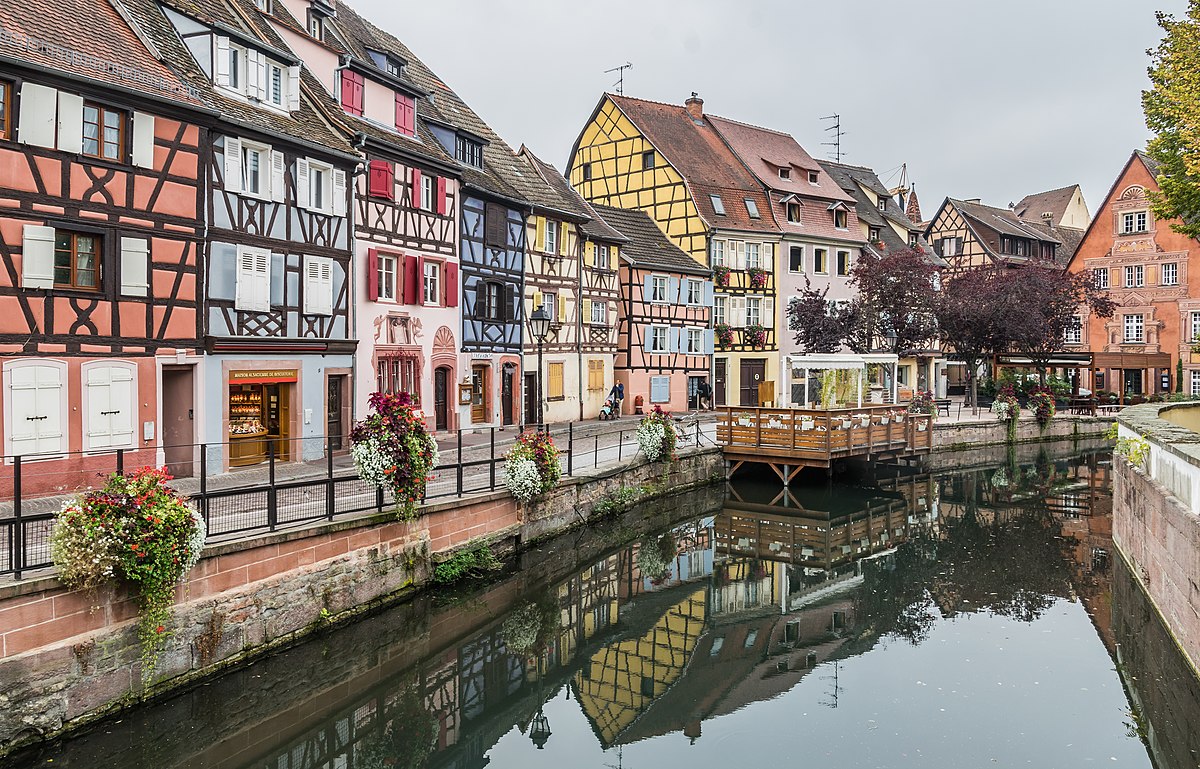
Alsace sits in the far north-east corner of France, pressed against the Rhine and the German border, and yet most English-speaking visitors have never heard of it. That is a shame — and, frankly, an opportunity for anyone willing to look beyond Paris, Provence and the Riviera. This is a region where Gothic cathedrals rise above cobbled lanes, half-timbered villages spill out of a storybook, and a 170-kilometre wine road threads through some of the finest vineyards in Europe. If you have ever looked at a photograph of brightly painted timber houses reflected in a canal and wondered where on earth that was, the answer is almost certainly Alsace.
This Alsace France travel guide covers everything you need to plan a visit: the cities, the villages, the food, the wine and the legendary Christmas markets that draw millions every winter. Whether you are building a week-long itinerary or adding a two-day detour to a wider French trip, Alsace will reward you richly.
Love France? So Do We
We send a free newsletter every week packed with stories, travel tips and hidden corners of France that most visitors never find. Join thousands of France lovers here — it is completely free and you can unsubscribe any time.
Why Alsace Deserves a Place on Your Itinerary
Alsace has changed hands between France and Germany five times since 1871. That turbulent history has produced something unique: a region that is unmistakably French in spirit yet profoundly Germanic in architecture, cuisine and winemaking tradition. Road signs are bilingual. Menus offer both choucroute and Sauerkraut. The timbered houses look as though they belong in the Black Forest, but the tricolore flies above every mairie.
Beyond the cultural fascination, the practical appeal is strong. Alsace is compact — Strasbourg to Colmar is barely 70 kilometres — so you can see a great deal without spending hours on the road. It is well connected by TGV from Paris and by air from the UK. And outside the Christmas market season, it remains refreshingly uncrowded compared with southern France.
Strasbourg: The Capital of Alsace
Strasbourg is the obvious starting point for any Alsace trip, and it earns that status. The Grande Île, the historic island at the heart of the city, is a UNESCO World Heritage Site — the first entire city centre to receive that designation.
Strasbourg Cathedral
The Cathédrale Notre-Dame de Strasbourg dominates the skyline with its single, delicately carved spire rising 142 metres. For over two centuries it was the tallest building in the world. The west facade is an extraordinary mass of Gothic sculpture, and inside the astronomical clock — a Renaissance marvel — puts on a mechanical show every day at half past noon. Arrive early; the crowd gathers well in advance.
Petite France
A few minutes’ walk from the cathedral, Petite France is the most photogenic quarter in Strasbourg. The canals of the River Ill wind between half-timbered houses that once belonged to tanners, millers and fishermen. The Ponts Couverts — three medieval bridges with defensive towers — mark the western edge. Walk here in the early morning before the tour groups arrive and you will have the reflections largely to yourself.
European Parliament and Institutions
Strasbourg is the official seat of the European Parliament, and the modern Quartier Européen in the north-east of the city offers a striking contrast to the medieval centre. Free guided tours of the Parliament are available when it is in session — worth booking in advance if European politics interests you.
Strasbourg Christmas Market
The Christkindelsmärik in Strasbourg is the oldest Christmas market in France, dating back to 1570, and arguably the finest. From late November through to late December, the city centre transforms into a constellation of themed markets — around the cathedral, in Place Kléber, and throughout Petite France. We cover this in more detail below, but if you are planning a winter visit, Strasbourg should be your base.
Colmar: The Jewel of Alsace
If Strasbourg is the capital, Colmar is the heart. Smaller, quieter and arguably even more beautiful, this is the town that appears on every Alsace postcard — and justifiably so.
Little Venice (La Petite Venise)
The Petite Venise quarter is where the River Lauch flows past painted timber houses draped in geraniums. A flat-bottomed boat ride along the canal is the classic Colmar experience, and it is every bit as lovely as the photographs suggest. The fishmonger’s district (Quai de la Poissonnerie) is the most colourful stretch.
Unterlinden Museum and the Isenheim Altarpiece
The Musée Unterlinden, housed in a former Dominican convent, is one of the most visited museums in France outside Paris. Its star exhibit is the Isenheim Altarpiece by Matthias Grünewald — a monumental, emotionally devastating work from around 1515 that is considered one of the masterpieces of Western art. Even if you are not an art lover, the altarpiece will stop you in your tracks. The museum also holds an excellent collection spanning medieval to modern art, expanded in 2015 with a striking extension by Herzog & de Meuron.
The Route des Vins d’Alsace
The Alsace Wine Route is one of the oldest and most scenic wine roads in France, stretching 170 kilometres from Marlenheim in the north to Thann in the south. It threads through more than 70 wine-growing villages, most of them absurdly pretty, with half-timbered houses, flowering window boxes and vineyards climbing the slopes of the Vosges mountains behind them. For more on French wine regions, see our guide to the best wine regions in France.
You do not need to drive the entire route to appreciate it. The most rewarding section lies between Colmar and Sélestat, where four of the finest villages sit within easy reach of each other.
Riquewihr
Riquewihr survived the Second World War almost entirely intact, which is why it looks today much as it did in the 16th century. The single main street, lined with painted houses and wrought-iron shop signs, climbs gently to the Dolder tower at the top. It is undeniably touristy in high season, but the beauty is genuine. Visit early morning or late afternoon for a quieter experience.
Eguisheim
Eguisheim is built in concentric circles around a central square, a layout unique in Alsace. It has been voted France’s favourite village and it is easy to see why — the pastel-coloured houses, the cobbled lanes, the fountains and the vineyards pressing right up to the village edge create something close to perfection. This is also the birthplace of Pope Leo IX, if ecclesiastical trivia is your thing.
Kaysersberg
Kaysersberg — the “Emperor’s Mountain” — sits at the mouth of the Weiss valley, with a ruined castle perched above. It is the birthplace of Albert Schweitzer, and a small museum commemorates the Nobel laureate. The fortified bridge, the half-timbered houses and the excellent local winstubs (traditional wine taverns) make it one of the most satisfying stops on the wine route.
Ribeauvillé
Ribeauvillé is overlooked by three ruined castles on the ridge above, and its Grand’Rue is one of the finest main streets in the region. Less manicured than Riquewihr, it feels more like a working town — which makes it all the more appealing. Every September, the Pfifferdaj (Fiddlers’ Festival) fills the streets with medieval pageantry, free-flowing wine and a parade dating back to the 14th century.
Haut-Koenigsbourg Castle
Perched 757 metres above the Alsatian plain, Château du Haut-Koenigsbourg is the most visited castle in Alsace. Originally built in the 12th century, it was destroyed in the Thirty Years’ War and then meticulously reconstructed by Kaiser Wilhelm II in the early 1900s. The result is a fairy-tale fortress with panoramic views stretching from the Vosges to the Black Forest and, on clear days, the Alps. It is a 20-minute drive from Sélestat and well worth the detour.
Stay in the Loop
If you are enjoying this guide, you will love our weekly France newsletter. Every edition is packed with travel ideas, hidden gems and honest advice for planning your next French adventure. Subscribe free here.
Alsatian Food and Wine: What to Eat and Drink
Alsatian cuisine is hearty, generous and utterly distinctive. It draws on both French technique and Germanic tradition, producing dishes you will not find anywhere else in France.
Tarte Flambée (Flammekueche)
The signature dish of Alsace. A paper-thin rectangle of dough is spread with fromage blanc, crème fraîche, thinly sliced onions and lardons, then blasted in a wood-fired oven until the edges char and blister. The classic version is magnificent, but you will also find variations with munster cheese, mushrooms or — in autumn — pumpkin. It is traditionally shared, torn by hand, and washed down with local wine or beer.
Choucroute Garnie
Alsatian sauerkraut, but elevated to an art form. Slow-cooked with Riesling, juniper berries and bay leaves, the fermented cabbage is piled high with an assortment of sausages, smoked pork belly, ham hock and potatoes. It is not delicate, but it is deeply satisfying — especially on a cold winter evening in a wood-panelled winstub.
Baeckeoffe
A slow-cooked casserole of three meats (pork, beef and lamb), layered with potatoes, onions and leeks, marinated overnight in Alsatian white wine and baked in a sealed earthenware pot. The name means “baker’s oven” — traditionally, women would prepare the dish at home and drop it at the local bakery to cook slowly in the residual heat of the bread oven.
Kugelhopf
A brioche-like cake baked in a distinctive ring-shaped mould, studded with almonds and sometimes soaked in kirsch. You will see kugelhopf moulds in every kitchen shop in Alsace — they make excellent souvenirs. The savoury version, filled with lardons and walnuts, is equally good.
Alsatian Wines
Alsace is France’s greatest white wine region, and the wines here are labelled by grape variety rather than appellation — unusual for France. The key varieties to know are:
- Riesling — the king of Alsatian wines. Dry, mineral, steely and food-friendly. Nothing like the sweet German Rieslings most people expect.
- Gewürztraminer — intensely aromatic, with lychee, rose petal and spice. Wonderful with munster cheese or Asian-influenced dishes.
- Pinot Gris — rich and full-bodied, often with honeyed notes. Superb with foie gras (another Alsatian speciality).
- Crémant d’Alsace — sparkling wine made in the traditional method. Excellent quality at a fraction of Champagne prices. It accounts for a quarter of all French crémant production.
Most producers along the wine route offer tastings, often free of charge. The caves (cellars) in Eguisheim, Riquewihr and Ribeauvillé are particularly rewarding.
The Christmas Markets of Alsace
Alsace is home to the biggest and oldest Christmas markets in France, and they are reason enough to visit. The season runs from late November through to late December, and the entire region transforms into something genuinely magical.
Strasbourg’s Christkindelsmärik, established in 1570, is the star — and draws around two million visitors each year. But the smaller markets in Colmar (five themed markets dotted around the old town), Kaysersberg (intimate and beautifully lit), and Eguisheim (set within the circular village) are arguably even more atmospheric. Expect mulled wine (vin chaud), gingerbread, roasted chestnuts, handcrafted ornaments and an overwhelming quantity of fairy lights.
If you are visiting during the Christmas market season, book accommodation well in advance — Alsace fills up quickly, and prices rise significantly from mid-November.
The Franco-German Culture of Alsace
What makes Alsace genuinely fascinating is its dual identity. The local dialect, Alsatian (Elsässisch), is a Germanic language, though it is increasingly spoken only by older generations. Place names are often German in origin — Strasbourg is Straßburg, Colmar is Kolmar. The architecture, with its exposed timber frames and steep roofs, is distinctly Rhineland.
Yet the culture is fiercely French. Alsace chose France after 1918 and again after 1945, and the attachment is genuine. The result is a cultural layering that gives the region its unique character — French savoir-vivre expressed through Germanic forms. You will feel it in the winstubs, in the bilingual menus, in the way Christmas is celebrated with both French and German traditions. It is one of the most culturally rich corners of Europe.
Getting to Alsace
By train: The TGV connects Paris Gare de l’Est to Strasbourg in just 1 hour 46 minutes — one of the fastest and most convenient rail journeys in France. From Strasbourg, regional trains run frequently to Colmar (35 minutes) and Sélestat (25 minutes). Book early on the SNCF website for the best fares.
By air: Strasbourg Airport (SXB) has flights from several European cities. EuroAirport Basel-Mulhouse-Freiburg (BSL), shared between France, Switzerland and Germany, is another option for southern Alsace and has more international connections.
By car: Alsace is easy to reach from the UK via the Channel Tunnel or ferry to Calais, then the motorway east. It is approximately 500 kilometres from Calais to Strasbourg. A car is particularly useful for exploring the wine route villages, though parking in Strasbourg and Colmar is limited. For more on driving in France, see our planning hub.
Best Time to Visit Alsace
Late spring (May-June) is arguably the finest time. The weather is warm, the vineyards are lush and green, the flowers are out in force and the tourist crowds have not yet peaked. Autumn (September-October) is equally rewarding — the wine harvest is underway, the vine-covered hillsides turn gold and russet, and the light is beautiful.
Summer (July-August) is warm and busy, particularly in the wine route villages. Strasbourg can feel hot. It is perfectly pleasant, but not Alsace at its most atmospheric.
Winter (late November-December) is Christmas market season, and Alsace is transformed. Cold, yes — expect temperatures around freezing — but the markets, the mulled wine and the fairy-lit villages make it unforgettable. January and February are quiet and cold, best suited to those who want the region largely to themselves.
Start Planning Your Alsace Trip
Alsace is one of those rare destinations that delivers on every front: history, architecture, food, wine, scenery and a cultural identity unlike anywhere else in France. It deserves far more attention than it gets from English-speaking travellers, and those who do make the journey invariably wonder why they did not come sooner.
For help planning your wider trip, visit our France planning hub — it covers everything from budgets and transport to the best time to visit each region.
And if you want a weekly dose of France inspiration delivered to your inbox, join our free newsletter. We would love to have you along.
Leave a Reply