
Tonight, somewhere in the south of France, someone will buy a ticket to watch an outdoor opera in a stadium the Romans finished building in the first century CE. They will sit in stone seats carved two thousand years ago. Below them, on a stage designed for imperial spectacles, a soprano will take her position.
France did not merely inherit its Roman past. It kept using it.
The Arena That Has Never Gone Dark
Roman builders completed the Arènes de Nîmes around 70 CE. They carved the amphitheatre to hold 24,000 spectators, and the design worked so well that the city never stopped filling the seats.
Medieval residents converted sections of it into housing. Families lived inside the arena walls for centuries. In 1863, the city cleared the structure and began a restoration that continues today.
The result is one of the best-preserved Roman amphitheatres in the world — and one that still earns its keep. Twice a year, Nîmes holds its Férias: week-long festivals centred on bullfighting, flamenco, and free concerts that pack the ancient stone tiers.
Stand outside on a Feria night. You will hear bass notes thumping from a building that predates the Colosseum in Rome.
An Opera Stage Two Millennia Old
Roman architects built the Théâtre Antique d’Orange in the first century CE. The stage wall stands 37 metres tall and survives almost completely intact — one of only three complete Roman theatre walls still standing in the world.
UNESCO declared it a World Heritage Site in 1981. Each summer since 1869, the Chorégies d’Orange has staged opera and classical music in the ancient theatre. The festival still draws sell-out crowds.
The acoustics remain extraordinary. Roman engineers designed the space to carry sound without amplification across several thousand spectators. Audiences today sit on the original stone tiers and can hear every word without effort.
The Aqueduct That Used No Mortar
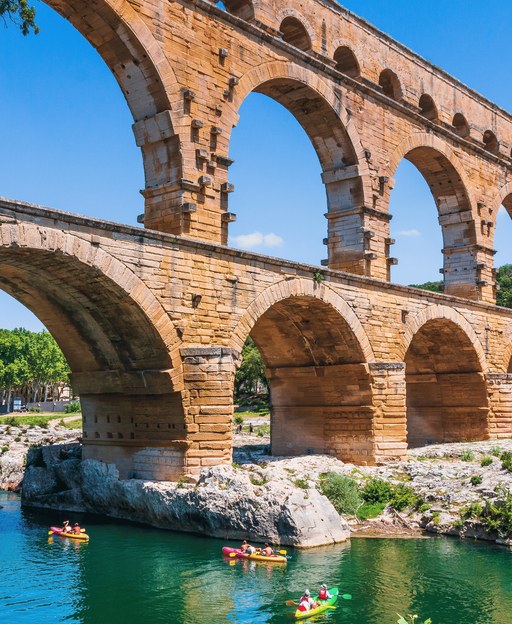
Roman engineers completed the Pont du Gard around 50 CE. The structure stands 49 metres high, crosses the Gardon river in three tiers of arches, and once carried fresh water 50 kilometres from Uzès to Nîmes.
They used no mortar. Every stone block interlocks by shape and weight alone. The bridge has stood for nearly 2,000 years without a single fixing agent.
Today, kayakers paddle beneath the lower arches on summer afternoons. The water long since stopped flowing through the upper channel. The structure carries on regardless — vast, quiet, and as solid as the day the Romans left it.
Enjoying this? 7,000 France lovers get stories like this every week.
Thinking about it for retirement? If you’ve started thinking seriously about retiring there, our complete our full Retire in France guide covers the visa, healthcare, cost-of-living, and the regions worth shortlisting.
The Amphitheatre Hiding in Paris
Most Paris visitors never find the Arènes de Lutèce. Roman builders constructed the amphitheatre in the second century CE in what is now the 5th arrondissement. Medieval Paris buried it. Workers uncovered it again during construction work in 1869.
Today, locals use it as a park. Children kick footballs across the arena floor. Old men play pétanque in the same oval space where Romans staged gladiatorial displays and animal hunts.
Entry is free. There are no queues. Most tourists walk right past it on their way to the Jardin des Plantes. The address is Rue Monge, 75005 — ten minutes on foot from the Panthéon.
Planning Your Visit to Roman France
Nîmes, Orange, and the Pont du Gard form a natural triangle, all within 60 kilometres of each other. Most visitors cover all three in two days. Avignon makes a practical base — it sits between all three sites and offers excellent transport links.
Spring and autumn offer the most comfortable weather. Summer heat regularly reaches 38°C in the Gard in July. Nîmes fills quickly during the Férias in late May and mid-September, so book accommodation early if either festival overlaps with your visit.
For broader trip planning across France, the France planning guide covers everything from train routes to regional priorities. If you plan to extend your stay in the south, the Provence seasonal guide explains the best months to visit and what you will find in each.
What is the best time to visit the Roman sites in southern France?
April to June and September to October give the most comfortable temperatures. The Férias at Nîmes run in late May and mid-September — book arena tickets and accommodation weeks ahead if you plan to attend either festival.
Do I need to book tickets for the Théâtre Antique d’Orange in advance?
For regular daytime visits, tickets at the door are usually available. For Chorégies d’Orange opera performances in July and August, book online well ahead — shows sell out months before the season begins.
How far is the Pont du Gard from Nîmes?
The Pont du Gard sits about 25 kilometres northeast of Nîmes. By car the drive takes around 25 minutes. Local buses from Nîmes connect to the site in summer, taking roughly 45 minutes.
Is the Arènes de Lutèce worth visiting in Paris?
Yes, especially if you want to step off the tourist trail for an hour. Entry is free, there are almost never queues, and watching locals play pétanque inside a 2,000-year-old Roman arena is unlike anything else Paris offers.
France does not treat its Roman past as ruins. It treats it as infrastructure. History, still working.
Join 7,000+ France Lovers
Three times a week, get France’s hidden gems, seasonal guides, local stories, and the art of la vie française — straight to your inbox.
Subscribe free — enter your email:
📲 Know someone who’d love this? Share on WhatsApp →
Love more? Join 65,000 Ireland lovers → · Join 43,000 Scotland lovers → · Join 29,000+ Italy lovers →
Free forever · Unsubscribe anytime
Frequently Asked Questions
Can you attend performances at 2,000-year-old Roman theaters in France?
Yes. The Théâtre Antique d'Orange has hosted opera and classical music every summer since 1869, and the Arènes de Nîmes holds week-long Férias festivals twice yearly featuring bullfighting, flamenco, and concerts.
How well-preserved are the Roman structures in France?
The Théâtre Antique d'Orange has one of only three intact Roman theater stage walls still standing in the world, and the Arènes de Nîmes is considered one of the best-preserved Roman amphitheaters anywhere. Both structures continue to function much as they did two thousand years ago.
What are the Férias de Nîmes?
Held twice yearly at the Arènes de Nîmes, these week-long festivals center on bullfighting, flamenco, and free concerts, with crowds filling an amphitheater built around 70 CE. The city cleared out the medieval residents who had lived inside the arena walls for centuries before restoration began in 1863.
Why do the acoustics work so well in ancient Roman theaters?
Roman engineers designed the Théâtre Antique d'Orange to carry sound without amplification across thousands of spectators, and that system remains extraordinarily effective—audiences today can hear every word from the original stone seats without any electronic assistance.
🇫🇷 You Might Also Love
Tours & experiences you might love


Powered by Viator. Some links are affiliate links — we may earn a small commission at no extra cost to you.

Leave a Reply