
You sit down in a stone-floored room in Quimper. Rain taps the windows. A ceramic bowl arrives at your table before you’ve opened the menu — cloudy, golden cider, no glass needed. This is Brittany, and lunch here does not rush.
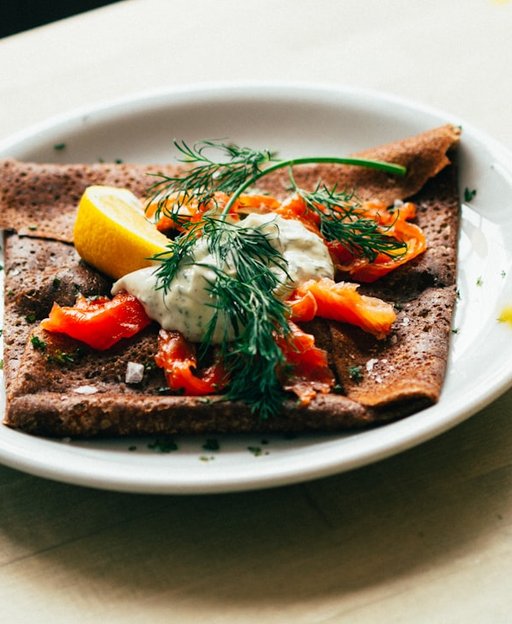
The Grain That Fed a Peninsula
Buckwheat arrived in Brittany in the 14th century. Farmers planted it on the rocky, acidic soil that wheat refused to tolerate. It grew fast, required little care, and produced a dark, earthy flour unlike anything else in France.
Millers ground it into powder. Cooks poured it onto cast-iron biligs — flat griddles heated over wood fires. The result: a dark, crisp galette, savoury and nutty, sturdy enough to hold a full meal.
The rest of France dismissed it. Bretons built a culture around it.
What a Real Crêperie Looks Like
Most traditional crêperies in Brittany seat fewer than forty people. Stone walls, wooden tables, candles in bottles. The menu runs to a single page. No background music plays.
The owner often works the bilig personally. Guests watch them pour batter in a smooth spiral, spread it with a wooden tool called a rozell, wait for the edges to lift, then fold the galette into a neat square. This takes about four minutes.
Nobody at the table looks at their phone.
The Classic Order — La Complète
Every Breton crêperie serves the complète: a buckwheat galette with ham, melted cheese, and a whole egg cracked directly onto the surface. The egg cooks as the galette folds. The cheese pulls into the corners.
Locals rarely study the menu. Most order a complète before they sit down. First-time visitors do well to copy them. This is the correct approach.
Enjoying this? 7,000 France lovers get stories like this every week.
Thinking about it for retirement? If you’ve started thinking seriously about retiring there, our complete our full Retire in France guide covers the visa, healthcare, cost-of-living, and the regions worth shortlisting.
Cider: The Only Correct Pairing
Breton cider skips the sweetness. Farms across Finistère and Morbihan press their own apples each autumn. The result ranges from dry and sharp to slightly cloudy and funky — nothing like commercial ciders sold elsewhere.
Crêperies serve cider in a ceramic bowl, not a glass. The bowl holds roughly 300ml. Drinkers cradle it in both hands. Locals call this a bolée, and they rarely stop at one.
Wine appears on most crêperie menus. Ordering it is not forbidden. Breton grandmothers will notice.
The Rule That Visitors Always Get Wrong
Buckwheat galettes come first. Sweet wheat crêpes come second. This is not a suggestion.
Many visitors see crêpes on the menu and assume they can order them at any point. Bretons find this baffling. The galette is the main course. The crêpe is dessert. Arriving out of order marks you immediately as someone who has never been here before.
Order the galette first, finish it completely, then ask for the sweet crêpe. The whole experience unfolds over an hour minimum. That is the point.
Where to Find the Real Thing
Brittany has thousands of crêperies, but quality varies. Three towns stand out as the best starting points.
Quimper
Quimper holds the strongest claim to being the spiritual home of the Breton galette. The old quarter contains dozens of crêperies, many in buildings older than the French republic. Visit on a weekday afternoon for shorter queues and an unhurried atmosphere.
Rennes
Rennes is the Breton capital, and its crêperies reflect that seriousness. Competition between makers is fierce. Locals argue passionately about batter ratios, bilig temperature, and the correct thickness of a complète. Visitors benefit from all of it.
Saint-Malo
Saint-Malo adds sea air to the equation. Several crêperies sit within the walled city. Winter visits work especially well — the crowds thin, the crêperies stay open, and the rain outside makes the stone interiors feel warmer.
For more on what makes Brittany unlike anywhere else in France, read our guide to why Brittany feels like a different country. Planning a longer trip? Our France trip planning guide covers everything from regions to routes.
Frequently Asked Questions
What is the difference between a galette and a crêpe in Brittany?
A galette uses dark buckwheat flour and is always savoury — typically filled with egg, ham, and cheese. A crêpe uses white wheat flour and is always sweet. In Brittany, you eat the galette first as your main course, then the crêpe as dessert.
What is the best time to visit Brittany for galettes?
Any time of year works, but September to November adds the bonus of fresh cider season. Farms across Finistère press their apples in autumn, so the bolée alongside your galette is as fresh as it gets. Winter visits are quieter but no less authentic.
How much does a galette meal cost in Brittany?
A complète galette typically costs €8–€12. Add a bolée of cider for €3–€5. A full crêperie meal — galette, sweet crêpe, and two bowls of cider — rarely exceeds €20 per person. Even by French standards, this counts as exceptional value.
The rain hasn’t stopped. Your bowl is empty. Somewhere in the kitchen, a bilig is still hot. Brittany measures time differently at lunch, and once you understand why, nowhere else quite matches it.
Join 7,000+ France Lovers
Three times a week, get France’s hidden gems, seasonal guides, local stories, and the art of la vie française — straight to your inbox.
Subscribe free — enter your email:
📲 Know someone who’d love this? Share on WhatsApp →
Love more? Join 65,000 Ireland lovers → · Join 43,000 Scotland lovers → · Join 29,000+ Italy lovers →
Free forever · Unsubscribe anytime
🇫🇷 You Might Also Love
Tours & experiences you might love


Powered by Viator. Some links are affiliate links — we may earn a small commission at no extra cost to you.

Leave a Reply