
Most visitors to France race south. They follow the signs to Provence, or head east to Alsace, or drift down to the coast. Somewhere in the middle of the country, between the motorways and the tourist maps, the Auvergne sits quietly — and waits.
The Region That the Rest of France Overlooks
The Auvergne covers a large stretch of south-central France. Its landscape climbs across ancient plateaus, drops into river gorges, and stretches through forests of oak and silver birch. Few international visitors reach it, and fewer still stop long enough to leave the car.
That gap is your advantage.
The region holds more villages on the official “Les Plus Beaux Villages de France” list than almost any other part of the country. These places have not been restored for tourists. Nobody redesigned them. They look the way they do because the Auvergne never attracted the kind of money or attention that changes things.
Salers — Built from Black Stone and Left Untouched
Salers sits on a plateau in the Cantal department, about 950 metres above sea level. Its builders used black volcanic lava stone for everything — towers, gateways, merchants’ houses, the church. The result is a town that looks like it formed from the landscape itself.
Walk through the main gate and you enter a place that feels genuinely old. No chain shops, no tourist market selling lavender sachets. A Romanesque church anchors the main square. Most days, the only sounds are footsteps on cobblestones and wind moving across the plateau.
Salers gives its name to a cheese and a breed of cattle, both famous long before the village appeared on any list. The fromageries still sell it in thick wheels from the doorway.
Lavaudieu — The Abbey With 900-Year-Old Frescoes
Lavaudieu sits in the Allier Valley, a few kilometres east of Brioude. Its Benedictine abbey dates from the 11th century, and inside the church, 12th-century frescoes still cover the walls. The cloister is small — one arcade wrapping a garden, columns carved with leaf and animal motifs.
The village has fewer than 250 residents. It appears on the “Les Plus Beaux Villages” list, yet most visitors to the Auvergne never find it.
Stand in the cloister on a weekday morning and you may have it entirely to yourself. The silence is not an absence. It feels like the place itself has chosen it.
Enjoying this? 7,000 France lovers get stories like this every week.
Thinking about it for retirement? If you’ve started thinking seriously about retiring there, our complete our full Retire in France guide covers the visa, healthcare, cost-of-living, and the regions worth shortlisting.
Thiers — A City Balanced on a Gorge
Most people know Thiers, if at all, as France’s cutlery capital. Knife-makers have worked this stretch of the Durolle River valley for over 600 years, using the fast-moving water to power their grinding wheels. The craft still continues, with workshops producing everything from pocket knives to kitchen blades.
What visitors rarely see is the old town itself. Thiers climbs a dramatic ridge above the gorge, its half-timbered houses projecting out over the streets below. The upper town dates largely from the 15th and 16th centuries and survives almost intact.
Stand at the Terrasse du Rempart and the valley drops away beneath you. It is one of France’s most spectacular urban viewpoints, and on most days you share it with nobody.
Hérisson — Where the Ruins Still Watch the River
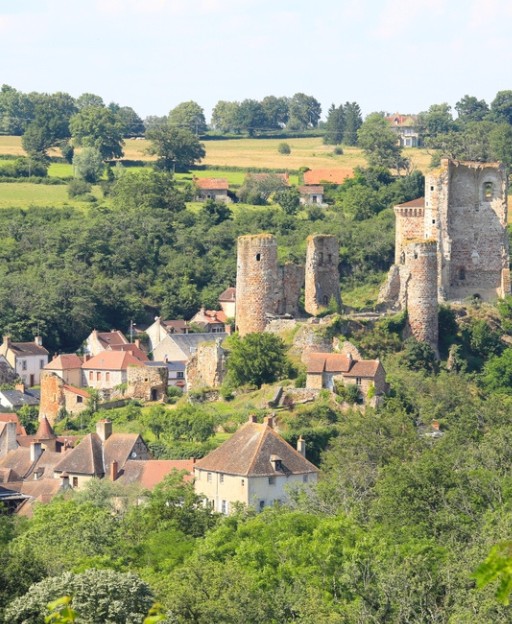
Hérisson stands in the Allier department, at the northern edge of the Auvergne. A ruined medieval castle sits on a rocky spur above the Aumance River, and the village clusters beneath it in the shadow of the old towers.
The countryside here runs gentler than the volcanic south. Low hills, river meadows, small forests — the kind of landscape that invites slowing down rather than stopping to photograph. Hérisson was once a significant stronghold. Now it holds a population of around 400, and the castle ruins sit mostly empty.
Some mornings, the only visitors are the swallows.
How to Plan Your Auvergne Village Trip
Clermont-Ferrand is the region’s main hub. Direct trains connect it to Paris Gare de Lyon in about three hours. A hire car is essential beyond that — the villages spread across the plateau and most lack public transport connections.
Clermont-Ferrand or the nearby town of Riom both work well as a base for day trips north and east. For the southern Cantal villages around Salers, consider staying in Aurillac instead.
Start your planning with our complete France travel guide. For the eastern Auvergne, our Le Puy-en-Velay guide covers a city that works well as a southern gateway.
What is the best time to visit the Auvergne villages in France?
May to September gives the most reliable weather and the best access to village sites and local markets. Late spring brings wildflowers across the plateau; early autumn keeps the light warm and the crowds minimal.
How do I get to the Auvergne villages from Paris?
Take a direct train to Clermont-Ferrand from Paris Gare de Lyon, which runs around three hours. Hire a car from Clermont to reach smaller villages — Salers, Lavaudieu, Thiers, and Hérisson — independently at your own pace.
What food is the Auvergne known for in France?
The Auvergne produces some of France’s most celebrated cheeses — Salers, Cantal, Saint-Nectaire, and Fourme d’Ambert. Regional dishes include aligot (potato beaten with fresh Tomme cheese), truffade, and potée auvergnate. Markets in the region sell most of these directly from local producers.
Is the Auvergne suitable for a self-drive road trip?
A road trip is the best way to explore the region. The villages sit spread across the plateau, each roughly an hour apart. A four- or five-day self-drive lets you reach Salers, Lavaudieu, Thiers, and Hérisson without rushing any of them.
Nobody arrives in the Auvergne by accident. You have to choose it — and then trust that choosing it was right. The moment you understand that is when you walk through your first village gate, hear nothing but wind moving across the plateau, and realise you have found the France most visitors never see.
Join 7,000+ France Lovers
Three times a week, get France’s hidden gems, seasonal guides, local stories, and the art of la vie française — straight to your inbox.
Subscribe free — enter your email:
📲 Know someone who’d love this? Share on WhatsApp →
Love more? Join 65,000 Ireland lovers → · Join 43,000 Scotland lovers → · Join 29,000+ Italy lovers →
Free forever · Unsubscribe anytime
🇫🇷 You Might Also Love
Tours & experiences you might love


Powered by Viator. Some links are affiliate links — we may earn a small commission at no extra cost to you.

Leave a Reply