
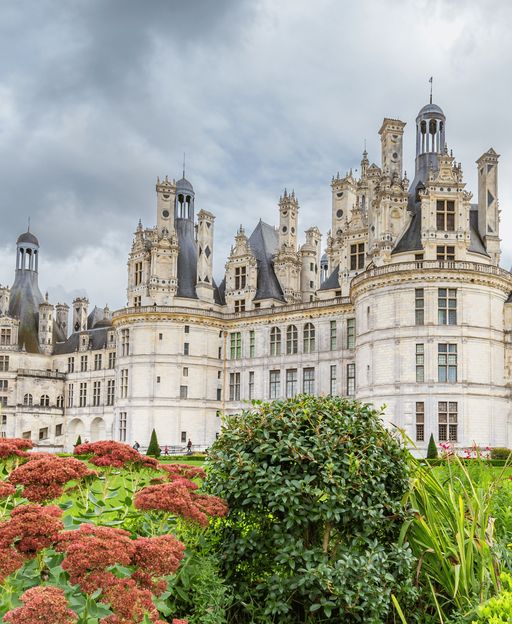
Château de Chambord appears suddenly from the trees. One moment the forest stretches in every direction. The next, a white Renaissance palace is rising in front of you — 440 rooms, 365 chimneys, towers and turrets reaching skyward from every corner. It looks impossible. It is also real. And it was built for a king who stayed there for less than three months total, across his entire reign.
Built to Be Seen, Not Lived In
Francis I began construction in 1519. He was not building a home. He was building an argument.
France at that time was competing with Italy, Spain, and the Holy Roman Empire for cultural prestige. A château of this scale — set deep in a royal hunting forest, visible for kilometres across the flat Loire plain — would announce to every visiting ambassador that French ambition had no ceiling.
Construction started the same year that Leonardo da Vinci was living just 40 kilometres away at Amboise, under Francis’s own patronage. Leonardo died in May 1519 — the same spring that work began at Chambord. Whether he discussed the design with the king before he died is one of French architecture’s most enduring questions. Nobody has ever settled it.
The Staircase Nobody Can Fully Explain
At Chambord’s centre is one of the most unusual staircases ever built. Two spiral staircases wind around each other, rising from the ground floor to the rooftop terraces. They share the same central column. They pass through the same open landings. They never meet.
You can walk up one while another person descends the other. You move through the same space, look across the same open voids — and never once cross paths. The design was unlike anything else in 16th-century Europe.
Leonardo da Vinci had sketched almost identical staircases in his private notebooks. Whether he passed the idea to Francis before dying in 1519, or whether the architects knew his drawings from another source, historians still argue about today. The staircase is there. Its exact origin is not.
Twenty-Eight Years to Build — and Barely Slept In
Construction began in 1519 and took 28 years. Francis I died in 1547 — the same year the final stones were placed. He never saw the finished château.
Across those 28 years, he stayed at Chambord for roughly 72 days in total. His royal hunting parties would arrive — horses, hounds, courtiers, servants filling every corridor — stay for a few days, then leave. The 440 rooms fell silent. The 365 chimneys cooled.
Even Louis XIV, who turned Versailles into the political centre of France, visited Chambord only occasionally. In 1670, Molière staged the world premiere of Le Bourgeois Gentilhomme in the great hall. After that, the château slipped into silence for long stretches at a time.
Enjoying this? 7,000 France lovers get stories like this every week.
Thinking about it seriously? If you’ve started actually planning a move, our complete our complete Moving to France guide walks through every step, every cost, and the paperwork that catches most people out.
A Century of Abandonment
The French Revolution stripped Chambord bare. Furniture was auctioned in lots. Windows were shuttered. Napoleon gave the estate to one of his generals as a reward for military service. The château passed through private hands for most of the 19th century, each owner leaving it slightly worse than the last.
Roofs leaked. Stonework crumbled. The building that had taken 28 years to construct — that had announced France’s ambitions to all of Europe — was quietly falling apart.
The French state took ownership in 1930 and began a restoration that is still ongoing. Chambord is now a UNESCO World Heritage Site, recognised alongside more than a dozen other châteaux along the Loire. If you are planning a visit to the region, our Loire Valley travel guide covers the châteaux, wine villages, and the best places to stay. For the full trip, start with our France trip planning hub.
What You Find When You Climb to the Top
More than 800,000 people visit Chambord each year, making it one of France’s most visited monuments outside Paris.
The château sits within a 5,440-hectare national hunting reserve — the largest walled forest in Europe. Wild boar, red deer, and mouflons still roam the same woodland Francis I rode through on horseback five centuries ago. The estate and the wildlife coexist in a way that feels slightly unreal.
The rooftop terrace is worth every step of the climb. Chambord’s skyline is extraordinary — a dense, beautiful confusion of towers, lanterns, and chimneys that looks different from every angle you approach it. On a clear morning, with mist still rising from the Cosson river below, it looks as though someone has dropped an Italian Renaissance dream into the middle of a French forest.
Which is, in a way, exactly what Francis I intended when he put the first stone in the ground in 1519.
Join 7,000+ France Lovers
Three times a week, get France’s hidden gems, seasonal guides, local stories, and the art of la vie française — straight to your inbox.
Subscribe free — enter your email:
🇫🇷 Discover the France Most Tourists Never Find
Get our free guide to 25 hidden villages of France — then join 7,000+ readers for weekly stories about places most guidebooks never mention.
Get Your Free Village Guide →Love more? Join 65,000 Ireland lovers → · Join 43,000 Scotland lovers → · Join 30,000 Italy lovers →
Free forever · Unsubscribe anytime
Francis I built something he barely used — and gave France one of its greatest wonders. Standing at the top of that double helix staircase, looking down through a spiral that has puzzled architects for five centuries, you understand something simple: some ideas are too good to waste, even when the person who had them is long gone.
🇫🇷 You Might Also Love
Tours & experiences you might love


Powered by Viator. Some links are affiliate links — we may earn a small commission at no extra cost to you.

Leave a Reply