
On the second of February, something shifts across France. The smell of warm butter seeps from kitchen windows in every city and village. Schools plan around it. Grandparents phone ahead. And from Brittany to the Rhône Valley, millions of French families take their place at the hob for a ritual as old as the country itself.
What Is La Chandeleur?
Chandeleur — known in English as Candlemas — falls forty days after Christmas. In the Catholic calendar, it marks the Presentation of Jesus at the Temple. But the tradition of making crêpes on this day goes far older than the Church.
Before Christianity reached Gaul, Celtic and Roman farmers marked early February as the turning point of winter. The days were getting longer. The worst of the cold was passing. To celebrate the returning sun, they made round, golden pancakes — a shape that mirrored the sun itself. Those round, buttery discs have been flipped in French kitchens ever since.
When the Church adopted the date, the paganism was absorbed rather than erased. Priests would bless candles on this day — hence Chandeleur, from chandelle, or candle. The crêpes stayed. The sun symbolism stayed. And the superstitions arrived with time.
The Coin in Your Left Hand
Here is where the tradition becomes something else entirely.
Before you flip the first crêpe of the day, you must hold a gold coin in your left hand. Traditionally it was a Louis d’or — a French gold coin used for centuries. Today, most families use whatever coin they can find. The point is the gesture, and the belief behind it.
With the coin gripped tight, you flip the crêpe cleanly with your right hand. If it lands back in the pan without tearing or folding, the year ahead will bring good fortune — financial luck, steady health, things going the way you hoped.
After the flip, the coin is placed on top of the armoire — a tall wardrobe or cabinet — where it stays for the rest of the year, quietly doing its work.
Most French families have done this since childhood. Many cannot say exactly why. They do it because their parents did, and their grandparents before them.
Why Brittany Does It Differently
France is never just one thing.
In Brittany, on the Atlantic coast, the crêpe is not just a February ritual — it is a way of life. Breton cuisine draws a firm line between the thin, sweet crêpe made with white flour and the galette: a denser, earthier pancake made with buckwheat flour, filled with savoury things such as ham, egg, cheese, and onion.
On Chandeleur, a Breton family might make both. Galettes first, as a proper savoury course. Then sweet crêpes, folded with salted caramel, cider-poached apples, or simply a squeeze of lemon and a spoonful of sugar. Cider poured throughout.
If you are planning your first trip to France, knowing that food follows entirely different rules from region to region is one of the most useful things to understand before you arrive.
Enjoying this? 7,000 France lovers get stories like this every week.
Thinking about it seriously? If you’ve started actually planning a move, our complete our complete Moving to France guide walks through every step, every cost, and the paperwork that catches most people out.
The Superstitions Nobody Mentions
The coin flip is only the beginning.
In some parts of France, the first crêpe of the day must be given to a poor person or a stranger. If you eat it yourself, misfortune follows. In other traditions, it should be accompanied by a quiet prayer. Some older customs say the crêpe must be made from the last flour of the previous year’s harvest — a ritual emptying before the new growing season can begin.
The condition of that first crêpe is read like an omen. A smooth, golden crêpe means a smooth year. A pale or torn one is a warning. A crêpe that folds in on itself — well, best not to dwell on it.
Whether anyone truly believes these things today is beside the point. The ritual continues because it connects people to something older than themselves — to the rhythms of the year, to the act of cooking together, to the memory of who first put a coin in their hand and told them to hold tight.
How the French Actually Eat Their Crêpes
France draws a firm line between sweet crêpes and savoury galettes, and rarely mixes the two.
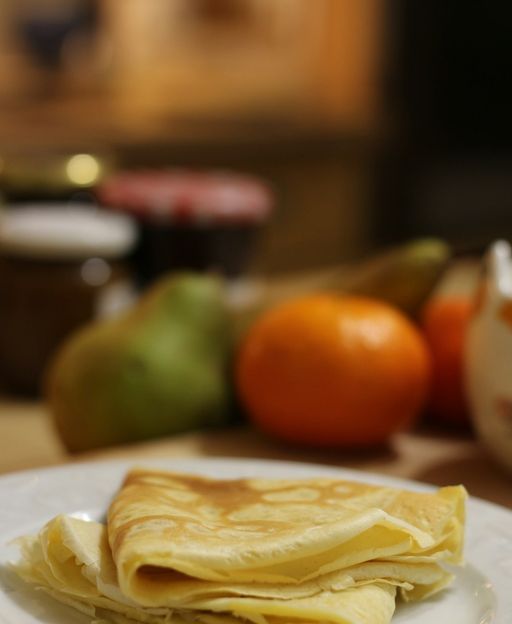
Sweet crêpes are made with white flour, eggs, milk, butter, a little sugar, and sometimes a splash of orange blossom water or rum. They come out thin, pale, almost translucent at the edges when properly made. They are eaten folded in quarters or rolled, with toppings spooned in the centre.
Common fillings include chocolate spread, strawberry jam, honey, chestnut cream, and salted caramel. But the simplest version — a squeeze of fresh lemon and a scatter of caster sugar — is considered by many to be the finest. The French have a strong instinct for restraint.
If this kind of food culture interests you, you might also enjoy reading about why the French Sunday lunch is about far more than food — another tradition where the ritual matters as much as the meal itself.
Right now, in a kitchen somewhere in France, someone is standing at the hob with a coin pressed into their palm. The butter is just beginning to bubble. They are about to flip — and for one held breath, the whole year hangs in the air with the crêpe.
Bonne Chandeleur.
Join 7,000+ France Lovers
Three times a week, get France’s hidden gems, seasonal guides, local stories, and the art of la vie française — straight to your inbox.
Subscribe free — enter your email:
Love more? Join 65,000 Ireland lovers → · Join 43,000 Scotland lovers → · Join 30,000 Italy lovers →
Free forever · Unsubscribe anytime
🇫🇷 You Might Also Love
Tours & experiences you might love


Powered by Viator. Some links are affiliate links — we may earn a small commission at no extra cost to you.

Leave a Reply