
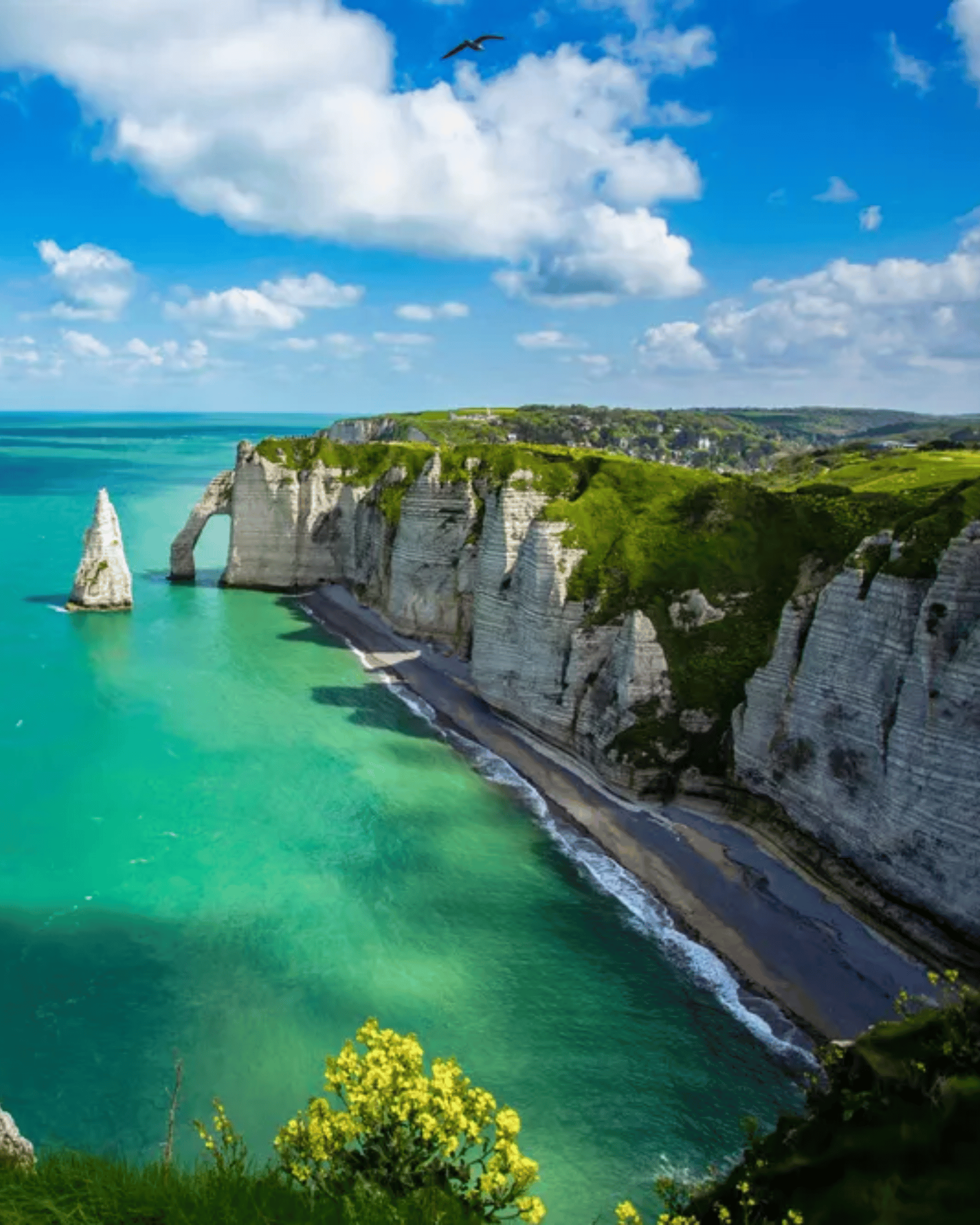
The chalk cliffs of Étretat rise straight from the English Channel on the Normandy coast — dramatic, white, and surprisingly accessible. This small town draws visitors for its arches, its clifftop walks, and its long connection to artists and writers who came here and stayed.
Here is what you need to know before you go.
The Geology Behind the Views
The cliffs at Étretat are made from chalk — the same chalk that forms the White Cliffs of Dover on the other side of the Channel. Both were part of the same seabed during the Cretaceous period, roughly 70 to 100 million years ago. When tectonic forces lifted the land and the sea began carving into it, the Channel formed, and the cliffs on both sides were left standing.
The chalk at Étretat is not uniform white. Bands of black flint run through it horizontally, formed from the compressed remains of ancient marine organisms. These dark lines are clearly visible from the beach and give the cliffs a layered appearance that shifts depending on how the light falls. At midday in summer, the white is almost blinding. In softer morning or evening light, or under overcast skies, the texture and banding become far more visible.
What makes Étretat distinctive is the degree of erosion the sea has achieved here. Over millions of years, waves have carved three major arches through the chalk headlands, along with a free-standing needle of rock called the Aiguille — a 70-metre spike that stands apart from the cliffs like a splinter of the original rock face. The arches are the reason most people make the journey.
Get more guides like this to your inbox. Subscribe to our free France newsletter — new articles every week, no clutter.
The Three Arches and the Aiguille
Porte d’Aval is the most photographed of the three arches. It sits at the southern end of the beach, a tall curved arch rising from the waterline, with the Aiguille standing just beyond it in the sea. From the clifftop path above, both are visible in the same view — the arch framing the needle, with the Channel stretching behind them. This is the image that appears in most travel photographs of Normandy.
The Manneporte is the largest of the three arches, though it cannot be seen from the main beach. It lies further around the southern headland, and reaching it requires either a boat trip or a longer clifftop walk. Its dimensions are considerable — large enough for a fishing boat to pass through with room to spare. It is less visited than Porte d’Aval but worth seeking out if you have the time.
Porte d’Amont is on the northern end of the beach, smaller and less dramatic than the others, but easily reached on foot. It has a chapel at the top — the Chapelle Notre-Dame de la Garde — which honours sailors lost at sea. The chapel is small and plain, but the clifftop position gives a clear view back across the beach and towards Porte d’Aval.
The best views of all three come from the clifftop paths above each arch. The path above Porte d’Aval starts at the southern end of the beach and takes roughly 20 minutes at a walking pace. The views from the top are the reason people come back.
Monet Painted Here Across Fifty Canvases
Claude Monet made multiple visits to Étretat during the 1880s, producing around 50 canvases in total. He worked in all conditions — morning fog, bright summer light, winter storms, grey overcast days — returning repeatedly to capture how the chalk changed colour and texture with different weather.
Looking down at the arches from the clifftop, his obsession is easy to understand. The surface of the chalk catches the light differently at every hour. The water below moves between grey-green and turquoise depending on cloud cover. The scene is the same, but it is never quite the same twice.
The paintings are now spread across major collections internationally. Several are in the Musée Marmottan Monet in Paris. Others are held by the Met in New York and the Art Institute of Chicago. Before visiting the cliffs, it is worth looking at a few of these works — they show the site through different conditions and help calibrate what to look for when you arrive.
Monet was not the first painter to work here. Gustave Courbet was painting the cliffs in the 1860s and 1870s, before Monet’s visits began. By the time Impressionism arrived, Étretat was already an established subject in French art.
The Literary Connection: Maupassant and Arsène Lupin
Étretat also has strong ties to French literature. Guy de Maupassant was born nearby in 1850 and spent much of his childhood in the area. The Normandy coast features throughout his short stories, and he regarded the landscape here as central to his writing. Several of his most well-known stories draw on the towns, people, and social life of this stretch of the coast.
Maurice Leblanc, creator of the gentleman thief Arsène Lupin, lived in Étretat for many years. In the novel The Hollow Needle, the Aiguille itself is at the centre of the plot — Leblanc used the actual rock formation as the setting for a hidden royal treasury. The house where Leblanc lived, the Villa Marguerite, has been renamed the Clos Arsène Lupin and is open to visitors during the season. It contains memorabilia from the stories and information about his life in the town.
Planning a trip to Normandy? Join our free France newsletter for practical guides and local detail delivered weekly.
Getting There from Paris
Étretat is roughly 200 kilometres from Paris by road — about two hours by car, depending on traffic around Rouen. Take the A13 motorway to Rouen, then the A29 towards Le Havre, and continue north along the D940 coastal road.
There is no direct train to Étretat. The nearest major rail hub is Le Havre, approximately 30 kilometres away, which has frequent direct trains from Paris Saint-Lazare (journey time around two hours by TGV). From Le Havre, buses run to Étretat — the journey takes roughly 45 minutes. Taxis and car hire are also available from Le Havre if you want more flexibility.
Parking in Étretat is available near the beach and at the edges of the town centre. It is paid and can fill quickly during summer weekends. Arriving on a weekday or outside July and August will make both parking and the clifftop paths considerably more manageable.
When to Visit
The cliffs are open year-round and the clifftop paths are free to walk at any time. Each season offers something different.
Summer brings the clearest skies and the most vivid colours in the water, but also the largest crowds. July and August in particular see the beach and viewpoints become busy, especially at weekends. If you are visiting in summer, go early in the morning before the day-trippers arrive from Le Havre.
Spring and autumn are arguably better for the clifftop walks. The light is softer, the crowds are thinner, and the Normandy coast’s variable weather can produce dramatic skies over the chalk. Monet preferred to work here outside the peak summer months, and the paintings from autumn and winter visits are often considered his strongest.
Winter visits are possible and the quiet is marked. Some restaurants and accommodation options close between November and March, so check availability before travelling. The clifftop paths remain walkable, and on clear winter days the views can be exceptional.
What to Do in the Town
A full visit to Étretat, covering both major clifftop walks and the town itself, fills most of a day. Beyond the cliffs, several things are worth knowing about.
Les Jardins d’Étretat sits on the clifftop above Porte d’Aval. The garden has a long history but has been significantly redesigned in recent years, incorporating contemporary landscape elements into the original structure. Entry is paid. The views from the garden over the arches and the Aiguille are among the best available without doing the full clifftop walk.
Clos Arsène Lupin — Leblanc’s former house — is open during the season and gives context to how the town figured in French popular culture during the early 20th century.
The Thursday market in the town centre sells food, local produce, and goods from across the Normandy region. Worth visiting if your trip coincides with it.
Seafood is the thing to eat in Étretat. Scallops from the Bay of the Seine, local mussels, and sole normande — sole cooked with cream, cider, and mushrooms — are the regional dishes most commonly found on menus. Several of the restaurants facing the beach offer good versions of these.
The beach itself is pebble, not sand. Swimming is possible in summer, though currents can be strong close to the arches. The water temperature in the Channel stays cold even in August.
Practical Information
- Getting there by train: Paris Saint-Lazare to Le Havre (approx. 2 hrs), then bus to Étretat (approx. 45 min)
- By car from Paris: A13 to Rouen, A29 to Le Havre, then D940 north — approximately 2 hours
- Parking: Paid parking near the beach; arrive early in summer
- Clifftop paths: Free to access; wear shoes with grip as chalk paths can be slippery when wet
- Les Jardins d’Étretat: Paid entry; check opening times before visiting
- Clos Arsène Lupin: Seasonal opening; check website for current hours
- Market day: Thursday mornings in the town centre
The cliffs need to be seen from above to be properly understood. The walk up to the clifftop path above Porte d’Aval takes around 20 minutes from the beach and requires no special equipment. It is the single most important thing to do here, and the view from the top is exactly what makes Étretat worth the journey.
More of this in your inbox. Subscribe to our free France newsletter — practical travel guides and stories from across France, every week.
Thinking about it seriously?
If you’ve started actually planning a move, our complete our complete Moving to France guide walks through every step, every cost, and the paperwork that catches most people out.
Tours & experiences you might love


Powered by Viator. Some links are affiliate links — we may earn a small commission at no extra cost to you.

Leave a Reply