
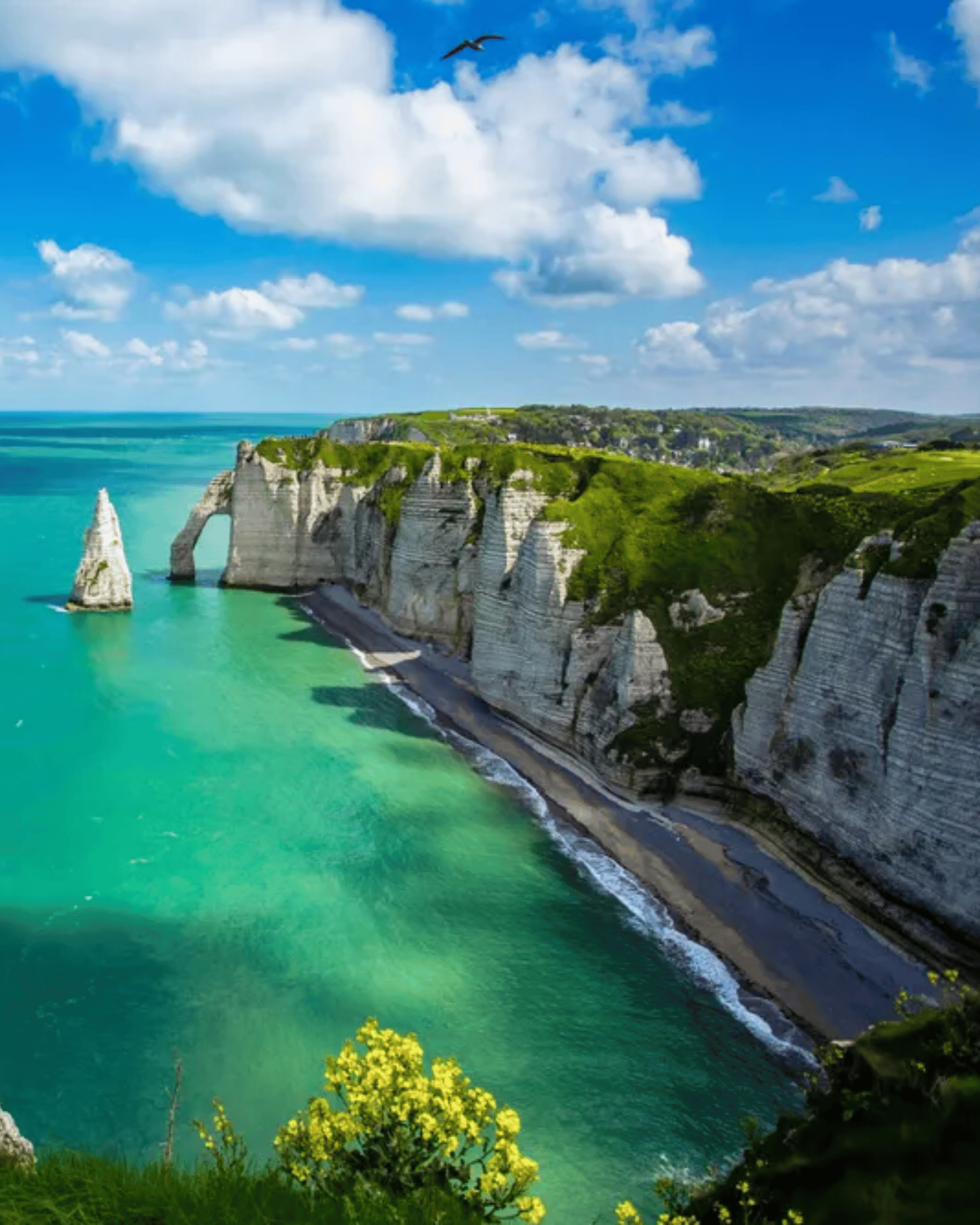
Some places get painted once and filed away. Étretat was never that kind of place for Claude Monet. Between the 1860s and the 1880s, he returned to this stretch of the Normandy coast again and again, producing around 50 paintings of the same white chalk cliffs. Not because he could not think of anything else to paint — this was a man who had all of France at his disposal — but because the cliffs kept changing.
That is the strange quality of Étretat. The rock does not move. The arches are always there. But the light on chalk behaves differently depending on when you show up. At midday in summer, the cliffs are close to white. On a grey winter morning, they shift towards gold or pewter. The sea underneath changes too — sometimes turquoise, sometimes steel. Monet understood this, and it kept pulling him back.
This article looks at what made Étretat so significant to Monet, what the cliffs actually are, and how to visit the place yourself.
Monet and Étretat — A Long Relationship
Monet first visited Étretat in 1868, though the visits that produced the bulk of his cliff paintings came in the 1880s. He stayed for extended periods — weeks at a time — working through different light conditions and weather. He wrote to his partner Alice Hoschedé about the difficulties and the rewards: the cold, the wind, the way the water and stone kept shifting in front of him.
By 1883 he was making serious, sustained work at Étretat. He returned in 1884, 1885, and 1886. The paintings from those years cover the three main cliff formations from multiple angles, in different seasons and at different times of day. This approach — painting the same subject repeatedly to capture its variation — would later define his Haystacks series and his Rouen Cathedral series. Étretat was an early version of that method.
The writer Guy de Maupassant, who also spent time at Étretat in those years, described watching Monet work. He wrote that Monet would grab canvases in sequence as the light changed, switching between them as conditions shifted. The cliffs were the subject, but time was the real variable.
What is striking, looking at the paintings together, is how far apart they feel despite showing the same rock face. Some are bright and sharp. Others are close to monochrome. Several look almost unfinished — thin marks on pale canvas — and those tend to be the winter ones, where the light was too flat to push the colour. Monet considered those failures, usually. But they are often the most honest records of what the coast actually looks like in December.
Get more like this in your inbox.
The In Love With France newsletter goes out each week with travel ideas, hidden corners, and stories from across the country. Subscribe free here.
The Chalk Cliffs — What You Are Actually Looking At
The cliffs at Étretat are made of chalk — the same chalk that runs under much of southern England and surfaces at the White Cliffs of Dover. The material is soft, porous, and bright. It has been shaped over millions of years by the sea, which has cut three natural arches into the rock face.
The main arch visible from the town beach is the Porte d’Aval, which opens onto the sea on the western side. Beyond it stands the Aiguille — a 70-metre chalk needle that rises straight out of the water. To the east is the smaller Porte d’Amont, also accessible on foot. Further west, a longer walk from the town, is the Porte de Manneporte, the largest of the three arches.
Monet painted all three, but the Porte d’Aval and the Aiguille appear most frequently in his work. They are the most dramatic from both the beach and the clifftops above.
The chalk is what makes the light so variable. Hard granite or limestone reflects light in a relatively uniform way. Chalk is different — it absorbs and scatters light depending on angle and moisture. That is why the same cliff face looks pale and clean at noon, and then shifts towards amber or grey as the sun lowers. Rain and cloud push the tones cooler. Winter mist flattens the colour entirely. Monet was not imagining these changes. He was documenting them, one canvas at a time.
The cliffs also erode. The Normandy coastline has been retreating for centuries as the sea undercuts the base. Old photographs show slight differences in the arch profiles compared to today. Monet’s paintings are, among other things, a record of what the cliffs looked like in the 1880s — which was already slightly different from what earlier artists had recorded, and is different again from what you will see if you stand on that beach this afternoon.
Visiting Étretat Today
Étretat is a small coastal town in the Seine-Maritime department of Upper Normandy. The population is under 2,000 people, but it receives a large number of visitors, particularly in summer. The town sits at the base of a valley between two cliff headlands, with a shingle beach running along its front.
The main beach gives a direct view of the Porte d’Aval and the Aiguille. You can walk up to the clifftops from both ends of the beach — the path on the western side takes you to the top of the Falaise d’Aval, where you look down onto the arch from above. This is the angle that appears in many of Monet’s paintings. The path is well-maintained but the clifftop edge has no barriers. Take care, especially in wet or windy conditions.
On the eastern side, a shorter climb leads to the Falaise d’Amont and a small chapel — the Chapelle Notre-Dame de la Garde — which has served as a memorial to lost fishermen and aviators. The view from here looks back over the town and west towards the Porte d’Aval. Early morning, when most visitors are still at breakfast, is the best time to walk up here.
France in your inbox, every week.
Travel ideas, places worth knowing, and stories from across the country — all free. Join the newsletter here.
What to Do in Étretat
The town itself is compact. There is a covered market hall in the centre, a handful of restaurants serving local Norman food — cream sauces, apple-based dishes, seafood, Camembert — and a small selection of shops. The covered market, Les Halles, dates from the 19th century.
One recent addition is the Jardins d’Étretat, a contemporary garden laid out on the clifftops above the town. It opened in 2017 and combines landscaping with digital art installations. The position above the cliffs provides clear views over the town and coastline, and the garden has become popular with visitors who want something beyond the beach.
The town also has a connection to French aviation history. Charles Nungesser, a First World War flying ace, set off on his ill-fated transatlantic crossing from Étretat in May 1927. He and his co-pilot François Coli disappeared over the Atlantic and were never found. There is a small museum dedicated to him in the town, and the Chapelle d’Amont on the eastern clifftop displays a mosaic commemorating the flight.
Étretat is also associated with Maurice Leblanc, the author who created Arsène Lupin, the gentleman thief. Leblanc lived in the town and set several Lupin stories in and around the cliffs. His house, the Clos Arsène Lupin, is now open to visitors and runs themed tours based on the stories. If you are travelling with children or with anyone who has read the books, it is worth an hour.
Getting to Étretat
Étretat is around 200 kilometres north-west of Paris by road. The most direct route is to take the A13 motorway towards Rouen, then continue north on the A29 and D925 towards Fécamp, with Étretat a short detour south of that road. The drive takes roughly two and a half hours from central Paris without heavy traffic.
By public transport, the nearest train station is Le Havre, roughly 30 kilometres away. Regular buses run between Le Havre and Étretat, though the service is limited on weekends — check schedules before you travel. A taxi or hire car from Le Havre is the simpler option if you are not driving.
Summer weekends bring significant visitor numbers and parking in Étretat becomes difficult in July and August. The town has car parks on the approach roads, and it is often easier to park there and walk in rather than attempt the town centre. If you are arriving by car on a Saturday in August, expect to spend time finding a space.
The Best Time to Visit
The short answer is: avoid August. The cliffs are the same all year, but the town gets very busy in high summer, and the light in August is often flat and harsh — the kind of mid-afternoon brightness that strips away the tonal variation that makes the cliffs interesting.
September, October, and early November offer a better balance. The summer tourist numbers have dropped, the light is lower and more interesting, and the sea conditions change more dramatically between morning and afternoon. Spring — April and May — is also good, with longer days and more variable weather.
If you want to see the cliffs in the kind of grey, diffuse winter light that appears in several of Monet’s paintings, December and January are worth considering. Étretat is quiet then, most restaurants stay open year-round, and the cliffs look entirely different from their summer selves. Cold, yes. But that is also closer to the conditions in which some of those 50 paintings were made.
Monet kept returning because the place was not finished. Every visit gave him something different. That is still true. The chalk is still shifting colour with the light, and the sea is still moving underneath it, and the arch is still standing. For now.
More France, every week.
The In Love With France newsletter covers the places, stories, and practical detail that make France worth knowing. It is free and arrives every week. Subscribe here.
Thinking about it for retirement?
If you’ve started thinking seriously about retiring there, our complete our full Retire in France guide covers the visa, healthcare, cost-of-living, and the regions worth shortlisting.
Tours & experiences you might love


Powered by Viator. Some links are affiliate links — we may earn a small commission at no extra cost to you.

Leave a Reply