
French Revolution history begins with a kingdom in crisis. In 1789, France was the most powerful country in Europe. It was also broken from the inside.
King Louis XVI ruled from his golden palace at Versailles. Around him, the nobility and the clergy lived in comfort. Outside the palace walls, ordinary French people struggled to buy bread.
Then the people rose up. What followed changed everything.
A Kingdom on the Edge
By 1789, France was nearly bankrupt. Two costly wars had drained the treasury — including the American Revolutionary War, which France had helped fund.
The tax system was deeply unfair. French society divided into three groups, called Estates. The First Estate was the clergy. The Second Estate was the nobility. Both groups paid almost no tax.
The Third Estate was everyone else — peasants, workers, traders, and the growing middle class. They paid nearly all the taxes. They had almost no political power.
Food prices rose sharply in 1788 and 1789. A bad harvest left millions hungry. In Paris, a loaf of bread cost more than a day’s wages for a worker.
The anger had been building for decades. Writers like Voltaire and Rousseau questioned the right of kings to rule without the people’s consent. Their ideas spread through pamphlets, cafés, and salons.
When Louis XVI called the Estates-General to discuss the financial crisis in May 1789, it was the first such meeting in 175 years. The Third Estate arrived ready to be heard. They demanded change. The king resisted. That resistance lit the fuse.
The Day the Bastille Fell
On 14 July 1789, a crowd of Parisians marched to the Bastille — a medieval fortress in the east of the city. The Bastille served as a royal prison and a symbol of absolute royal power.
The crowd stormed the fortress. The garrison surrendered after hours of fighting. The governor, the Marquis de Launay, died in the chaos. The seven prisoners inside walked free.
The Bastille fell in a single afternoon.
News spread across France within days. In cities and villages alike, local authorities lost control. Nobles fled their estates. The old order was crumbling.
Louis XVI accepted a new tricolour cockade — red and blue for Paris, white for the Bourbon dynasty. Those three colours still fly on the French flag today.
The date — 14 July — became France’s national day. The French call it Quatorze Juillet. You may know it as Bastille Day.
You can stand on the exact spot today. The Place de la Bastille now holds the July Column — built to mark a later revolution in 1830. Nothing remains of the fortress itself. Hawkers sold the stones as souvenirs after it fell.
The Rights of Man — A New Idea for Humanity
Six weeks after the Bastille fell, the National Assembly passed one of the most important documents in human history.
The Declaration of the Rights of Man and of the Citizen stated that all men were born free and equal in rights. It declared liberty, property, security, and resistance to oppression as fundamental rights.
It drew directly on the ideas of the Enlightenment — and on the American Declaration of Independence of 1776.
The ideas were radical. In a world of kings, nobles, and hereditary privilege, the Declaration said something bold: governments exist to serve the people, not the other way around.
The document did not yet include women. Olympe de Gouges published her Declaration of the Rights of Woman in 1791 in response. The authorities executed her two years later.
But the core idea — that citizens hold rights by birth, not by royal grant — changed political thought forever. Every time you hear the words “human rights”, the French Revolution echoes.
🇫🇷 Enjoying this? 7,000 France lovers get stories like this every week.
Thinking about it seriously? If you’ve started actually planning a move, our complete our complete Moving to France guide walks through every step, every cost, and the paperwork that catches most people out.
The Terror — When Revolution Turned on Itself
The Revolution did not stop with the Declaration. It grew more radical, more violent.
Louis XVI tried to flee France in June 1791. Guards caught him at Varennes and brought him back to Paris. His credibility collapsed.
War broke out with Austria and Prussia in 1792. Foreign armies threatened Paris. Inside France, counter-revolutionary uprisings erupted in regions like the Vendée and Lyon.
The radical Jacobin faction seized power. In September 1792, they abolished the monarchy. France became a republic.
Louis XVI stood trial in December 1792. The Convention found him guilty of treason. He died by the guillotine on 21 January 1793 at the Place de la Révolution — today’s Place de la Concorde. Marie Antoinette followed him nine months later.
Then came the Reign of Terror.
Maximilien Robespierre and the Committee of Public Safety ruled France with iron discipline. They identified enemies of the Revolution — real and imagined. Between September 1793 and July 1794, revolutionary tribunals sentenced around 17,000 people to death. Many more died in prison.
The guillotine worked daily. It claimed aristocrats, priests, foreign agents — and eventually Robespierre himself. In July 1794, his own colleagues turned on him. He died on the same scaffold he had sent others to.
The Terror ended. But France was exhausted and fractured. Napoleon Bonaparte emerged from the chaos. A brilliant military commander, he seized power in a coup in 1799. You can read the full story in our article on Napoleon’s France.
What the Revolution Left Behind
The French Revolution ended the old world. It did not create a perfect one. But it planted ideas that grew across centuries.
Liberty, Equality, Fraternity — Liberté, Égalité, Fraternité — became France’s national motto. These words came from the Revolution’s spirit, even if no single document coined them.
The Revolution abolished feudalism across France. It ended serfdom. It gave Europe a new legal model — the Napoleonic Code — that still forms the basis of civil law in dozens of countries today.
It separated church and state. France became a secular republic, a principle still central to French identity today.
The Revolution inspired uprisings far beyond France. The Haitian Revolution (1791–1804) drew directly on the Declaration of the Rights of Man. So did the Latin American independence movements of the early 19th century.
The right to vote. Free speech. Equality before the law. These seem obvious now. In 1789, they were dangerous new thoughts.
Where to Walk in Revolutionary France
You can trace the Revolution across Paris and beyond. Each site brings the history alive in a different way.
The Conciergerie on the Île de la Cité served as the prison where Marie Antoinette spent her last weeks before her execution. Her cell is open to visitors today. The building dates back to the medieval royal palace — layers of history compressed into one haunting place.
Place de la Concorde is where the guillotine stood during the Terror. Today, fountains and an Egyptian obelisk fill the square. Stand here at dusk and look toward the Tuileries — it is one of the most atmospheric views in Paris.
The Panthéon in the Latin Quarter holds the remains of figures central to the Revolution’s ideas — Voltaire, Rousseau, and other thinkers who challenged royal power. We discuss the Panthéon further in our article on French surnames of Île-de-France.
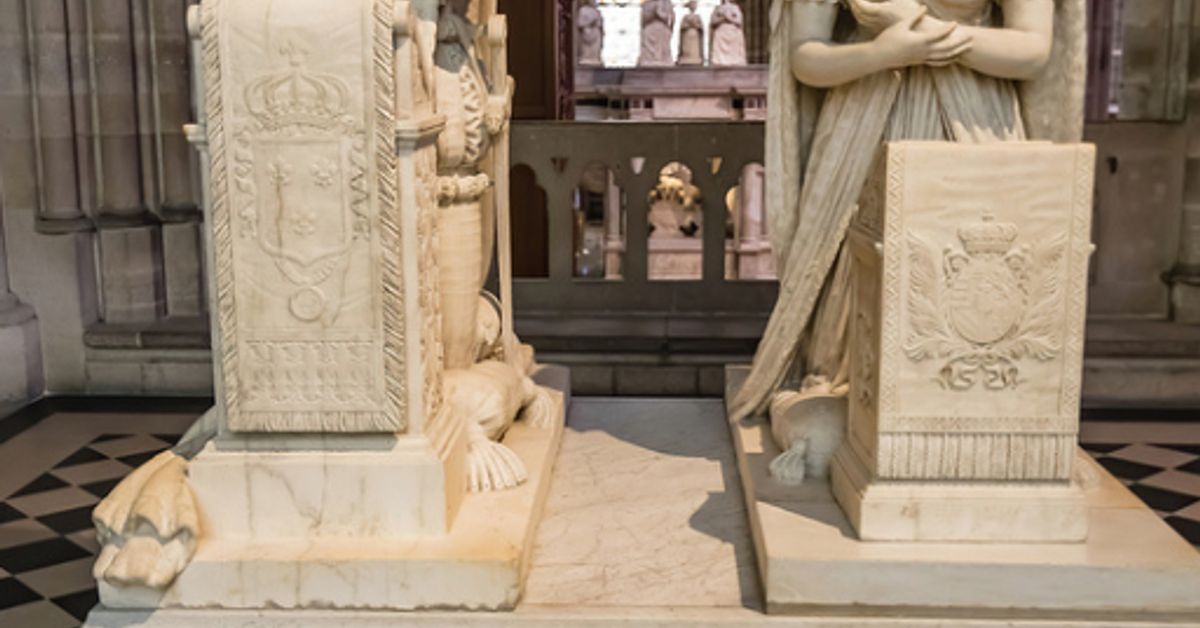
The Basilica of Saint-Denis, just north of Paris, is the burial church of French royalty. The kneeling effigies of Louis XVI and Marie Antoinette rest here — exquisite marble figures in a Gothic cathedral, exactly as shown in the image above. Standing before them is a quiet, strange moment. These were the last two people to hold absolute power over France.
The Palace of Versailles shows you what the Revolution was reacting to. The Hall of Mirrors. The royal apartments. The sheer scale of excess. It is extraordinary — and instructive. The people who built it did not imagine that one day the people would storm the gates.
France’s revolutionary history connects to its wider story. The Normans who built France’s medieval power are explored in our piece on how one duchy changed three continents. The story of French Protestant persecution — another chapter of freedom denied — is told in our article on the Huguenots and their global legacy.
For help planning your trip to these sites, visit our complete guide to planning your trip to France.
Frequently Asked Questions about the French Revolution
What caused the French Revolution?
A combination of financial crisis, food shortages, and deep social inequality triggered the Revolution. The tax burden fell almost entirely on the poor, while the clergy and nobility paid almost nothing. Years of bad harvests and rising bread prices pushed millions to breaking point.
When did the French Revolution start and end?
The Revolution began on 14 July 1789 with the storming of the Bastille. Most historians date its end to Napoleon Bonaparte’s coup on 9 November 1799 — though the ideas it unleashed shaped politics well into the 19th century and beyond.
Why did the French Revolution lead to the Reign of Terror?
War with Austria and Prussia, counter-revolutionary uprisings inside France, and fears of foreign invasion pushed France’s Jacobin leaders toward extreme measures. Robespierre and the Committee of Public Safety believed ruthless action was needed to save the Republic. The result was mass executions — before Robespierre himself met the same fate in July 1794.
How did the French Revolution influence the modern world?
The Revolution’s ideals of liberty, equality, human rights, secular government, and democracy spread across Europe and Latin America. Its legal legacy — the Napoleonic Code — still forms the basis of civil law in dozens of countries. It fundamentally changed how people thought about government, power, and the rights of every individual.
Can you visit sites from the French Revolution today?
Yes — Paris has several key sites. The Conciergerie holds Marie Antoinette’s cell. The Place de la Concorde marks where the guillotine stood. The Panthéon contains the graves of Enlightenment thinkers. The Basilica of Saint-Denis holds the royal tombs of Louis XVI and Marie Antoinette. The Palace of Versailles shows the royal world the Revolution swept away.
You Might Also Enjoy
- Joan of Arc: Why France’s National Hero Still Matters — the story of France’s greatest medieval hero and the war she helped end.
- Napoleon’s France: The Man Who Remade Europe — how the Revolution’s most famous son conquered a continent.
- The Huguenots: France’s Great Exodus and Its Global Legacy — another chapter of French history that echoed around the world.
Plan Your France Trip
Ready to walk the streets where history was made? Our complete guide to planning your trip to France covers everything from the best time to visit Paris to where to stay near the key historical sites.
Join 7,000+ France Lovers
Every week, get France’s hidden gems, seasonal guides, local stories, and the art of la vie française — straight to your inbox.
Subscribe free — enter your email:
Love more? Join 64,000 Ireland lovers → · Join 43,000 Scotland lovers → · Join 30,000 Italy lovers →
Free forever · One email per week · Unsubscribe anytime
Tours & experiences you might love


Powered by Viator. Some links are affiliate links — we may earn a small commission at no extra cost to you.

Leave a Reply