
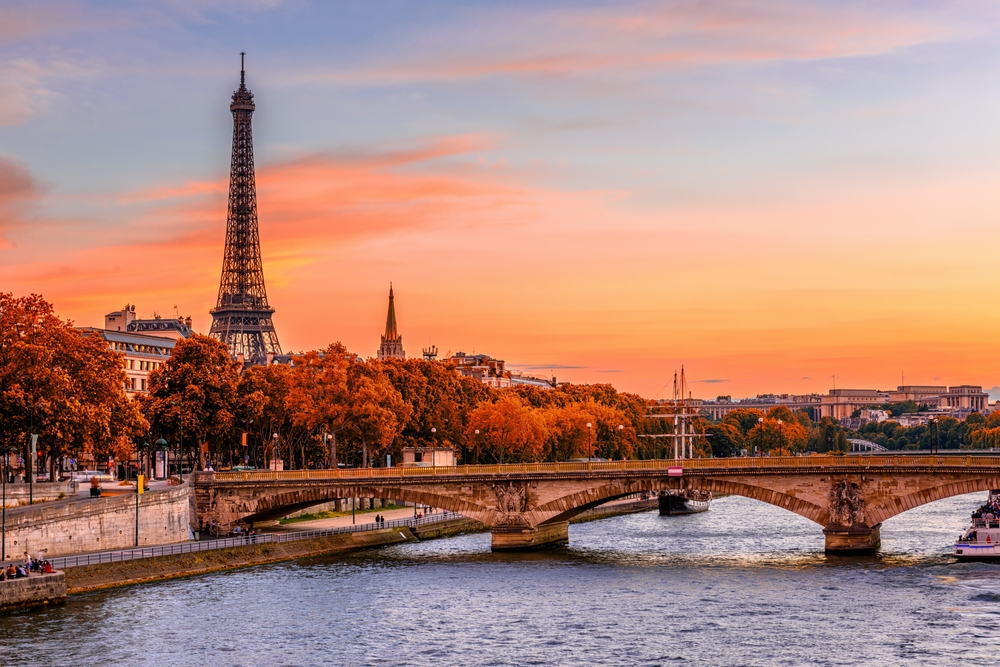
There is a particular quality to the light in Paris around 8 or 9 o’clock on a summer evening that takes most visitors completely by surprise.
You have seen the photographs. You have probably saved a few to your phone. And then you walk down to the Seine on a July evening, and the Eiffel Tower is right there in front of you — bigger than you imagined — and the sky is doing something that your camera will try and fail to replicate.
This is golden hour in Paris. It lasts roughly 45 minutes to an hour, and if you time it right, it may well be the single best thing you do on your trip.
If you love France and want more guides like this, subscribe to our free newsletter — we cover Paris and beyond every week.
Why Golden Hour Looks Different in Paris
The term golden hour refers to the period shortly before sunset when sunlight travels through more of the Earth’s atmosphere. The result is a warm, diffused light — less harsh than midday sun, with longer shadows and a reddish-orange hue that makes stone and water glow.
Paris is particularly well set up for this. The city’s building heights are tightly regulated, which means the skyline stays low and open. The wide boulevards channel light in from the west. And the Seine — which cuts a broad curve through the centre of the city — catches and reflects the evening sky like a mirror.
The Eiffel Tower is made from puddle iron, which takes on a warm bronze tone in low light. In full midday sun it looks grey and industrial. At golden hour it looks like something from a painting — and the gap between expectation and reality closes very quickly once you are standing on the riverbank watching it happen.
When Golden Hour Happens in Paris
The timing shifts throughout the year, so it is worth checking before you go. In June and July, sunset in Paris falls between 9:45pm and 10pm. That means golden hour begins roughly around 8:30pm to 9pm — late enough that you can eat dinner first and still make it to the river in time.
In August, sunset pulls back slightly, arriving around 9pm by the end of the month. September brings it earlier still, to around 8pm, but the light is often richer and the tourist crowds have thinned considerably. Many regular visitors rate September as the best month for this reason alone.
If you are visiting in spring, April and May give you golden hour around 8pm and 8:45pm respectively. These are good months — the light is warm, the trees along the Seine are in blossom, and the viewpoints are not yet at peak-summer crowding.
Winter golden hour in Paris is a different experience. Sunset can arrive before 5pm in December, which makes logistics more difficult. But the low angle of winter light can produce some of the most dramatic skies of the year, particularly over the bridges of the Seine. If you are visiting in January or February, it is still worth planning for it.
The Best Spots to Watch It
There is no single best spot — it depends on what you want to look at and how you want to feel.
The Trocadéro
The Trocadéro gardens sit on a hill directly across the Seine from the Eiffel Tower, giving you an elevated, head-on view. This is the most photographed angle in the city, and for good reason — on a clear evening, the light turns the tower to gold and the sky behind it into deep orange and pink.
It is also the busiest spot. If you want this view without fighting through a crowd of other cameras, arrive by 7:30pm in summer.
Pont de Bir-Hakeim
This double-decker bridge, made famous by the film Inception, offers a long diagonal view down the Seine with the Eiffel Tower rising at the end. It is less busy than the Trocadéro and gives a more unusual composition. Stand on the lower walkway for the most dramatic angle.
Quai Branly
Walking along the Quai Branly on the south bank of the Seine puts you at river level, directly alongside the Tower. The view is more intimate here than the formal angles from the Trocadéro. You can walk, sit on the grass, or find a spot on the low wall above the water. This is where many Parisians gather in the evenings during summer — locals rather than tourists, often with wine and something to eat.
Pont Alexandre III
Further east, the Pont Alexandre III is arguably the most ornate bridge in Paris. Its gilded lamp posts and stone carvings are lit beautifully in evening light, and from its centre you get a long view back towards the Eiffel Tower with the river running through the middle. It is one of the better spots for watching the sky change colour in the 20 minutes after the sun has dropped below the horizon.
How to Get There
The nearest Métro stations to the Eiffel Tower are Bir-Hakeim (Line 6) and Trocadéro (Lines 6 and 9). Both are a short walk from the river. The RER C also stops at Champ de Mars–Tour Eiffel, which puts you directly on the south bank.
If you are coming from the Marais or the Latin Quarter, allow around 30 to 40 minutes on the Métro. From Saint-Germain-des-Prés it is roughly a 20-minute walk along the river, which is worth doing if the evening is warm.
Avoid the area directly under the Tower if your goal is to watch the light. The space beneath it is crowded and gives you no useful distance for perspective. Walk at least 500 metres away — the Trocadéro side or along the Quai Branly — to get the view that works.
What to Bring
A jacket, even in summer. The temperature along the Seine drops noticeably once the sun is down, and the open riverside is exposed to wind. A picnic blanket or portable seat is useful if you plan to stay for an hour or two — there are grassed areas on the Champ de Mars that fill up with people doing exactly this on warm evenings.
If you want to take photographs, get to your spot early and take test shots before the peak light arrives. The light changes quickly — sometimes within 10 minutes the colour shifts from pale amber to deep orange. A tripod is useful for after sunset when light levels drop further and exposure times get longer.
The Eiffel Tower Light Show
Separately from golden hour, the Eiffel Tower has its own light show. Every evening after dark, the tower’s 20,000 light bulbs flash for five minutes at the top of each hour. It runs from nightfall until 1am, and it is worth staying for — particularly from the Trocadéro.
This is not the same as golden hour. Golden hour is entirely natural and depends on clear or partly cloudy skies. The light show happens regardless of weather conditions. Both are worth seeing; they are simply different experiences.
How Reliable Are Clear Skies?
Paris has roughly 2,000 hours of sunshine per year, putting it broadly in line with cities in southern England and northern Spain. Clear skies in summer are not guaranteed — June in particular can be mixed, with overcast evenings breaking into clear ones and vice versa.
July and August are more reliably sunny. For the best chance of a dramatic golden hour, aim for evenings following a day with some cloud movement rather than a completely blank sky. High-altitude cloud often throws more vivid colour in the final 30 minutes before dark than a perfectly clear day does.
If you get to the river and the sky is grey, it is still worth staying. On overcast evenings the light is diffused and even, which softens the contrast and produces its own quiet atmosphere — just not the dramatic orange-and-gold version you might have hoped for.
Making It Part of Your Evening
The 7th arrondissement, which runs along the south bank near the Eiffel Tower, has a good range of restaurants and cafés. A meal around 6:30pm puts you in a position to walk down to the river by 8pm and arrive comfortably before the light begins to change.
Rue Cler, about 10 minutes’ walk from the Quai Branly, is a pedestrianised market street with several good options for an early dinner. It is a working neighbourhood street rather than a tourist strip, and prices are more reasonable than you might expect this close to the Tower.
Coming from the Trocadéro side, the cafés on Place du Trocadéro itself are convenient but tend to be pricier. The streets just behind — particularly Rue Benjamin Franklin and Rue de Longchamp — offer better value and shorter queues.
For more practical guides to Paris and the rest of France, join our free weekly newsletter. We cover places to visit, things to see, and the kind of details that make a trip feel less like a checklist.
What No Photograph Can Show You
The version of Paris many people carry in their heads — the one built from films and travel guides — is based largely on images taken around golden hour or just after. The light really does look like that. It is not heavily edited and it is not a filter.
What photographs cannot convey is the scale, or the simple fact that you can walk to the riverbank on an ordinary Thursday evening and find this waiting for you. No tickets. No reservation. Just a 15-minute Métro ride and an evening that tends to exceed expectations.
The Eiffel Tower is one of those rare landmarks that actually lives up to what you imagined — and on a summer evening around 9pm, with the sky turning amber and the river reflecting it back at you, it exceeds it.
Planning a trip to Paris or France? Subscribe to our free newsletter for practical guides, local tips, and the best of France delivered to your inbox every week.
Thinking about it seriously?
If you’ve started actually planning a move, our complete our complete Moving to France guide walks through every step, every cost, and the paperwork that catches most people out.
Tours & experiences you might love


Powered by Viator. Some links are affiliate links — we may earn a small commission at no extra cost to you.

Leave a Reply