
The French Riviera is one of those places that lives up to every expectation — and then quietly surpasses them. From the pastel-washed lanes of Vieux Nice to the jaw-dropping clifftop villages of Èze and Saint-Paul-de-Vence, choosing where to stay along this coast shapes the entire feel of your trip. The good news is that whether you are working with a careful budget or ready to splash out, every corner of the Côte d’Azur offers something worth waking up to.
This guide walks through the best areas to stay in Nice and along the wider Riviera, covering what to expect at each price point, who each area suits best, and how easy it is to reach the beach and get around. If you are in the early stages of planning, our France Planning Hub is a good place to start.
Love France? Join 7,000+ readers
Our free weekly newsletter delivers the best of France straight to your inbox — hidden villages, practical travel tips, food worth crossing the country for, and stories that make you fall in love with France all over again. Subscribe here — it is completely free.
Nice: Where Most Visitors Begin
Nice is the natural base for exploring the Riviera. It has its own international airport, excellent rail connections, and enough character to hold your attention for days. The city divides neatly into distinct neighbourhoods, each with a different personality when it comes to hotels.
Vieux Nice (Old Town)
🇫🇷 Discover the France Most Tourists Never Find
Get our free guide to 25 hidden villages of France — then join 7,000+ readers for weekly stories about places most guidebooks never mention.
Get Your Free Village Guide →The old town is the beating heart of Nice — a tight web of ochre and terracotta buildings, bustling market squares, and restaurants spilling onto narrow lanes. Staying here puts you inside the atmosphere rather than observing it from a distance.
Budget (€60–€100/night): You will find small, family-run guesthouses and renovated townhouse hotels tucked into the backstreets. Rooms tend to be compact — this is old Nice, after all — but they are full of character. Expect tiled floors, shuttered windows, and the sound of the Cours Saleya flower market drifting in each morning. Perfect for solo travellers and couples who plan to be out exploring most of the day.
Mid-range (€120–€220/night): Step up and you will get air conditioning that actually works, renovated bathrooms, and often a small balcony overlooking a courtyard or lane. Some mid-range hotels in Vieux Nice occupy beautifully restored 18th-century buildings — look for ones with rooftop terraces. Best for couples and friends travelling together who want atmosphere without roughing it.
Luxury (€300+/night): A handful of boutique luxury hotels have appeared in Vieux Nice in recent years, blending exposed stone walls with designer furnishings. Think rainfall showers, curated minibars, and concierge services that can get you into restaurants others cannot. The beach is a five-minute walk, and the opera house is practically next door.
Beach access: The Ponchettes beach (public) is immediately south of the old town — a two-minute walk from most hotels. Transport: The tram runs along the northern edge of Vieux Nice, connecting you to the train station and the rest of the city.
Promenade des Anglais
This is the iconic stretch — the sweeping seafront boulevard lined with grand Belle Époque hotels and palm trees. If your image of the Riviera involves gazing at the Mediterranean from a balcony, this is where to stay.
Budget (€70–€110/night): Budget options along the Promenade itself are rare, but step one or two streets back and you will find functional, clean hotels with surprisingly good value. They will not have sea views, but the beach is still barely a minute away. Good for families who want easy beach access without the premium.
Mid-range (€150–€280/night): This is the sweet spot on the Promenade. Many hotels offer sea-facing rooms with private balconies, swimming pools, and breakfast terraces overlooking the bay. The classic Riviera experience without the four-figure price tag. Ideal for couples on a special occasion or anyone who wants to feel like they are properly on holiday from the moment they wake up.
Luxury (€400–€800+/night): The Promenade is home to some of the most famous hotel addresses on the Riviera. Expect palatial lobbies, private beach clubs, Michelin-quality dining, and the kind of service where staff remember your name before you have finished checking in. Best for honeymoons, anniversaries, and anyone who considers a hotel part of the destination.
Beach access: Immediate — you are right on it. Both public and private (paid) beach sections run the full length. Transport: The Promenade is well served by buses, and the tram is a short walk inland. Nice Ville station is about 15 minutes on foot.
Nice Port (Port Lympia)
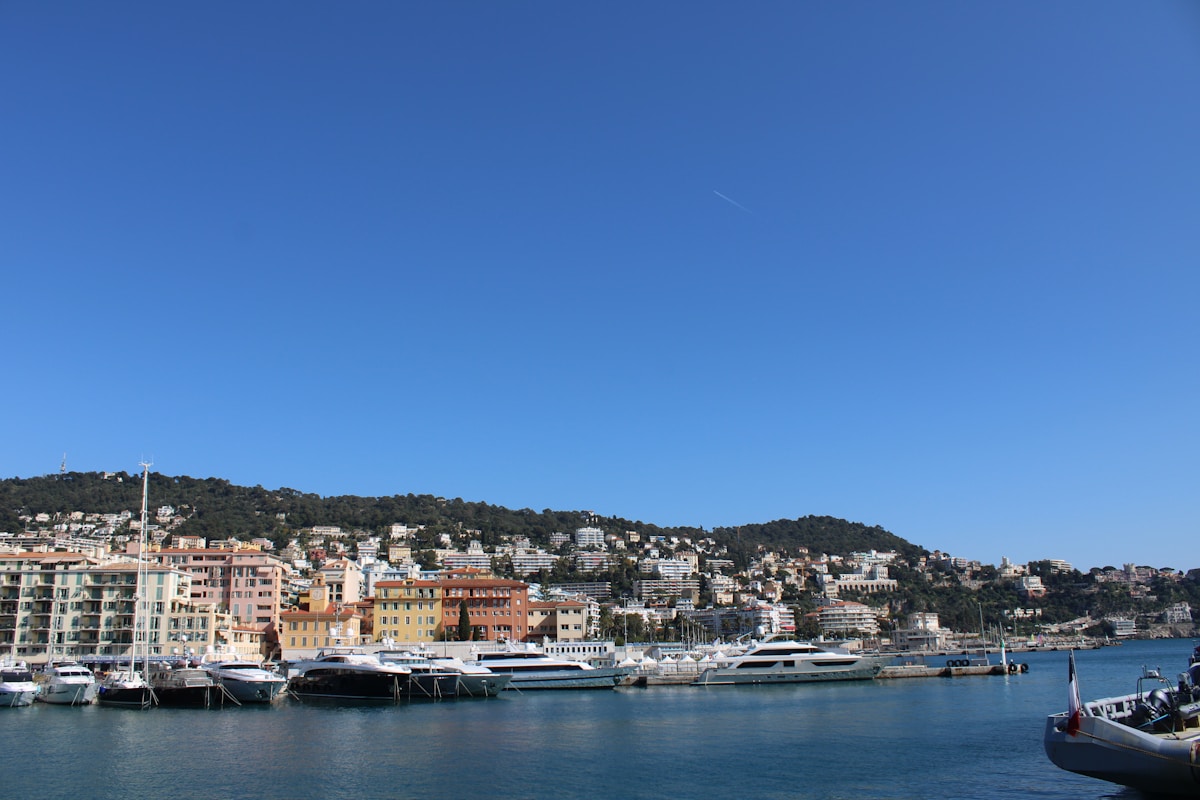
The port area sits east of the old town, beneath Castle Hill. It is quieter, more residential, and increasingly popular with visitors who want a more local feel. The antiques market on Saturdays and the portside restaurants serving the freshest catch make this a neighbourhood with real personality.
Budget (€55–€95/night): This is one of the best value areas in Nice. Small hotels and apart-hotels here offer more space for less money than the old town. You will find kitchenettes at this price point — a genuine advantage for longer stays or families. Grocery shops and bakeries are everywhere.
Mid-range (€110–€200/night): Look for boutique hotels with port views. Several converted warehouses and maritime buildings now house stylish hotels with a nautical edge — think polished wood, navy accents, and terraces overlooking the colourful fishing boats. Excellent for couples and solo travellers who prefer quiet evenings.
Luxury (€250–€450/night): Fewer luxury options than the Promenade, but the ones here tend to be more intimate and design-led. Some offer rooftop pools with views across the port to Castle Hill. A lovely choice for anyone who values calm over spectacle.
Beach access: The small Plage de la Reserve is a 10-minute walk east, or head west past Castle Hill to the main beaches. Transport: Ferries to Corsica depart from here, and the tram stop at Port Lympia connects to the city centre and train station.
Beyond Nice: The Wider Riviera
Nice makes a superb base, but some of the most memorable stays on the Riviera are found in the smaller towns scattered along the coast and up into the hills. Each has its own rhythm and appeal. If you are considering a broader route, our 7-day France road trip itinerary covers some of this ground beautifully.
Villefranche-sur-Mer
Just 10 minutes by train from Nice, Villefranche-sur-Mer has one of the best natural harbours on the coast and a sandy beach that is genuinely swimmable (unlike Nice’s famous pebbles). The town tumbles down a steep hillside in layers of pastel-painted houses.
Budget (€70–€110/night): Charming family pensions and small hotels line the streets above the harbour. Rooms are simple but the setting is extraordinary. Perfect for travellers who want a village pace with city access.
Mid-range (€140–€250/night): Several hotels with sea-view terraces and pools perch on the hillside. Breakfast with a view of the bay is standard at this level. Wonderful for couples.
Luxury (€350–€600/night): A few exceptional properties sit right on the waterfront or high above it. Expect private beach access, gardens cascading down the hillside, and that rare feeling of utter seclusion just minutes from a major city.
Best for: Couples, families with young children (the calm bay is ideal), anyone who wants beauty without bustle. Transport: Trains to Nice run every 10–15 minutes. No car needed.
Èze
Èze is a medieval village perched 400 metres above the sea on a rocky pinnacle. It is staggeringly beautiful, deeply atmospheric, and not the easiest place to reach — which is precisely the point. Staying overnight means having the stone lanes and panoramic views to yourself once the day-trippers leave.
Budget (€80–€120/night): Options are limited in Èze village itself, but the lower section (Èze-bord-de-Mer, by the coast) has more affordable guesthouses. From there, you can walk the Nietzsche Path up to the hilltop village — a steep but spectacular trail.
Mid-range (€160–€280/night): Small stone-walled hotels and chambres d’hôtes within the medieval village. Rooms tend to be atmospheric — vaulted ceilings, thick walls, wrought-iron details. Balconies often look out over the entire coastline.
Luxury (€400–€1,200/night): Èze is home to some of the most celebrated luxury hotels on the Riviera, carved into the rock itself. Infinity pools overlooking Cap Ferrat, Michelin-starred restaurants, and suites that feel like they belong in a film. Worth it for a once-in-a-lifetime stay.
Best for: Couples seeking romance, photographers, anyone who wants to feel like they have discovered somewhere secret. Beach access: The Nietzsche Path connects to the coast (about 45 minutes down). Transport: Bus 82 from Nice (30 minutes), or drive. Having a car helps here.
Love France? So do we.
We write about France every week — the places most guides skip, the food worth planning a trip around, and the kind of practical advice that actually saves you time and money. Join our free newsletter and get it all delivered to your inbox.
Antibes and Juan-les-Pins
Antibes is one of the Riviera’s most complete towns — a walled old town with a Picasso museum, a covered market that rivals anything in Provence, a vast yacht harbour, and sandy beaches stretching south toward Juan-les-Pins. It is less showy than Cannes and more lived-in than many coastal towns.
Budget (€60–€100/night): Antibes old town has a good selection of small hotels and studios. Juan-les-Pins, slightly south, offers beachside hotels that are surprisingly affordable outside July and August. Great for younger travellers and families.
Mid-range (€130–€240/night): Hotels near the ramparts or overlooking Plage de la Gravette offer the best of both worlds — old-town character and immediate beach access. Many include courtyards with lemon trees and breakfast under canvas awnings. Suits just about everyone.
Luxury (€350–€700/night): Cap d’Antibes, the wooded peninsula between Antibes and Juan-les-Pins, is home to some of the most exclusive hotels on the entire coast. Think private coves, gardens thick with pine and jasmine, and the kind of understated elegance that old money prefers. Best for special occasions and those who value privacy.
Beach access: Sandy beaches at Plage de la Gravette (old town) and all along Juan-les-Pins. Cap d’Antibes has rocky coves. Transport: Trains to Nice (25 min) and Cannes (10 min) run frequently. Very walkable town centre. For getting around the wider region, see our guide to transport in France.
Cannes
Cannes is glamour distilled — the Croisette, the film festival, the superyachts. But look past the red carpets and you will find a proper working town with excellent markets, a charming old quarter (Le Suquet), and some of the best sandy beaches on the Riviera.
Budget (€65–€110/night): Head to the streets behind the train station or the Rue d’Antibes area. Hotels here are functional and well-located, if not especially atmospheric. Cannes’ compact size means you are never more than 10 minutes from the beach on foot. Good for solo travellers and those using Cannes as a transport hub.
Mid-range (€150–€300/night): This is where Cannes starts to shine. Hotels near the old port or in Le Suquet combine character with convenience. Some offer rooftop terraces with views across the bay to the Îles de Lérins. Excellent for couples who enjoy dining out — Cannes has superb restaurants at every level.
Luxury (€500–€2,000+/night): The Boulevard de la Croisette is lined with the kind of hotels that appear in films about the Riviera — marble lobbies, private beaches with white-gloved attendants, suites larger than most flats. During the film festival (May), prices double and availability vanishes. Book months ahead.
Best for: Anyone who enjoys people-watching, shopping, and dining. Families will love the sandy beaches. Transport: Excellent rail connections — Nice (30 min), Antibes (10 min), Marseille (2 hours). The Îles de Lérins are a 15-minute ferry ride.
Saint-Paul-de-Vence
This medieval hilltop village, set back from the coast among olive groves and cypress trees, has been drawing artists and writers for a century. Chagall, Matisse, and Baldwin all spent time here. It is small — you can walk the entire village in 20 minutes — but the galleries, stone lanes, and views over the Pre-Alps make it feel like another world entirely.
Budget (€75–€120/night): Chambres d’hôtes (B&Bs) in the surrounding countryside offer stone farmhouse rooms with gardens and pools. You will need a car, but the peace and the views are worth it. Ideal for couples or solo travellers seeking creative inspiration.
Mid-range (€150–€280/night): Several beautifully converted properties sit just outside the village walls, offering terraces shaded by wisteria, swimming pools overlooking the valley, and breakfast with local honey and fresh bread. A real step away from the coastal bustle.
Luxury (€400–€900/night): Saint-Paul-de-Vence is home to at least one of the most famous hotels in all of France — the kind of place where the guest book reads like a who’s-who of 20th-century art and literature. Gardens filled with sculpture, Michelin-starred dining, and suites furnished with original artworks. For a truly memorable stay.
Best for: Art lovers, couples, anyone who wants to slow down. No beach access — this is a hill village. Transport: Bus 400 from Nice (45 minutes) or a 25-minute drive. A car gives you the most flexibility for exploring the surrounding villages.
Practical Tips for Booking on the Riviera
When to book: For July and August, book at least three to four months ahead — the Riviera fills up fast. The best value (and often the best weather) is in May, June, and September. October can be lovely too, though some smaller hotels close for the season.
What to budget: As a rough guide, expect to spend €80–€150 per night for a comfortable mid-range double room outside peak season, rising to €150–€300+ in July and August. For a fuller picture of trip costs, see our guide to how much a trip to France costs.
Car or no car? For Nice, Villefranche, Antibes, and Cannes, you do not need a car — trains and buses are excellent. For Èze village, Saint-Paul-de-Vence, and exploring the back roads of Provence (see our 5-day Provence guide), a car is a significant advantage.
Apartment vs hotel: Self-catering apartments are widely available and often better value for families or stays of four nights or more. Markets are so good on the Riviera that cooking in feels like a treat rather than a compromise.
Tax: French hotels charge a small tourist tax (taxe de séjour) on top of the room rate — typically €1–€5 per person per night depending on the hotel’s star rating. It is rarely included in the quoted price.
Our Pick: How to Structure a Riviera Stay
If you have a week, consider splitting your time: three or four nights in Nice (using it as a base for Villefranche and Èze), then two or three nights in Antibes or Cannes with a day trip to Saint-Paul-de-Vence. This gives you the best mix of city energy, coastal beauty, and hilltop charm without constantly moving hotels. Our 7-day France road trip itinerary offers a broader route if you want to combine the Riviera with other regions.
Whatever you choose, the Riviera rewards you for staying a little longer and digging a little deeper. The real magic of this coast is not just the views from your hotel window — it is the morning markets, the cliffside walks, the long dinners that stretch past midnight, and the light that turns everything golden in the hour before sunset.
Plan your France trip with us
Start with our France Planning Hub for everything you need — or subscribe to our free newsletter for weekly inspiration, tips, and hidden gems delivered straight to your inbox. We would love to help you fall in love with France.
Love France? So Do We.
Join our free newsletter and get the best of France — travel tips, hidden villages, food traditions, and cultural stories — straight to your inbox every week.
Free. No spam. Unsubscribe anytime.
📥 Free Download: France Travel Planning Guide
Itineraries, insider tips, and the places you must not miss on your next trip to France.
🇫🇷 You Might Also Love
Tours & experiences you might love


Powered by Viator. Some links are affiliate links — we may earn a small commission at no extra cost to you.

Leave a Reply