
The Louvre sits on the Right Bank of the Seine in central Paris, and it is the most visited art museum in the world. Every year, millions of people from every corner of the globe walk through its doors to see some of the most famous works of art ever created. Whether you are planning your first trip to Paris or your fifth, the Louvre is worth understanding before you arrive.
This guide covers what’s inside, how to plan your visit, and why so many people leave feeling they’ve only scratched the surface.
🇫🇷 Discover the France Most Tourists Never Find
Get our free guide to 25 hidden villages of France — then join 7,000+ readers for weekly stories about places most guidebooks never mention.
Get Your Free Village Guide →A Palace Turned Museum
The Louvre’s history stretches back more than 800 years. It began as a fortress built by King Philippe II in 1190, designed to protect Paris from invasion. Over the centuries it was transformed into a royal palace, expanded, rebuilt and eventually abandoned by the monarchy when Louis XIV moved his court to Versailles in 1682.
The building became a museum in 1793, during the French Revolution, when the new republican government opened it to the public. At the time it held around 537 works of art. Today, the collection spans more than 380,000 objects, of which roughly 35,000 are on display at any one time.
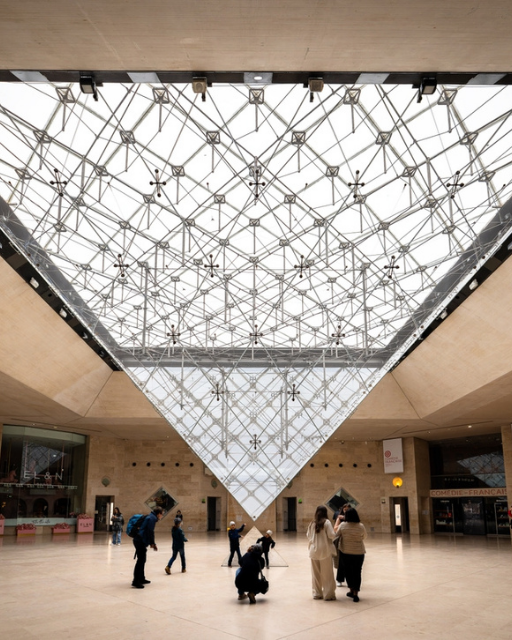
The iconic glass pyramid at the main entrance was added in 1989, designed by architect I.M. Pei. It caused considerable controversy at the time — many Parisians objected to the modern structure being placed in the historic courtyard — but it has since become one of the most recognised landmarks in the city. A second, inverted pyramid can be found underground in the Carrousel du Louvre shopping area, where light filters down from above into the lower level.
The Collections: What’s Actually Inside
The Louvre is divided into eight departments, each covering a different period or type of art. Walking through all of them in a single visit is not realistic. Most people focus on two or three areas and make their peace with the rest.
The museum is split across three wings: Denon, Sully and Richelieu. Denon is where most visitors spend the majority of their time, as it houses the most famous paintings. Sully contains Egyptian antiquities and Greek sculpture. Richelieu covers the arts of France, Northern Europe and the Islamic world.
Paintings: The largest department covers European paintings from the 13th to the 19th centuries. French, Italian, Spanish, Dutch and Flemish schools are all represented in depth. The collection includes works by Raphael, Titian, Vermeer, Caravaggio and Delacroix, among many others.
Greek, Etruscan and Roman Antiquities: Some of the most immediately striking pieces in the museum come from the ancient world. The Winged Victory of Samothrace stands at the top of a grand staircase, and the Venus de Milo occupies a dedicated gallery. Both draw large crowds throughout the day.
Egyptian Antiquities: The Louvre holds one of the most important Egyptian collections outside of Cairo. Artefacts cover more than 4,000 years of Egyptian civilisation, from the Predynastic period through to the Christian era.
Islamic Arts: Added in 2012 in a dramatic new wing, the Islamic arts department covers objects from the 7th century to the 19th century, spanning three continents. The undulating glass and metal roof over the courtyard is itself worth seeing.
The Mona Lisa: Managing Your Expectations
The Mona Lisa is the most famous painting in the world and also one of the most consistently surprising experiences at the Louvre — not because of the painting itself, but because of the crowd in front of it.
The painting is smaller than most people expect: 77 cm by 53 cm. It hangs behind bulletproof glass at the far end of the Salle des États, and on a busy day you will be looking at it from some distance across a crowd of people holding phones in the air. Getting close requires patience and strategic timing.
The best approach is to arrive early, go straight to the Denon wing, take the stairs to the first floor and head directly to room 711. If you arrive when the museum opens, you will have a few minutes before the crowd builds. By mid-morning, the room is packed.
The painting was executed by Leonardo da Vinci between approximately 1503 and 1519. It is believed to be a portrait of Lisa Gherardini, the wife of a Florentine merchant. It came to France during the reign of François I and has been in French possession ever since, aside from the years 1911 to 1913 when it was stolen and later recovered, and a brief period during the Second World War when it was hidden in various châteaux for safekeeping.
Want more guides like this? Sign up for our free France newsletter and get the best of France delivered every week.
Winged Victory and Venus de Milo
Two other works draw nearly as much attention as the Mona Lisa, and both are considerably easier to appreciate up close.
The Winged Victory of Samothrace is a marble sculpture of the Greek goddess Nike, dating from around 200 to 190 BC. It was discovered in 1863 on the Greek island of Samothrace, broken into 118 pieces. Restored and placed at the top of the Daru staircase in the Denon wing, it is one of the most dramatic displays in the museum. The figure is headless and armless, but the sense of movement and power in the stone is remarkable.
The Venus de Milo is believed to date from between 130 and 100 BC. Discovered on the Greek island of Milos in 1820, it was acquired by the French ambassador and presented to King Louis XVIII. It has been at the Louvre since 1821. The statue depicts Aphrodite, the Greek goddess of love, and stands around 2 metres tall. Its arms were missing when it was found, and their original position remains a subject of debate among historians.
Practical Information for Visitors
The Louvre is open every day except Tuesday. Standard opening hours are 9am to 6pm, with extended hours until 9:45pm on Wednesdays and Fridays. The museum is busiest from mid-morning to mid-afternoon, particularly on weekdays when large tour groups arrive. Early mornings and evenings are the quietest times.
Tickets must be purchased in advance online; the Louvre does not sell tickets at the door. The standard adult ticket costs €22. Entry is free for visitors under 18, for EU residents under 26, and for all visitors on the first Friday evening of each month (6pm to 9:45pm). A Paris Museum Pass, if you are visiting multiple sites, covers entry to the Louvre.
The museum has three entrances: the main Pyramid entrance in the Cour Napoléon, the Carrousel du Louvre entrance accessed from the underground shopping area, and the Richelieu entrance from the Rue de Rivoli. Pre-booked ticket holders can use all three. The Carrousel entrance often has shorter queues during busy periods.
Allow a minimum of two to three hours for a focused visit. If you want to cover more ground, a full day is useful, though fatigue sets in well before closing time for most visitors. Wear comfortable shoes — the floors are hard and the distances between wings are substantial.
Getting to the Louvre
The Louvre is served by two Paris Métro stations: Palais Royal – Musée du Louvre (lines 1 and 7) and Louvre – Rivoli (line 1). Both are a short walk from the entrances. Bus routes 21, 24, 27, 39, 48, 68, 69, 72, 81 and 95 also stop nearby.
The museum is on the Right Bank, a 15-minute walk from the Marais and about 20 minutes on foot from Notre-Dame cathedral. If you are combining it with other central Paris attractions, the Tuileries Garden begins immediately to the west of the Louvre and leads to the Place de la Concorde.
Beyond the Main Attractions
Many visitors focus entirely on the three headline works — the Mona Lisa, the Winged Victory and the Venus de Milo — and miss much of what makes the Louvre genuinely extraordinary. The Dutch and Flemish painting rooms in the Richelieu wing are often quiet, even on busy days, and contain outstanding work by Rembrandt, Rubens and Van Dyck. The Galerie d’Apollon, which houses the French crown jewels, is one of the most elaborately decorated rooms in any museum anywhere. The medieval Louvre exhibition in the basement shows the original fortress walls discovered during excavations in the 1980s.
The Louvre rewards slow visitors more than fast ones. A single room, explored properly, often yields more than a rushed circuit of all eight departments.
Planning a trip to France? Join thousands of France lovers in our free newsletter — practical tips, regional guides and the best of French culture every week.
Thinking about it seriously?
If you’ve started actually planning a move, our complete our complete Moving to France guide walks through every step, every cost, and the paperwork that catches most people out.
Tours & experiences you might love


Powered by Viator. Some links are affiliate links — we may earn a small commission at no extra cost to you.

Leave a Reply