
There is nothing quite like a French market. The colours, the aromas, the gentle theatre of vendors arranging their stalls at dawn — it is one of those experiences that makes you feel as though you have slipped into real French life, even if only for a morning. Whether you are wandering through a tiny village square in the Dordogne or navigating the bustling aisles of a covered hall in Lyon, the marché is where France feeds itself, and where visitors find some of their most treasured memories.
This guide covers everything you need to know: the different types of French markets, how to find them wherever you are staying, what to buy (and what to taste), the etiquette that will earn you a smile from every vendor, and a handful of famous markets that deserve a place on your itinerary.
Love France? Join over 7,000 readers who get our free weekly newsletter — stories, travel tips and insider recommendations straight to your inbox. Subscribe here.
The Different Types of French Markets
Not all French markets are the same, and knowing the difference will help you find exactly what you are looking for.
Marché Alimentaire (Food Market)
This is the classic open-air food market that most visitors picture when they think of France. Stalls are set up in a town square or along a main street, usually one or two mornings a week. You will find fruit and vegetables, cheese, charcuterie, bread, olives, honey, spices, rotisserie chickens, fresh fish, and whatever is in season. These markets are the backbone of daily French life — locals shop here not out of nostalgia, but because the produce is genuinely better than anything in a supermarket.
Marché Couvert (Covered Market Hall)
🇫🇷 Discover the France Most Tourists Never Find
Get our free guide to 25 hidden villages of France — then join 7,000+ readers for weekly stories about places most guidebooks never mention.
Get Your Free Village Guide →Many French towns have a permanent covered market hall, often a handsome 19th-century iron-and-glass building. These operate daily (except Mondays in many cases) and house specialist vendors — a fromagerie, a charcutier, a poissonnier, a baker, perhaps a wine merchant. The covered markets of Lyon (Les Halles de Lyon Paul Bocuse), Narbonne, Colmar, and Biarritz are particularly worth seeking out. They are open rain or shine and tend to attract serious food lovers.
Brocante and Vide-Grenier (Antiques and Flea Markets)
If you love hunting for vintage treasures, France is paradise. A brocante is an antiques or second-hand market, often held monthly or seasonally. A vide-grenier (literally “empty the attic”) is the French equivalent of a car boot sale — less curated, more chaotic, and full of surprises. You might find old copper pans, linen tablecloths, enamel coffee pots, or a beautifully worn garden chair. These markets are typically advertised on posters in the town centre or on local websites like vide-greniers.org.
Marché de Noël (Christmas Market)
From late November through December, Christmas markets appear across France, particularly in Alsace. Strasbourg’s is the oldest and most famous, but Colmar, Metz, Reims, and even smaller villages put on magical displays of wooden chalets selling mulled wine, gingerbread, handmade decorations, and local specialities.
How to Find a Market Wherever You Are
Here is the single most useful thing to know about French markets: every town and village in France has a market day. It might be Tuesday morning. It might be Saturday. But there will be one, and it will have been happening on that same day for decades, sometimes centuries.
To find out when and where, you have several options:
- Ask at the mairie (town hall). Every commune has one, and they will have a list of local market days.
- Visit the local tourist office (office de tourisme). They almost always have a printed leaflet listing every market in the area, including seasonal and evening markets.
- Check jfrench market websites. Sites like jfrenchmarkets.com and regional tourism websites maintain searchable directories.
- Ask your accommodation host. Whether you are in a gîte, a chambre d’hôte, or a hotel, your host will know exactly which morning to head out.
- Simply listen. On market mornings, follow the sound of activity, the smell of roasting chickens, and the stream of people carrying baskets and trolleys.
In rural areas, it is worth noting that surrounding villages often stagger their market days so that the same vendors can move between towns throughout the week. Your Tuesday market village might be quiet, but the one fifteen minutes down the road could be buzzing on Wednesday.
What to Buy at a French Market
This is where things get wonderfully overwhelming. Here is what to look for, and what to bring home.
Cheese
France produces over 400 named varieties of cheese, and the market is the best place to taste them. Look for local specialities — Comté in the Jura, Roquefort in the Aveyron, chèvre (goat’s cheese) in the Loire, Camembert in Normandy, Ossau-Iraty in the Basque Country. Most fromagerie stalls will let you taste before buying. Point and say “Je peux goûter?” (May I taste?) and they will cut you a sliver. Buy what you love, and do not be afraid of the strong-smelling ones — they are usually the best.
Charcuterie
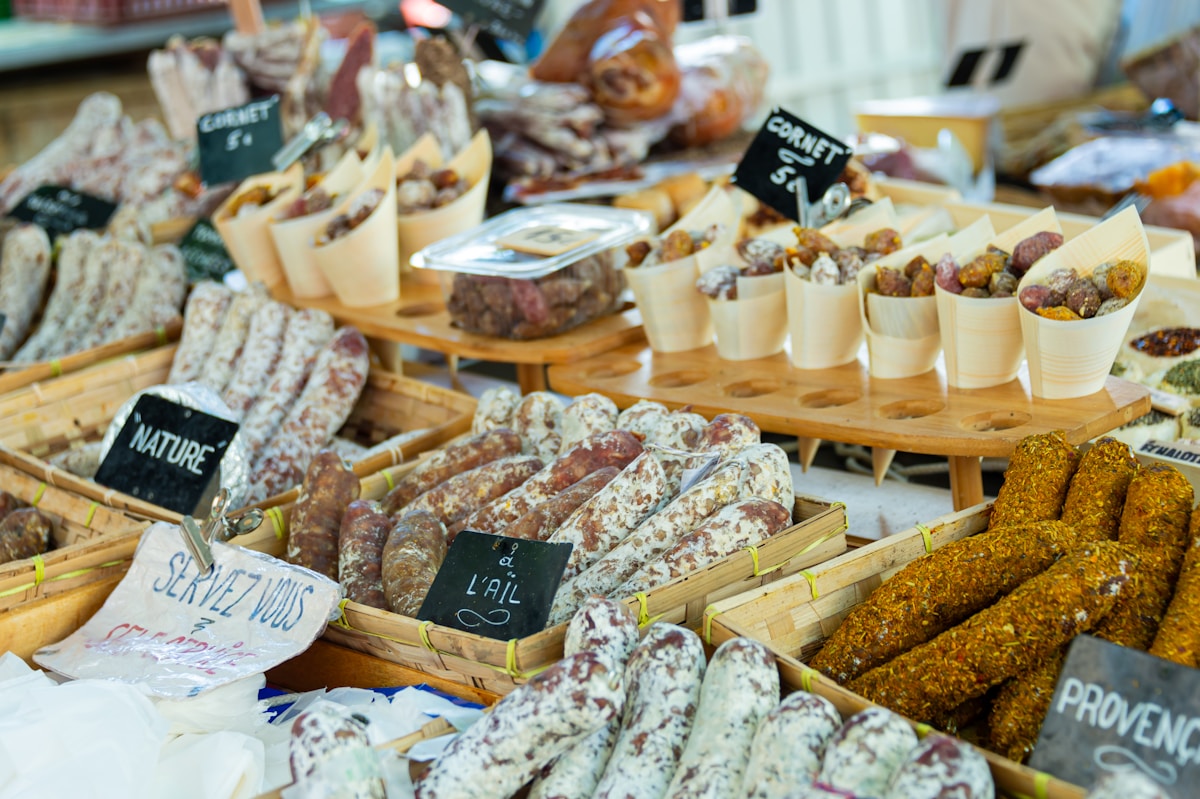
Saucisson sec (dry-cured sausage), pâté, rillettes, jambon cru, boudin noir — the charcuterie stall is a carnivore’s dream. In the south-west, look for duck confit and foie gras. In Corsica, seek out figatellu and coppa. Saucisson travels well and makes an excellent gift or picnic centrepiece.
Bread
Many markets have a bread stall selling pain de campagne, sourdough, walnut bread, olive bread, and fougasse (a flatbread from Provence, often studded with olives or lardons). Buy a loaf, tear it apart, and eat it with your market cheese and charcuterie. This is the French picnic at its finest.
Olives, Tapenade and Oils
Particularly in Provence and the south, you will find stalls piled with glistening olives in every colour and marinade — herbes de Provence, garlic, chilli, lemon. Tapenade (olive paste) is sold by the pot, and locally pressed olive oil is a wonderful souvenir. Taste before you buy — quality varies enormously.
Honey, Lavender and Soap
Lavender honey from Provence is extraordinary — floral, intense, and nothing like supermarket honey. You will also find lavender sachets, essential oils, and beautifully packaged Marseille soap (savon de Marseille) made from olive oil. These are affordable, easy to pack, and make lovely gifts.
Seasonal Produce
This is where French markets truly shine. In spring, look for white asparagus, strawberries, and fresh peas. Summer brings peaches, apricots, tomatoes in every shape and colour, and courgette flowers for stuffing. Autumn means wild mushrooms (cèpes, girolles, trompettes de la mort), figs, and grapes. Winter is the season for truffles, chestnuts, and root vegetables. Whatever the calendar says, the market will tell you what to cook for dinner.
Planning a trip to France? Our Planning Hub has everything you need to get started, from transport to accommodation to regional guides. And if you want weekly inspiration delivered free, join our newsletter.
Market Etiquette: The Unwritten Rules
French markets have a rhythm and a set of customs that are worth knowing. None of them are complicated, but observing them will make your experience much more enjoyable — and the vendors much more helpful.
- Always greet the vendor. A simple “Bonjour, Madame” or “Bonjour, Monsieur” before any transaction is not just polite — it is essential. In France, launching straight into what you want without a greeting is considered quite rude.
- Do not touch the produce. This is perhaps the biggest difference from British or American markets. At most French market stalls, the vendor selects the fruit and vegetables for you. Point to what you want, or say “Je voudrais…” (I would like…). Some stalls now have self-service sections, but when in doubt, keep your hands to yourself.
- Bring cash. Whilst card payments are becoming more common at larger markets, many small vendors — especially in rural areas — still operate on cash only. Bring a good supply of coins and small notes.
- Bring your own bags. Plastic bags are banned in France. Most vendors will have paper bags for small items, but bringing a sturdy tote bag or basket is both practical and very much in the spirit of the thing.
- Be patient. Queuing at French markets can feel informal, but there is usually an unspoken order. If in doubt, ask “C’est à qui le tour?” (Whose turn is it?). Do not rush. The market is meant to be savoured.
- Taste when offered. If a vendor offers you a taste, accept. It is part of the experience and the vendor will not pressure you to buy. Equally, do not be shy about asking to taste cheese or charcuterie — it is expected.
The Best Time to Arrive
Most French markets open between 7:00 and 8:00 in the morning and wind down by 12:30 or 13:00. The golden rule: arrive early for the best choice, arrive late for the best bargains.
If you want the pick of the produce — the ripest tomatoes, the freshest fish, the widest selection of cheese — aim to arrive by 8:30 or 9:00. The serious local shoppers are there even earlier, and the best items do sell out.
If you are more interested in a relaxed browse with a coffee in hand, mid-morning (around 10:00-11:00) is perfect. The market will be in full swing, the atmosphere will be lively, and you can take your time.
In the last hour before closing, some vendors reduce their prices rather than pack unsold stock back into the van. This is particularly true for fruit, vegetables, and flowers. It is not guaranteed, but it is worth a look if you are flexible.
Famous French Markets Worth a Detour
Whilst every French market has its charm, some have earned a reputation that draws visitors from far and wide. Here are six that genuinely deserve the trip.
Rue Mouffetard, Paris
One of the oldest market streets in Paris, winding downhill from the Place de la Contrescarpe in the 5th arrondissement. It operates most days but is at its best on Saturday and Sunday mornings. The street is lined with fromageries, boulangeries, fishmongers, and greengrocers, and the atmosphere is wonderfully local despite the central location.
L’Isle-sur-la-Sorgue, Provence
This small town in the Vaucluse is famous for its Sunday market, which combines a food market with one of the largest antique and brocante markets in France. The town sits on canals fed by the River Sorgue, and the combination of water, plane trees, and market stalls makes it one of the most photogenic markets in the country.
Aix-en-Provence
Aix has markets nearly every day, but the main food market on Place Richelme runs daily and the larger market on Tuesday, Thursday, and Saturday mornings sprawls across several squares. It is a beautiful setting — golden stone buildings, plane trees, fountains — and the Provençal produce is outstanding. Look for calissons (the local almond sweet), socca-style snacks, and the region’s superb olive oils.
Nice — Cours Saleya
The flower and food market on Cours Saleya in Nice’s Old Town runs Tuesday to Sunday mornings. It is famous for its spectacular flower displays, but the food section is equally impressive — pissaladière (onion tart), socca (chickpea pancake), candied fruits, Niçoise olives, and fresh herbs. On Mondays, the flowers give way to a bustling brocante market.
Sarlat-la-Canéda, Dordogne
Sarlat’s Saturday market is legendary. The medieval town centre fills with stalls selling foie gras, duck confit, walnut oil, truffles (in season), cèpe mushrooms, Cabécou cheese, and Bergerac wine. In winter, the truffle market (November to March) is a pilgrimage for food lovers. The setting, surrounded by honey-coloured medieval buildings, is extraordinary.
Uzès, Languedoc
The Wednesday market in Uzès is one of the finest in the south. It fills the Place aux Herbes and surrounding streets with colour and scent — lavender, herbs, goat’s cheese, tapenade, charcuterie, ceramics, and textiles. The town itself is elegant and unspoilt, and the market has a genuine local feel despite growing popularity with visitors.
Seasonal Highlights: When to Visit for What
The French market calendar follows the seasons closely, and planning your visit around what is in season can make a real difference to your experience.
- Spring (March–May): White asparagus, strawberries (especially from Périgord), fresh peas, radishes, and the first cherries. Markets feel vibrant after the winter quiet.
- Summer (June–August): The peak season. Peaches, nectarines, melons from Cavaillon, tomatoes, aubergines, courgettes, fresh herbs, and lavender in full bloom across Provence. Evening markets (marchés nocturnes) appear in many towns, often with live music and local wine.
- Autumn (September–November): Wild mushrooms (cèpes, girolles, chanterelles), figs, grapes, walnuts, chestnuts, and the start of truffle season. This is arguably the most rewarding time for food lovers.
- Winter (December–February): Truffles (Périgord black truffles peak in January), oysters, root vegetables, citrus from Corsica and the south, and Christmas markets across Alsace and beyond.
Practical Tips for Your Market Visit
- Learn a few key phrases. “Bonjour,” “Je voudrais…” (I would like…), “C’est combien?” (How much is it?), “Un peu plus” (a bit more), “C’est tout, merci” (that’s all, thank you).
- Bring a cool bag if you are buying cheese, charcuterie, or fish and have a drive ahead of you.
- Check for parking early. Market days fill car parks quickly in popular towns. Arrive before 9:00 to be safe.
- Do not buy everything at the first stall. Walk the entire market first, compare, and then go back to buy. The best stall might be at the far end.
- Talk to the vendors. Even with limited French, a smile and a few words go a long way. Vendors are often passionate about their products and happy to recommend what is at its best that week.
A morning at a French market is one of the simplest and most rewarding things you can do in France. No reservation, no entry fee, no itinerary required — just turn up with an empty bag and a willingness to be guided by what looks good. It is, in the truest sense, a taste of real French life.
For more help planning your trip, visit our France Planning Hub. And to receive weekly stories, tips and inspiration from across France, subscribe to our free newsletter — we would love to have you along.
Love France? So Do We.
Join our free newsletter and get the best of France — travel tips, hidden villages, food traditions, and cultural stories — straight to your inbox every week.
Thinking about it for retirement?
If you’ve started thinking seriously about retiring there, our complete our full Retire in France guide covers the visa, healthcare, cost-of-living, and the regions worth shortlisting.
Free. No spam. Unsubscribe anytime.
📥 Free Download: France Travel Planning Guide
Itineraries, insider tips, and the places you must not miss on your next trip to France.
Tours & experiences you might love


Powered by Viator. Some links are affiliate links — we may earn a small commission at no extra cost to you.

Leave a Reply