France has one of the most recognised names in the world. But where did that name come from?
It came from a people called the Franks.
They were Germanic warriors who emerged from the Rhine valley in the 5th century. They built the first true French kingdom. They gave Europe one of its greatest rulers. And they gave us the word “France” itself.
If you have French heritage — whether you grew up in Quebec, Louisiana, or anywhere else in the world — your roots connect back to these people. This is their story.
Who Were the Franks?
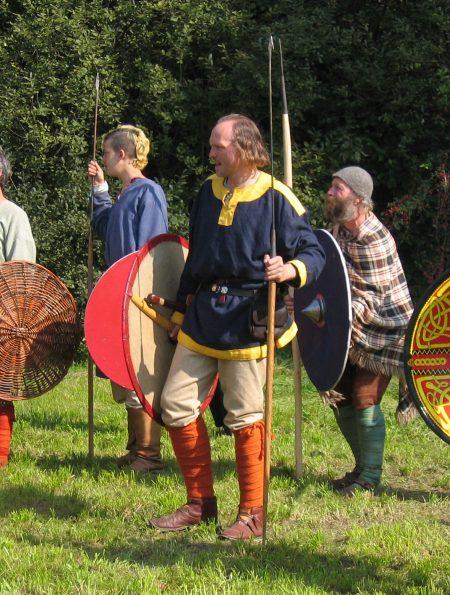
The Franks were a Germanic people. They came from the region east and north of the Rhine river. Today, that area covers western Germany, Belgium, and the Netherlands.
The Romans first wrote about them in the 3rd century AD. At that time, the Franks lived beyond the Roman Empire’s eastern frontier. Romans called them barbarians — but that word simply meant “foreigners.” It did not mean savage or uncivilised.
The Franks were farmers and fighters. They organised themselves into clans and family groups. Their signature weapon was the francisca — a short-handled throwing axe. Historians believe the Franks may have taken their name from this axe, or the axe may have taken its name from them. Either way, the weapon and the people were linked.
There were two main groups. The Salian Franks lived near the coast, in what is now Belgium. The Ripuarian Franks lived further east, along the Rhine. Both groups would eventually unite under a single kingdom.
Long before the Franks arrived in France, the land belonged to the Gauls. Then Rome conquered it. To understand the full story of France’s origins, read our article on The Gauls: France Before the Romans.
🇫🇷 Free Guide: How to Trace Your French Ancestry
Step-by-step: Archives Départementales, état civil records, parish registers, Acadian roots, DNA testing, and planning a heritage trip to France. Completely free.
Get the Free Guide → Subscribe free at the guide page to receive weekly France storiesClovis I — The King Who Shaped France Forever
The Franks changed history when a young chieftain named Clovis took power in 481 AD.
Clovis was around 15 years old when he became leader of the Salian Franks. Over the next three decades, he did something remarkable. He united the Frankish tribes. He defeated the last Roman governor in northern France in 486 AD. He pushed south into Gaul, fighting rival kingdoms one by one.
By 507 AD, Clovis controlled most of what we now call France.
One moment changed everything. In 496 AD, Clovis converted to Christianity. He was baptised at Reims by Bishop Saint Remigius. This was not a small event. The Frankish kingdom became the first Germanic power to adopt Roman Christianity.
That decision echoed through fifteen centuries of French history. It tied France permanently to the Catholic Church. It shaped French culture, art, architecture, and identity. Even today, France calls itself la fille aînée de l’Église — the eldest daughter of the Church.
Clovis chose Soissons and Paris as his main cities. When he died in 511 AD, he left a kingdom stretching from the Rhine to the Pyrenees. For the first time, something recognisably French existed in the world.
The Merovingian Dynasty
Clovis belonged to a royal family called the Merovingians. Historians named the dynasty after a legendary ancestor, Merovech.
The Merovingians ruled for two and a half centuries. Under them, France grew into a powerful Christian kingdom. They built monasteries and supported the Church. They established a royal court and a system of laws.
But as the years passed, the Merovingian kings grew weaker. Power shifted slowly to their chief advisors — men called the Mayors of the Palace. These officials ran the kingdom while the kings sat on their thrones.
By the 7th century, historians called the last Merovingians the rois fainéants — the do-nothing kings. They wore the crown. But they held no real power.
Real power had passed to one family in particular: the Carolingians.
Charles Martel and the Battle of Tours
In 732 AD, a Muslim army crossed the Pyrenees and marched north through France.
They had already conquered Spain. Now they moved toward the Loire valley. Cities like Tours and Poitiers stood in their path.
The Mayor of the Palace, Charles Martel, moved his Frankish army to block them. The two forces met near Tours. Historians still debate the exact location. But the outcome was clear. After two days of fighting, Charles Martel’s army stopped the advance.
The Muslim forces retreated south. They never threatened France again.
This battle reshaped European history. It kept France — and much of Western Europe — in the Christian sphere. Edward Gibbon, the historian, called it one of the most decisive battles ever fought.
Charles Martel earned his nickname from the victory. “Martel” means “the Hammer” in Old French.
🇫🇷 Enjoying this? 7,000 France lovers get stories like this every week.
Thinking about it for retirement? If you’ve started thinking seriously about retiring there, our complete our full Retire in France guide covers the visa, healthcare, cost-of-living, and the regions worth shortlisting.
Charlemagne — The Greatest of the Franks
Charles Martel’s grandson became the most famous ruler in European history.
His name was Karl. We call him Charlemagne — Charles the Great.
Charlemagne became King of the Franks in 768 AD. He spent the next thirty years expanding his kingdom. He fought the Saxons in Germany. He drove the Moors back in Spain. He conquered northern Italy. By the time he finished, he ruled a territory larger than any European empire since Rome.
On Christmas Day in 800 AD, Pope Leo III crowned Charlemagne as Emperor of the Romans in the city of Rome. It was an extraordinary moment. The western Roman Empire had collapsed three centuries earlier. Now a Frankish king stood in its place.
Charlemagne did more than fight. He reformed the Church and standardised weights and measures. He established a common currency across his empire. He created schools attached to monasteries and cathedrals. He encouraged scholars and collected manuscripts.
His capital was Aachen, in what is now western Germany. You can visit his palace chapel there today. It stands as one of the finest surviving examples of Carolingian architecture in Europe.
Charlemagne’s story connects closely to Alsace and the border regions between France and Germany. For more on that contested history, read Alsace: The Region That Was French, Then German, Then French Again.
How the Franks Became the French
Charlemagne died in 814 AD. His son, Louis the Pious, inherited the empire. But after Louis died, his three sons went to war over the inheritance.
In 843 AD, they signed the Treaty of Verdun. They divided the empire into three parts.
The western part went to Charles the Bald. This was West Francia. It covered roughly the territory of modern France. The eastern part went to Louis the German — this was East Francia, the root of modern Germany. The middle kingdom, left to Lothair, eventually became Belgium, the Netherlands, and parts of Italy.
West Francia was the seed of France. Over the following centuries, “Francia” became “France.” The French language developed from the Vulgar Latin spoken in Roman Gaul. Frankish words entered the language — particularly military terms and words for land and forest. But French itself is a Romance language, shaped far more by Latin than by Germanic Frankish.
The French people were not simply Franks. They were a blend — Gauls, Romans, and Franks, mixed together across generations. That blend is the foundation of French identity.
France is the only European nation named after a people who, today, we would not call French.
The Frankish Legacy in French Surnames
The Franks left their mark on French surnames and first names. Many of the most common French names trace directly to Frankish origins.
Louis comes from the Frankish name Hlodwig — meaning “famous warrior.” This name also gave us “Ludwig” in German and “Lewis” in English.
Bernard comes from the Frankish Berinhard — meaning “bear-strong.”
Gérard traces to Gerhard — meaning “spear-brave.”
Robert comes from Hrodebert — “bright fame.”
Henri traces to Heimrich — “ruler of the home.”
Charles itself comes from the Old Germanic Karl — meaning “free man.”
If any of these names appear in your French family tree, you carry a Frankish name passed down across 1,500 years of history. For a deeper look at French name origins, explore our French Surnames of Normandy and our complete guide to tracing your French ancestry.
Where to Find Frankish France Today
The Franks left fewer physical monuments than the Romans. But you can still stand in places where the Frankish story unfolded.
Reims Cathedral, Reims — Clovis was baptised here in 496 AD. The current Gothic cathedral is later, but it stands on the same ground. All French kings were crowned here for 1,300 years, following the tradition Clovis began. It is one of the most important churches in French history.
Saint-Denis Basilica, Paris — the royal burial church of the Frankish and French kings. Clovis and many of his successors are buried here. So are Charlemagne’s descendants. The basilica sits just north of Paris and is open to visitors.
Soissons, Aisne — the first capital of the Frankish kingdom. Clovis made this city his seat after defeating the Romans in 486 AD. The cathedral dates to the 12th century, but the city has deep Frankish roots.
Aachen, Germany — technically not in France, but the spiritual heart of the Carolingian empire. Charlemagne’s palace chapel survives at the core of Aachen Cathedral. It is a UNESCO World Heritage Site and one of Europe’s most extraordinary medieval buildings.
Planning a heritage trip to follow in these footsteps? Read our complete guide: How to Plan a French Heritage Trip to Your Ancestral Village.
The Franks and the Huguenots — A Later Chapter
The Frankish conversion to Christianity in 496 AD set France on a Catholic path. That path held for over a thousand years.
But in the 16th century, France’s Catholic identity fractured. A Protestant movement emerged — the Huguenots. Their story became one of the great diasporas in French history, scattering French families across England, South Africa, the Netherlands, and North America.
To understand how France’s Frankish-Catholic heritage shaped the Huguenot conflict, read our article: The Huguenots: France’s Great Exodus and Its Global Legacy.
Frequently Asked Questions
Who were the Franks and where did they come from?
The Franks were a Germanic people who originally lived east of the Rhine, in what is now Belgium, the Netherlands, and western Germany. They moved into Gaul during the decline of the Western Roman Empire, eventually establishing the kingdom that gave France its name.
Did the Franks speak French?
No. The Franks spoke a Germanic language, related to Old Dutch. French developed from Vulgar Latin — the spoken Latin of Roman Gaul. Frankish words did enter the French language, but French itself is a Romance language, not a Germanic one.
What happened to the Franks?
The Franks gradually mixed with the existing population of Gaul — the Gallo-Romans who spoke Latin. Over generations, they adopted the Latin language and blended their culture with Roman and Celtic traditions. The result was the French people. The Franks did not disappear — they became French.
Is Charlemagne French or German?
Both countries claim him, and both have a point. Charlemagne was King of the Franks — a people who lived before the modern division between France and Germany. His empire covered much of both countries. The French call him Charlemagne and consider him a founding figure. Germans call him Karl der Große and claim him equally. He is genuinely an ancestor of both nations.
Why is France named after the Franks?
After Charlemagne’s empire split in 843 AD, the western portion became known as West Francia — the land of the Franks. Over centuries, “Francia” evolved into “France.” The Franks themselves mixed with the Gallo-Roman population and eventually ceased to exist as a distinct people, but their name lives on in the country they built.
You Might Also Enjoy
The Gauls: France Before the Romans — The Celtic people who lived in France before Caesar arrived. The story of who the Franks replaced.
The Normans Who Changed the World — How descendants of Viking raiders became the most powerful French dynasty of the Middle Ages.
How to Trace Your French Ancestry — A step-by-step guide for Canadians and Americans looking to discover their French roots.
Plan Your France Trip
Ready to follow the Frankish trail through France? Start with our complete planning hub: Start Here: Planning Your Trip to France.
Join 7,000+ France Lovers
Every week, get France’s hidden gems, seasonal guides, local stories, and the art of la vie française — straight to your inbox.
Subscribe free — enter your email:
Love more? Join 64,000 Ireland lovers → · Join 43,000 Scotland lovers → · Join 30,000 Italy lovers →
Free forever · One email per week · Unsubscribe anytime
Tours & experiences you might love


Powered by Viator. Some links are affiliate links — we may earn a small commission at no extra cost to you.

Leave a Reply