
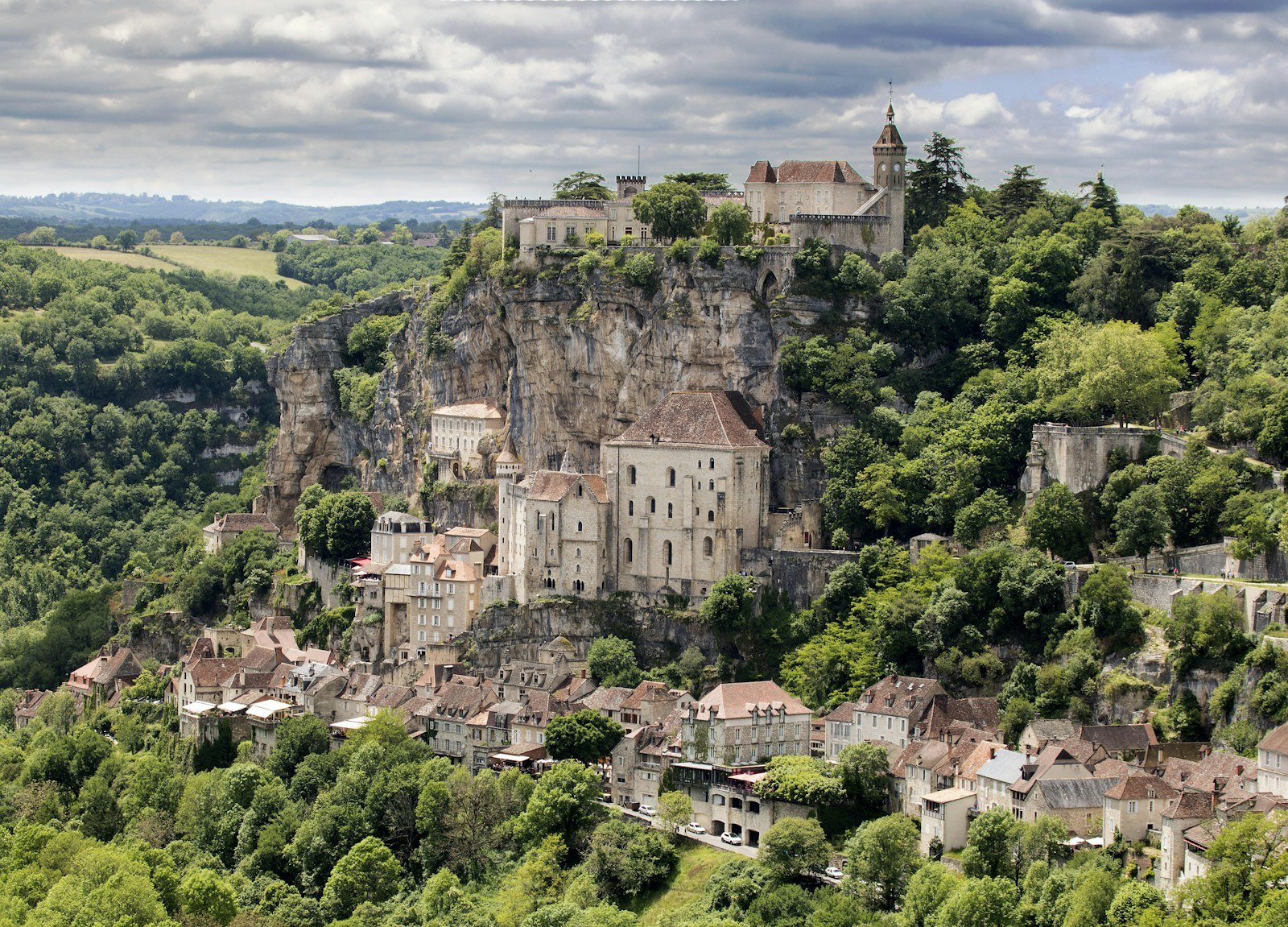
Rocamadour looks almost impossible. A whole village clings to a limestone cliff in south-west France, about 120 metres above the Alzou canyon. Houses sit at the bottom, churches are set into the rock face, and a château with a bell tower crowns the top. If you are planning a trip to the Lot, this is one of the most striking stops you can make. This guide explains how the village is laid out, how to get there, and how to see it without wearing yourself out.
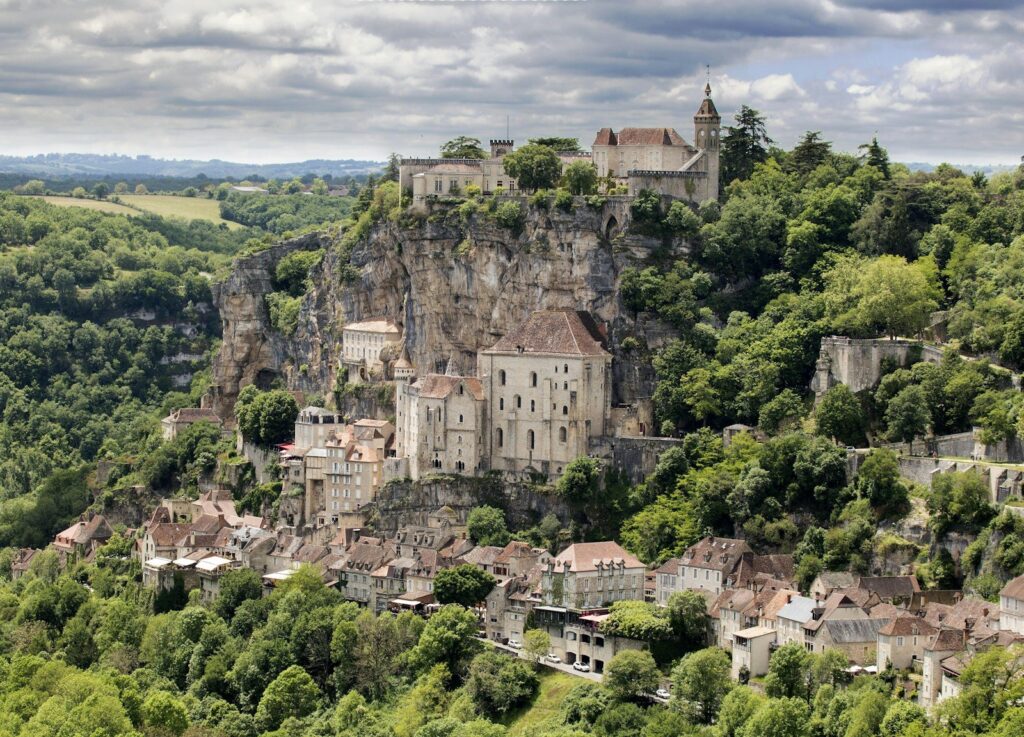
Where is Rocamadour?
Rocamadour is in the Lot department, in the Occitanie region. It sits on the edge of the Causse de Gramat, a dry limestone plateau. The Alzou, a small river, has cut a deep canyon through the stone, and the village was built on the side of it.
The nearest big towns are Brive-la-Gaillarde and Cahors. Both are within about an hour or so by car. The Dordogne valley is close too, so Rocamadour fits easily into a wider trip through the area. Many visitors combine it with Sarlat, Souillac or the Gouffre de Padirac, a huge cave with an underground river.
Love France? Get our free newsletter with village guides and travel tips. Subscribe here.
The three levels of the village
The easiest way to understand Rocamadour is to see it as three tiers, one on top of another.
The Cité at the base
At the bottom is the Cité, the medieval village street. Stone houses line a narrow main road, and many now hold small shops, cafés and restaurants. The street is busy in summer, so expect crowds. It is the first thing you reach on foot from the car parks near the valley floor.
The sanctuaries in the middle
Above the street, the religious buildings are set into the cliff itself. This group is known as the sanctuaries. It includes the Basilica of Saint-Sauveur and the crypt of Saint-Amadour. It also holds several small chapels, including the Chapel of Notre-Dame, where a famous wooden statue of the Virgin Mary is kept. The statue is dark with age and is known as the Black Madonna.
The buildings are close together on a narrow ledge. Some chapels lean right against the rock, so the cliff forms part of the wall.
The château at the top
At the very top are the château ramparts and the bell tower. The château was built to guard the pilgrim site below. Today you can walk along the ramparts for wide views over the canyon. Opening arrangements can change, so check locally before you go.
A pilgrim town
Rocamadour has drawn pilgrims for around a thousand years. In the Middle Ages it was one of the major places of pilgrimage in Western Europe. Travellers came to see the Black Madonna and to pray at the shrine. It was also a stop on the routes leading to Santiago de Compostela in Spain.
The name is linked to a figure called Saint Amadour. His story is wrapped in legend, and historians still debate who he was. What is clear is that a shrine grew around his tomb, and the village grew around the shrine.
The Grand Staircase is the best-known part of the pilgrim route. It has 216 steps and leads up from the Cité to the sanctuaries. Pilgrims once climbed it on their knees as an act of devotion. Most visitors today simply walk, and it is a steady climb rather than a hard one.
The legend of Durandal
Look up at the rock face near the chapels and you may spot an iron sword fixed in the stone. Local legend says it is Durandal, the sword of the hero Roland from the medieval epic poem the Song of Roland. The story says Roland tried to destroy it so it would not fall into enemy hands, and it ended up here. It is only a legend, but it adds to the sense of old stories hanging over the place.
Want more places like Rocamadour in your inbox? Join our free France newsletter.
Would you climb it? How to get up
You have a few choices, depending on your energy and your knees.
- Walk the Grand Staircase. This is the traditional way. It is steep in places, so wear shoes with good grip.
- Take the lift. An inclined lift links the Cité with the sanctuary level. It saves effort and is useful with children or if you have limited mobility.
- Use the paths to the château. A zigzag path leads up to the top. There is also a lift to the upper level. A Stations of the Cross path winds up the hillside as well, and it is quieter than the main stairs.
Whatever you choose, expect to climb some steps. The village is vertical, and there is no flat route through it. Take your time and rest at the landings, which also make good photo spots.
Best viewpoints for photos
The classic view of the three tiers comes from a distance, not from inside the village. Two spots are worth knowing.
- L’Hospitalet. This small hamlet sits on the plateau across the canyon. Its viewpoint gives the full postcard shot of the village on the cliff. It is a good place to stop at the start or end of the day.
- The château ramparts. From the top you look down over the roofs and out across the canyon. Use this view for the sense of height.
Morning and late afternoon light is the kindest for the pale limestone. Midday sun can flatten the view and bring the biggest crowds.
What to eat: cabécou cheese
Rocamadour gives its name to a small round goat’s cheese called Rocamadour, or cabécou. It has protected status, which means it must be made in the local area in the traditional way. It is soft, creamy and mild when young, and firmer and stronger as it ages. You can buy it in the village shops and try it on a plate at a local café. It is often served warm on toast with salad, or with walnuts, which also grow well in this part of France.
Practical tips for visiting
- Go early. Summer mornings are calmer, and parking is easier.
- Visit out of season. Spring and autumn bring cooler weather, fewer people and softer light. Some shops close in winter, so check ahead.
- Wear comfortable shoes. The stone steps and cobbles can be slippery when wet.
- Allow half a day. That is enough for the sanctuaries, the ramparts and lunch. Allow a full day if you want to hike in the canyon.
- Parking. Car parks sit at the top and the bottom of the village. Pick the one that suits your legs, and check fees on arrival.
- Dress respectfully. The sanctuaries are active places of worship, so keep your voice low inside.
- Getting there without a car. There is a railway station for Rocamadour, but it is a few kilometres from the village. Check how you will cover the last stretch before you travel.
Is Rocamadour worth the climb?
For most visitors, yes. The village is small, and you can see the main sights in a few hours. But the setting is what makes it special. Few places in France show so clearly how people have built, prayed and defended themselves on a steep and unlikely site. Even if you skip every step and ride the lift, the view from the canyon edge is worth the trip.
So, would you climb up to see it? Whether you take all 216 steps or choose the lift, Rocamadour rewards the effort.
Planning a trip to France? Subscribe to our free newsletter for guides, ideas and practical advice.
Tours & experiences you might love


Powered by Viator. Some links are affiliate links — we may earn a small commission at no extra cost to you.

Leave a Reply