
Most of France’s celebrated coastlines are broadly what you’d expect: golden sand, timber-framed fishing ports, the occasional dramatic drop to the sea. Then there’s the Côte de Granit Rose. A 15-kilometre stretch of northern Brittany where the rocks are not grey, not brown, not even beige. They glow. Rose-pink in the morning, warm amber by noon, flamingo at dusk. And if you haven’t heard of it, that’s rather the point.
A Coast That Shouldn’t Quite Exist
The geology of the Pink Granite Coast is genuinely strange. These rocks are around 300 million years old — formed deep underground during a period of intense volcanic activity, then pushed slowly to the surface long before the Alps existed, before the dinosaurs arrived, before almost anything in the modern world took shape.
Millions of years of wind and Atlantic weather have carved the granite into forms that stop you mid-step. Some boulders look like sleeping animals. Others like vast mushrooms balanced on slender stems. A few have profiles so unmistakably human that local families have been naming them for generations — the Witch, the Tortoise, the Rabbit, Napoleon’s Hat.
Children are brought here to find the familiar shapes in the stone. Adults spend considerably longer looking than they expected.
The Lighthouse at the World’s Edge
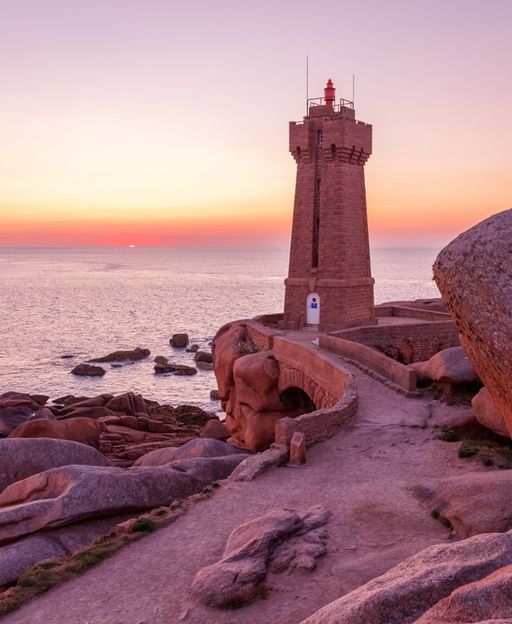
At the outermost point of the coast, above Ploumanac’h harbour, stands the Phare de Mean Ruz. Built from the same local pink granite, the lighthouse almost disappears into the rocks around it — until the sun drops low, and everything turns the colour of a long, satisfied exhale.
The first lighthouse here was built in 1860. The current tower dates from 1945, reconstructed after being destroyed during the Second World War. Lighthouse keepers once lived here for weeks at a stretch, watching for ships navigating one of France’s most treacherous stretches of water. The currents are fierce, the rocks unforgiving. Before the lights came on, hundreds of vessels came to grief on this coast.
The light is automated now. But standing on the granite path that winds toward the tower at dusk, it’s hard not to feel something of what those keepers must have felt — the strange privilege of watching the world from its very edge.
Walking the Path
The main walking trail along the Pink Granite Coast — the Sentier des Douaniers, the old customs officers’ path — runs along the clifftops from Perros-Guirec through Ploumanac’h and on toward Trégastel. The full stretch takes around two hours at an unhurried pace.
Parts of the path bring you between boulders so close you could touch both sides at once. The granite is warm in sunlight, slightly rough beneath your palm. The sea sounds different here than on open beaches — amplified and channelled by the rock, then suddenly silent as you round a corner and find yourself on a small sheltered ledge with the whole Atlantic horizon laid out in front of you.
There are no cafés on the path itself. Bring water. Bring a camera, though photographs rarely capture the colour accurately — the pink always looks slightly improbable in print, slightly less extraordinary than you remember it being. Go and see it instead.
Enjoying this? 7,000 France lovers get stories like this every week. Subscribe free →
The Breton Way with the Sea
Brittany has never romanticised the ocean. This is not a coastline that invites you to lie on the sand with a novel. The Atlantic here is cold, the tides dramatic, the weather changeable. Bretons don’t sentimentalise the sea — they respect it, work alongside it, live by its rhythms on its own terms.
Ploumanac’h itself, tucked behind the lighthouse path, has a working harbour. On summer mornings, boats return by 9am with crab and lobster. At the quayside café, the same men who were out before dawn sit at the same table, hands wrapped around black coffee, the morning’s work done before most of France has had breakfast. It’s a rhythm that hasn’t changed much in a century.
If you’d like to explore this coast more deeply, the Brittany Travel Guide covers the region from the medieval walled towns inland to the oyster beds of the south. For the full north-western arc of France, Normandy’s coast pairs beautifully with Brittany as a single journey.
When to Come (and Why Most People Get It Wrong)
July and August bring visitors to the Pink Granite Coast — the path between the boulders becomes a slow shuffle by mid-morning. Come in May or September instead, and you’ll have long stretches almost entirely to yourself.
The September light is extraordinary: lower, slower, turning everything honey-gold before it disappears. May brings wildflowers along the cliff edges and the first real warmth of spring. In both months, the boulangeries are quieter, the restaurant terraces less frantic, and the sea is doing exactly as it pleases.
The genuine secret is early morning. Be on the path before 7am in summer and you may have the lighthouse, the rocks, and the full slow spread of sunrise entirely to yourself. No crowds. No car parks. Just France at its most quietly, impossibly beautiful. For anyone building a wider French adventure, the France trip-planning hub is the best place to start — it covers transport, timing, and which regions to pair together.
There is a particular quality of silence on the Pink Granite Coast just after sunset, when the colour drains slowly from the rocks and the lighthouse beam begins its long sweep across the water. The world feels ancient and unhurried. It’s the kind of place you find yourself planning to return to while you’re still standing in it.
🇫🇷 Join 7,000+ France Lovers
Get hidden gems, food secrets, and travel stories every week. Free forever.
Love France? So Do We.
Join our free newsletter and get the best of France — travel tips, hidden villages, food traditions, and cultural stories — straight to your inbox every week.
Free. No spam. Unsubscribe anytime.
📥 Free Download: France Travel Planning Guide
Itineraries, insider tips, and the places you must not miss on your next trip to France.
🇫🇷 You Might Also Love
Tours & experiences you might love


Powered by Viator. Some links are affiliate links — we may earn a small commission at no extra cost to you.

Leave a Reply