
Paris is one of those rare cities that genuinely lives up to the hype. With seven full days, you can move beyond the rushed highlights tour that most visitors endure and actually settle into the rhythm of the city — lingering over morning coffee, walking the quieter streets, and giving the major sights the time they deserve. This one week in Paris itinerary is built for travellers who want to see the essentials without feeling like they are racing from one queue to the next.
Join 7,000+ readers on our free Love France newsletter for weekly Paris tips, planning guides, and inspiration → lovetovisitfrance.substack.com
This itinerary groups Paris by neighbourhood so you spend less time on the Métro and more time exploring on foot. Each day includes practical advice on the best times to arrive, where to eat nearby, and how to get around. If you are planning your first visit or returning for a deeper look, this is a sensible way to structure your week.
For more France planning resources, visit our Planning Hub.
Before You Go: Practical Paris Essentials
Getting Around on the Métro
The Paris Métro is the fastest and cheapest way to move between neighbourhoods. Buy a Navigo Easy card at any station — it is a rechargeable contactless card that works on the Métro, buses, and RER trains within central Paris. A single ticket (t+) costs around €2.15, but a carnet of ten is better value if you plan to use public transport regularly.
Key lines you will use most during this itinerary: Line 1 (east-west, passing the Louvre, Champs-Élysées, and Bastille), Line 4 (north-south, connecting Montmartre to the Latin Quarter), and Line 6 (with above-ground views of the Eiffel Tower between Bir-Hakeim and Passy).
Trains run from approximately 05:30 until 01:15 (02:15 on Friday and Saturday nights). Avoid the Métro during rush hour (08:00–09:30 and 17:30–19:00) if you can — it gets genuinely packed.
Tipping and Money
France uses the euro. Card payments are accepted nearly everywhere, though smaller cafés and market stalls may prefer cash. Tipping is not expected in the same way as in North America — a euro or two for good service at a sit-down meal is appreciated but not required. Service is included in the bill by law.
When to Visit
April to June and September to October offer the best balance of weather, manageable crowds, and reasonable hotel prices. July and August are hot and heavily touristed, though many Parisians leave the city, which gives it a different character. Winter (November to February) is cold but beautiful, with shorter queues and Christmas markets in December.
Day 1: Eiffel Tower and Trocadéro
Morning: Trocadéro and the Eiffel Tower
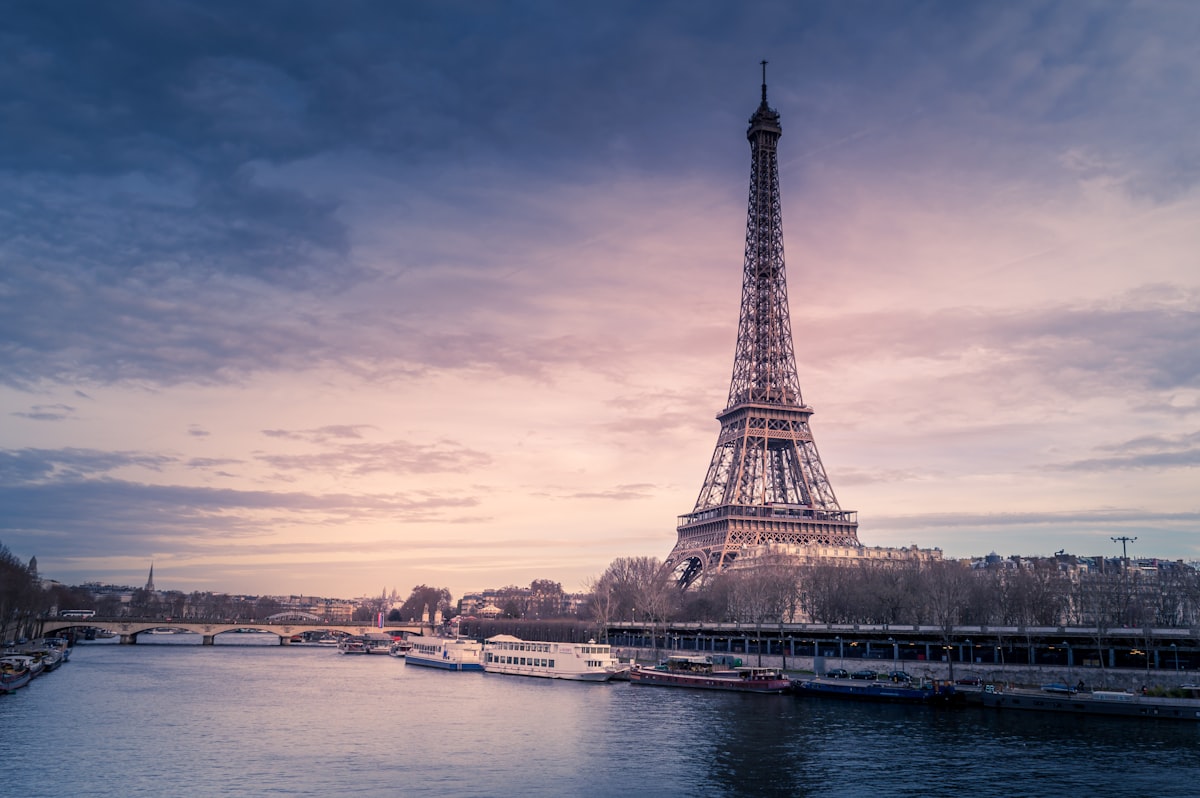
Start your week with the sight that defines Paris. Take the Métro to Trocadéro (Lines 6 or 9) and walk down the steps of the Palais de Chaillot for the best panoramic view of the Eiffel Tower across the river. This is the classic photograph — arrive before 09:00 to beat the crowds and get clean shots without hundreds of heads in frame.
Cross the Pont d’Iéna to reach the tower itself. If you want to go up, book your tickets online at least two weeks in advance through the official website (tour-eiffel.fr). The summit tickets sell out quickly. The second floor offers nearly as good a view and is easier to book. Budget around 90 minutes for the visit including the queue and time at the top.
If you would rather not go up, the Champ de Mars gardens stretching south from the tower are lovely for a morning walk.
Afternoon: Rue Cler and Les Invalides
Walk south-east from the Eiffel Tower to Rue Cler, one of the best market streets in Paris. This is where locals shop for cheese, bread, pastries, and wine. Pick up supplies for a picnic or sit down at one of the street-side cafés. Café du Marché is a reliable choice for a relaxed lunch — try the croque-monsieur or a simple omelette with a carafe of house wine.
After lunch, continue to the Musée de l’Armée at Les Invalides, where Napoleon’s tomb sits beneath the gilded dome. The military history collection is extensive — allow at least 90 minutes. The building itself, commissioned by Louis XIV, is striking from every angle.
Evening
Return to the Eiffel Tower area at dusk. Every evening, the tower sparkles with lights for five minutes on the hour from nightfall until 01:00. Watch from the Trocadéro esplanade or the Champ de Mars — it never gets old, even for repeat visitors.
Day 2: The Louvre and Tuileries
Morning: The Louvre
The Louvre is the world’s most visited museum, and it deserves a proper half-day rather than a frantic sprint past the Mona Lisa. Take the Métro to Palais Royal – Musée du Louvre (Lines 1 or 7). Book timed-entry tickets online — walk-up queues can exceed two hours in peak season.
Arrive when the doors open at 09:00. Head straight to the Denon Wing for the Mona Lisa, Winged Victory of Samothrace, and Venus de Milo before the crowds build. Then explore at your own pace — the Egyptian antiquities and the French paintings galleries are highlights that many visitors miss entirely.
The museum is closed on Tuesdays. Wednesday and Friday evenings it stays open until 21:45, which is an excellent time to visit with far fewer people.
Afternoon: Tuileries Garden and Place de la Concorde
Exit the Louvre through the Cour Napoléon and walk directly into the Jardin des Tuileries. This formal French garden stretches from the Louvre to the Place de la Concorde and is one of the most pleasant walks in Paris. In warmer months, the green metal chairs around the central fountain are perfect for resting after a museum-heavy morning.
At the western end, the Place de la Concorde opens up with its Egyptian obelisk and views in every direction — the Champs-Élysées to the west, the Tuileries behind you, and the National Assembly across the river. The Musée de l’Orangerie, tucked into the corner of the Tuileries, houses Monet’s enormous Water Lilies murals in two purpose-built oval rooms. It takes less than an hour and is one of the most moving art experiences in the city.
Where to Eat
For lunch near the Louvre, avoid the tourist traps on the Rue de Rivoli. Instead, walk a few streets north to Rue Sainte-Anne in the Japanese quarter for excellent ramen at Kotteri Ramen Naritake, or head to Le Fumoir on Rue de l’Amiral de Coligny for a well-executed French bistro lunch in a handsome library-bar setting.
Day 3: Montmartre and Sacré-Cœur
Morning: The Hilltop Village
Montmartre feels like a separate village sitting on a hill above the city. Take the Métro to Abbesses (Line 12) — it is the deepest station in Paris, so take the lift rather than the spiral staircase unless you enjoy the climb. From Abbesses, wind uphill through the narrow streets to the Basilica of Sacré-Cœur.
The basilica is free to enter, though there is a charge to climb to the dome (around €7). The view from the dome is superb — on a clear day, you can see for 30 kilometres in every direction. Arrive before 10:00 to beat the tour groups. The steps in front of the basilica are a gathering spot in the evenings, but in the morning they are relatively peaceful.
Midday: Place du Tertre and the Artists’ Quarter
Behind the basilica, the Place du Tertre is the famous square where portrait artists have worked since the 1800s. It is touristy — there is no getting around that — but it is also genuinely charming when it is not too crowded. Early morning or late afternoon are the best times.
Wander the backstreets around Rue Lepic and Rue Norvins. This is the Montmartre of Renoir, Toulouse-Lautrec, and Picasso — many of the buildings they painted or lived in still stand. The Musée de Montmartre on Rue Cortot tells this story well and has lovely gardens with a view over the vineyard.
Afternoon: Pigalle and South Montmartre
Walk downhill through South Pigalle (known locally as SoPi), which has transformed in recent years into one of the best food and coffee neighbourhoods in Paris. KB CaféShop on Rue des Martyrs does excellent specialty coffee. For lunch, Bouillon Pigalle on Boulevard de Clichy serves traditional French dishes at remarkably low prices — expect to queue, but it moves fast.
Day 4: Versailles Day Trip
Getting There
Take the RER C train from central Paris to Versailles Château – Rive Gauche. The journey takes around 40 minutes from Saint-Michel – Notre-Dame. Your Navigo Easy card or a standard Île-de-France ticket will work. Trains run frequently. Aim to arrive by 09:00 when the palace opens — the queues build dramatically by mid-morning.
The Palace
Book tickets online in advance at chateauversailles.fr. The main palace tour takes you through the State Apartments, the Hall of Mirrors, and the Queen’s Apartments. Budget at least two hours for the interior. The Hall of Mirrors is genuinely breathtaking — 357 mirrors reflecting the light from the garden-facing windows across 73 metres of gallery.
The Gardens
The gardens are the real reason Versailles needs a full day. They cover 800 hectares and include the Grand Canal, the Grand Trianon, the Petit Trianon, and Marie Antoinette’s Estate (the Hameau de la Reine). You can rent a golf cart or a bicycle, or simply walk — but be prepared for distance. The Petit Trianon and the Hameau are a 20-minute walk from the main palace.
On Tuesdays and Saturdays from April to October, the Musical Fountains Show runs in the gardens — the fountains are choreographed to Baroque music and the effect is quite special. There is a separate garden ticket on show days (around €10).
Where to Eat
Avoid eating inside the palace grounds — it is overpriced and underwhelming. Instead, walk into Versailles town to Rue de Satory or the area around the market hall. La Table du Roi offers a good-value lunch menu with classic French cooking.
Love planning trips to France? Join 7,000+ readers getting our free weekly newsletter with practical guides, hidden gems, and local tips → lovetovisitfrance.substack.com
Day 5: Le Marais and Île de la Cité
Morning: Le Marais
Le Marais is arguably the most enjoyable neighbourhood in Paris for walking. Take the Métro to Saint-Paul (Line 1) and explore on foot. The area is packed with independent boutiques, galleries, historic mansions (hôtels particuliers), and some of the best food in the city.
Visit the Place des Vosges — the oldest planned square in Paris, completed in 1612. Victor Hugo’s apartment at number 6 is now a free museum. The arcaded walkways around the square house art galleries and cafés.
For breakfast, Café Carette on the Place des Vosges does traditional French pastries and excellent hot chocolate. For something more modern, Season on Rue Charles-François Dupuis serves brunch with fresh, seasonal ingredients.
Midday: The Jewish Quarter and Rue des Rosiers
Walk through the historic Jewish quarter along Rue des Rosiers. The falafel shops here are legendary — L’As du Fallafel usually has the longest queue, but Mi-Va-Mi across the street is equally good with a shorter wait. Get a falafel pitta to take away and eat in the Place des Vosges gardens.
Afternoon: Île de la Cité and Notre-Dame
Cross the Pont Marie to the Île Saint-Louis, a tiny island in the Seine with some of the most expensive real estate in Paris. Walk its single main street and stop at Berthillon for what many consider the best ice cream in the city — the salted caramel and wild strawberry flavours are outstanding.
Continue to the neighbouring Île de la Cité, the historical heart of Paris. The Cathédrale Notre-Dame de Paris, following its restoration after the 2019 fire, remains the centrepiece of the island. Even from the exterior, the Gothic architecture is remarkable — the flying buttresses and the rose windows are best appreciated from the garden behind the cathedral.
Nearby, the Sainte-Chapelle is an absolute must. This 13th-century Gothic chapel contains some of the finest stained glass in the world — 1,113 panels depicting biblical scenes, with light pouring through on sunny days in a way that photographs simply cannot capture. Book tickets online to skip the queue.
Day 6: Latin Quarter and Luxembourg Gardens
Morning: The Latin Quarter
The Latin Quarter, on the Left Bank around the Sorbonne university, has been the intellectual heart of Paris for centuries. Take the Métro to Cluny – La Sorbonne (Line 10) or Saint-Michel (Line 4).
Start at the Panthéon, the neoclassical mausoleum where France’s greatest citizens are buried — Voltaire, Rousseau, Victor Hugo, Marie Curie, and Alexandre Dumas among them. The crypt is included in the entry ticket. The building’s dome offers panoramic views, though it is only accessible in summer months.
Walk down Rue Mouffetard, one of the oldest streets in Paris and home to a daily street market. The lower section near Place de la Contrescarpe is the best stretch — cheese shops, fishmongers, bakeries, and greengrocers line both sides. This is a wonderful place to assemble a picnic.
Midday: Shakespeare and Company
Walk north to the Seine and visit Shakespeare and Company, the famous English-language bookshop at 37 Rue de la Bûcherie. The current shop opened in 1951 and has hosted writers from Allen Ginsberg to Anaïs Nin. The upstairs reading room is open to visitors, and the café next door serves excellent coffee with a view of Notre-Dame.
Afternoon: Luxembourg Gardens
Head south to the Jardin du Luxembourg, the finest park in Paris and quite possibly in all of France. Parisians come here to read, jog, play tennis, sail toy boats on the central fountain, and sit in the green metal chairs watching the world go by. It is the most Parisian thing you can do.
The Medici Fountain, tucked away in the north-east corner, is one of the most romantic spots in the city — a long, shaded pool flanked by plane trees. Spend at least an hour here. There is no charge to enter the gardens.
Where to Eat
The Latin Quarter has more tourist traps per square metre than anywhere else in Paris, particularly around Rue de la Huchette. Avoid the places with aggressive touts outside. Instead, try Le Comptoir du Panthéon on the Place du Panthéon for a solid bistro lunch, or Chez Janou on Rue Roger Verlomme (technically in the Marais) for what many claim is the best chocolate mousse in Paris — served from an enormous communal bowl.
Day 7: Musée d’Orsay and Saint-Germain-des-Prés
Morning: Musée d’Orsay
Save one of Paris’s greatest museums for your final day. The Musée d’Orsay (Métro: Solférino, Line 12, or RER C: Musée d’Orsay) occupies a stunning Beaux-Arts railway station and houses the world’s finest collection of Impressionist and Post-Impressionist art. Monet, Renoir, Degas, Cézanne, Van Gogh, Gauguin — they are all here, and the collection is extraordinary.
Book online and arrive at 09:30 when it opens. Head straight to the top floor for the Impressionist galleries — this is where the crowds concentrate later in the day. The clock windows on the top floor frame views of Montmartre and the Seine. The museum is closed on Mondays.
Allow at least three hours. The ground floor includes Courbet, Delacroix, and early Manet. The middle level has Art Nouveau furniture and the ballroom, which is often overlooked and is spectacular.
Afternoon: Saint-Germain-des-Prés
Walk south from the museum into Saint-Germain-des-Prés, the literary and intellectual quarter of the Left Bank. This is the Paris of Sartre, de Beauvoir, and Hemingway. The famous cafés — Café de Flore and Les Deux Magots — sit side by side on the Boulevard Saint-Germain. They are expensive and tourist-heavy, but ordering a single coffee and sitting on the terrace is a rite of passage worth doing once.
For a more authentic experience, duck into the side streets. Rue de Buci and Rue de Seine are lined with galleries, antique shops, and smaller cafés. The Marché Saint-Germain (covered market) has good food options.
Evening: A Final Walk Along the Seine
End your week with an evening walk along the Seine. Start at the Musée d’Orsay, cross to the Right Bank via the Passerelle Léopold-Sédar-Senghor, and walk east along the river past the Louvre and the Pont des Arts towards the Île de la Cité. As the light fades and the buildings illuminate, Paris is at its most beautiful. You will understand why people come back again and again.
Where to Eat on Your Final Evening
For your last dinner in Paris, treat yourself. Le Bouillon Racine on Rue Racine is an Art Nouveau gem serving updated classic French cooking at fair prices — the duck confit and the crème brûlée are both excellent. Book ahead. Alternatively, Polène on Rue de l’Ancienne Comédie does exceptional bread and pastries if you want to grab provisions for the journey home.
Budget Tips for One Week in Paris
Paris is not cheap, but a week does not have to break the bank. Here are the key ways to manage costs:
- Museum Pass: The Paris Museum Pass (2-day or 4-day) covers the Louvre, Orsay, Versailles, Sainte-Chapelle, and dozens more. If you plan to visit three or more major museums, it pays for itself and lets you skip many ticket queues.
- Eat where Parisians eat: The “bouillon” restaurants (Bouillon Pigalle, Bouillon Chartier, Bouillon Racine) serve traditional dishes at prices well below typical restaurant rates. Bakeries sell excellent sandwiches for €4–6.
- Free museum days: The first Sunday of each month offers free entry to many national museums, though they are extremely busy.
- Walk: Paris is compact. Most of the central arrondissements are walkable, and you will see far more on foot than from inside a Métro carriage.
- Accommodation: Stay in the 10th, 11th, or 18th arrondissements for better hotel and rental rates while still being well connected by Métro.
Getting To and From the Airport
Most visitors arrive at Charles de Gaulle (CDG). The RER B train runs directly from CDG to central Paris (Gare du Nord, Châtelet–Les Halles, Saint-Michel) in about 35 minutes for around €11.50. It is the most reliable option. Taxis charge a flat rate of €55 to the Right Bank or €62 to the Left Bank.
From Orly, the Orly Bus to Denfert-Rochereau takes 30 minutes. The OrlyVal automated train connects to RER B at Antony station.
Plan Your Trip
Seven days in Paris gives you time to see the great sights, eat extraordinary food, and develop a real feel for how the city works — its rhythms, its neighbourhoods, its quiet corners. This itinerary covers the essentials, but leave room for the unplanned: a café that catches your eye, a street market you stumble upon, a park bench where you sit longer than expected. That is how you fall in love with Paris.
For more detailed planning guides, packing lists, and neighbourhood deep-dives, visit our France Planning Hub.
Never miss a France travel guide — join 7,000+ readers on our free Love France newsletter → lovetovisitfrance.substack.com
Leave a Reply