Imagine being born in France. Then, without moving an inch, waking up to find yourself living in Germany. Then, after a lifetime, becoming French again — only to be occupied by Germans once more before finally returning to France for good.
This is not a thought experiment. It is the real history of Alsace, and it shaped how the people here think, speak, eat, and see themselves in ways that still echo today.
A Region Passed Between Empires
For most of its history, Alsace sat on the border between France and the Germanic world. The Rhine marked the line. For centuries, the people here were simply Alsatian — with their own language, their own customs, and their own quiet stubbornness about both.
Then came 1871. France lost the Franco-Prussian War, and Alsace was handed to the German Empire. Overnight, schools switched to German. Street names changed. People had to make a choice: stay and become German, or leave for France.
Most stayed. But they never stopped being themselves. They kept speaking Alsatian at home, kept baking their kougelhopf on Sunday mornings, and kept an eye on the Rhine as though waiting for something to change. In 1918, after the First World War, that something finally came.
The Language That Nobody Could Erase
Alsatian is not quite French and not quite German. It is a Germanic dialect that was spoken here long before either nation claimed the land. Today, only older generations speak it fluently. But it still sounds from market stalls, farmhouses, and village squares across the region.
When France reclaimed Alsace in 1918, French became the official language again. Children went back to French classrooms. Life began to feel French once more. Then in 1940, Germany occupied the region during the Second World War, and everything reversed again. Children who had grown up speaking French were suddenly punished for using it in public. German was forced back into schools, workplaces, and daily life.
Through all of it — the flags, the laws, the edicts, the occupations — Alsatian survived. It is a small language that refused to die, spoken by a people who refused to be erased entirely. That says something important about who they are.
What You See Walking Down a Street
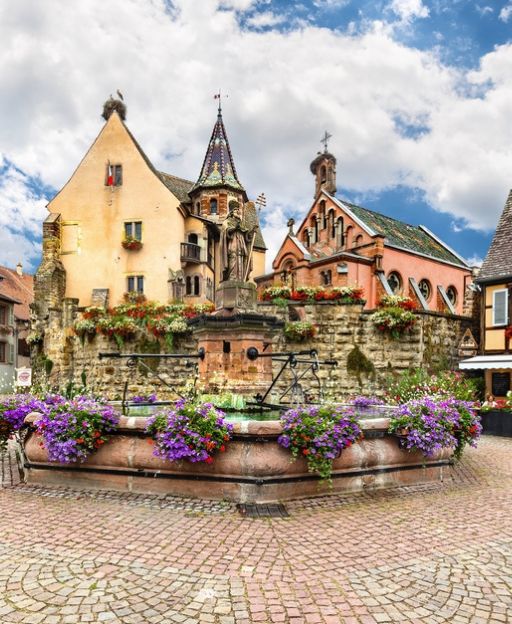
Stand in Eguisheim or Colmar and you notice something different immediately. The houses are half-timbered with steep terracotta roofs. Shutters are painted yellow, blue, and green. Window boxes burst with red geraniums even in autumn. The cobblestones are scrubbed clean.
This is not French architecture. It is not quite German either. It is Alsatian — a style that evolved over centuries in this particular valley, under these particular conditions, shaped by people who had to find beauty in a world that kept changing around them.
The towns feel like something from a medieval illustration, but they are lived-in, breathing places. Bakeries sell choucroute alongside croissants. Wine bars pour Riesling from tall German-shaped bottles. Street signs sometimes appear in two languages. The culture here has its own DNA, and you feel it the moment you step out of the car. If you are planning a visit, our full Alsace travel guide covers everything you need to know before you go.
Enjoying this? 7,000 France lovers get stories like this every week. Subscribe free →
The Alsatian Character
People from Alsace are often described as reserved, independent, and deeply proud — but quietly so. They do not wave flags or make speeches about identity. They simply live it, in the food they cook and the wine they pour and the particular way they greet a stranger at a market stall.
There is a common joke in France: Alsatians are the most European people in the country, because they have already been everything. The region now sits at the heart of the European Union, with Strasbourg home to the European Parliament and the European Court of Human Rights. Many Alsatians find that entirely fitting. A people caught between nations helped build the institution designed to make borders matter less.
They were between two worlds for generations. Now the world has moved a little closer to where they already stood. That is not an accident. That is character.
The Food That Tells the Whole Story
Nothing shows the French-German blend better than what lands on your plate in Alsace. Choucroute garnie — sauerkraut slow-cooked with sausages, smoked pork, and potatoes — is the region’s most famous dish. It is entirely German in origin and entirely beloved across France, found on brasserie menus from Paris to Lyon.
Kougelhopf is a brioche-style cake baked in a distinctive fluted tin, found in every bakery window across the region. Tarte flambée — a thin flatbread spread with crème fraîche, white onions, and lardons — has found its way onto menus across the whole country. The wines, dry and deeply aromatic, are bottled in tall German-shaped flutes and taste like nothing else produced in France.
The food is a living record of everything Alsace has absorbed, survived, and made beautifully its own. You could eat your way through the region and understand its entire history more clearly than any book could teach you.
Why This History Matters When You Visit
Cemeteries in Alsace hold graves with inscriptions in two languages. The town names — Strasbourg, Colmar, Mulhouse, Obernai — carry German sounds that surprise visitors expecting something purely French. Older residents remember a time when speaking the wrong language in public was genuinely dangerous.
Visiting Alsace with this history in mind changes how you see it. The beautiful villages are not just picturesque. They are the result of a people holding on to something through extraordinary pressure over more than a century. The wine is not just delicious. It is grown on land that was fought over and lost and won back across generations of the same families.
Alsace makes visible something that France sometimes obscures: this country is not one single thing. It is dozens of overlapping histories, dozens of languages, and dozens of ways of being — layered on top of each other over centuries. Alsace just shows you those layers more honestly than almost anywhere else. If you are ready to plan your trip, our France travel planning guide and first-time France tips will help you build the perfect itinerary.
Love France? So do 7,000 of us.
Every week, our free newsletter delivers hidden gems, seasonal guides, local stories, French recipes, and the art of la vie française — straight to your inbox. Join the community that loves France as much as you do.
Subscribe Free — Get the Newsletter →
Love Ireland too? Join 65,000 Ireland lovers → · Love Scotland? Join 43,000 readers → · Love Italy? Join 30,000 readers →
The people of Alsace were shaped by forces far beyond their control. And what they built from all of it — this particular corner of the world, with its own food, its own language, and its fierce quiet pride — is one of the most remarkable things you will find anywhere in Europe. Sometimes the places caught between things end up being the most interesting of all.
Love France? So Do We.
Join our free newsletter and get the best of France — travel tips, hidden villages, food traditions, and cultural stories — straight to your inbox every week.
Free. No spam. Unsubscribe anytime.
📥 Free Download: France Travel Planning Guide
Itineraries, insider tips, and the places you must not miss on your next trip to France.
Leave a Reply