
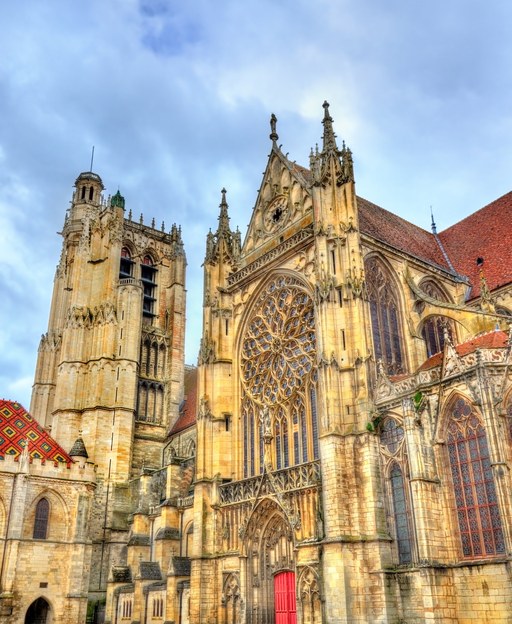
South-east of Paris, in the little Burgundy town of Sens, stands a cathedral that most Americans have never heard of, yet its builders helped shape Canterbury, Notre-Dame and the whole Gothic style. It sheltered an English archbishop on the run from his king, saw a French king married, and still keeps that archbishop’s robes in its treasury. Here is the story of Saint-Étienne de Sens, and how to see it for yourself.
Where Gothic Began
Work on the cathedral started around 1130 to 1135, and it was consecrated in 1164. The Sens tourist office calls it one of the very first Gothic cathedrals in Europe and says it is often thought of as the “mother” of Notre-Dame de Paris, because of how much it influenced that great church.
What makes it Gothic? The tourist office’s guide to the cathedral points to six-part rib vaults spanning an unusually wide nave, walls in three levels (great arches, a gallery and tall upper windows), and strong piers alternating with lighter ones. The guide adds a careful note: Sens is not Gothic in its finished form, but the place where you can watch the new way of building take shape.
The Archbishop Who Ran from His King
In 1164 Thomas Becket, Archbishop of Canterbury, was in open conflict with King Henry II of England. He fled to France and found refuge in Sens, under the protection of Pope Alexander III, who was himself living in the town from 1163 to 1165, according to the Sens tourist office.
Becket later went home to Canterbury, where he was murdered in 1170, as Canterbury Cathedral recounts. Sens never forgot him: the cathedral’s treasury still preserves several of his liturgical garments, which the town calls a very tangible link between France, England and the medieval Church.
The Builder from Sens Who Fell at Canterbury
Four years after Becket’s death, in 1174, fire swept through Canterbury Cathedral. Canterbury Cathedral says a French master mason called William of Sens brought new building techniques and a different architectural style to the rebuilding, and the Sens tourist office says he was called to England from Sens to rebuild the choir.
The result, Canterbury tells its visitors, is the first Gothic building in England. William did not see it finished. He fell from the scaffolding while inspecting the roof, and the work was completed by his young assistant, known as William the Englishman. Canterbury became one of Europe’s great pilgrimage centres because of Becket’s murder, and its new Gothic choir was begun by a man from the very town that had sheltered him.
A Royal Wedding and a Crown of Thorns
Sens kept its place in French history. The tourist office says King Louis IX, Saint Louis, married Marguerite of Provence in the cathedral in 1234, and that the treasury holds a fragment of the Crown of Thorns, brought back by Saint Louis in the 13th century before the relic went to the Sainte-Chapelle in Paris, the chapel he built to hold it.
The town was powerful in other ways, too. Until 1622 the diocese of Paris belonged to the church province ruled from Sens, and in 1140 the cathedral district hosted the famous Council of Sens, where Peter Abelard faced Bernard of Clairvaux, as the tourist office explains.
Planning Your Visit
Sens is in the Yonne, the northern tip of Burgundy, on the way from Paris to the Burgundy vineyards. Around the cathedral you can also see the 13th-century Synodal Palace and the Archbishops’ Palace, where the treasury is displayed. The Sens tourist office has the visiting details and guided tours of the treasury; check them before you go.
If you love Gothic churches, Sens pairs well with the Burgundy abbeys of Vézelay and Fontenay.
Sources
- Sens et Sénonais Tourisme: Saint Stephen’s Cathedral in Sens
- Sens et Sénonais Tourisme: Sens, berceau du gothique
- Canterbury Cathedral Learning: Building the Cathedral
- Canterbury Cathedral: the Quire, rebuilt after the fire of 1174
Tours & experiences you might love


Powered by Viator. Some links are affiliate links — we may earn a small commission at no extra cost to you.

Leave a Reply