
Walk into the main square of Arles on a warm evening and something strikes you immediately. The cafés are ordinary enough. The plane trees are classically French. But look left and a two-thousand-year-old Roman amphitheatre fills the skyline — and still packs in crowds every summer.
The Arena That Never Stopped
Most Roman amphitheatres are ruins you peer at from behind a rope. Not in Arles.
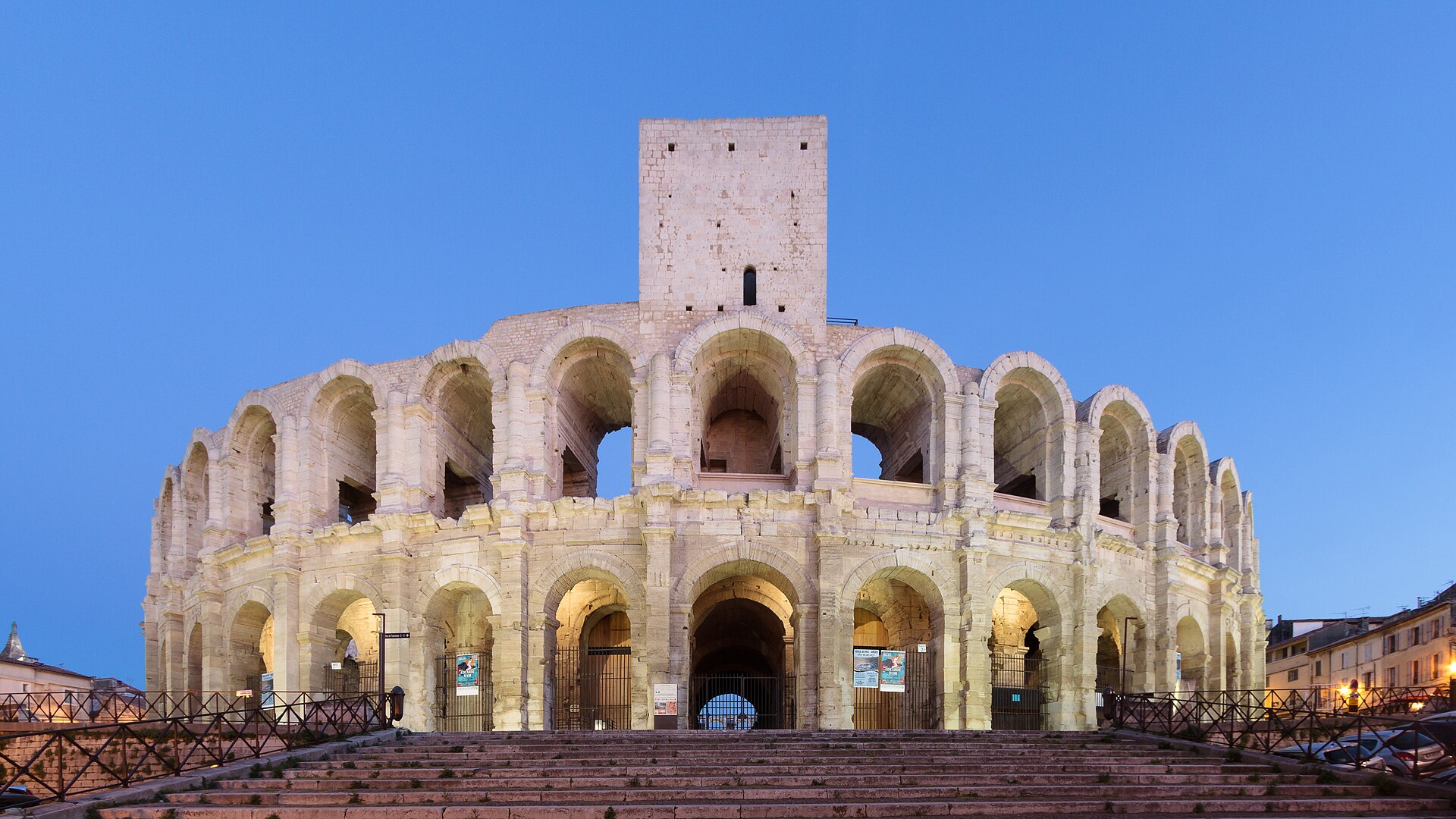
The Arènes d’Arles seats 20,000 people. Roman builders completed it around 90 AD. Today, bullfighting events and open-air concerts fill the arena every summer. You can buy a ticket and sit exactly where a Roman citizen once sat.
Walk the outer walls and you will notice medieval towers built directly into the Roman stonework. After Rome’s empire collapsed, people moved inside the arena itself. Hundreds of houses, three chapels, and a thriving mini-town grew up within those elliptical walls. Authorities demolished those houses in 1825 to restore the original structure.
The Theatre Hiding in Plain Sight
Five minutes from the arena, the Théâtre Antique looks less impressive at first glance. Two tall columns stand lonely against the sky. A semicircle of stone steps curves around a bare stage.
Stand in the right spot and the scale becomes clear. Every summer, live performances fill this ancient space. Classical music, theatre productions, and open-air cinema all take place in a venue built before the birth of Christ.
The original stage measured 102 metres wide. Medieval builders stripped most of the stone to construct Arles’s churches. When you admire the carved façade of Saint-Trophime cathedral nearby, you are partly looking at the old Roman theatre.
Underground Rome Beneath Your Feet
Few tourists find the cryptoporticus. This is a mistake they almost always regret.
Roman builders dug these underground galleries around 30 BC, beneath what was then the city’s forum. Historians debate the exact purpose. Builders may have stored grain here, or the galleries may have supported the forum platform above.
Today you walk beneath the town centre in long vaulted passages lit by spotlights. The stone ceiling is intact. The air is cool even in midsummer. You are walking inside Arelate — once one of the most powerful cities in the Western Roman Empire.
Enjoying this? 7,000 France lovers get stories like this every week.
Thinking about it for retirement? If you’ve started thinking seriously about retiring there, our complete our full Retire in France guide covers the visa, healthcare, cost-of-living, and the regions worth shortlisting.
Why the Emperor Chose Arles
Rome chose Arles deliberately. The Rhône delta created a natural deep-water port. Goods from across the Mediterranean flowed through here. Julius Caesar stationed his fleet in Arles during campaigns against Marseille.
Emperor Constantine built a palace here in the fourth century and ruled parts of the empire from this city. The palace itself is mostly gone. But the baths Constantine commissioned — the Thermes de Constantin — still stand on the banks of the Rhône. They are the largest surviving Roman baths in France.
What Van Gogh Understood About This Light
Van Gogh arrived in Arles in 1888 and produced over 200 paintings in fifteen months. He did not arrive by accident. The light in Arles is extraordinary — flat and clear in winter, golden and heavy in summer.
That same light fell on the Roman amphitheatre two thousand years ago. It fell on the forum where Constantine walked. It still falls on the market stalls and café terrasses today.
Stand at the Place du Forum on a clear evening and every age of Arles seems to press together. The ancient and the ordinary sit side by side in a way that happens almost nowhere else in France. If you want to explore the wider region, our complete Provence travel guide covers everything from lavender season to the best hill-village drives. And the Camargue wetlands begin just south of the city — one of the most surprising landscapes in France.
Ready to start planning? Our France planning guide has everything you need to build your trip from scratch.
How do I get to Arles from Paris?
TGV trains run direct from Paris Gare de Lyon to Arles in roughly three hours. The station sits a ten-minute walk from the amphitheatre. Hiring a car in Arles gives easy access to the Camargue and Les Baux-de-Provence.
What is the best time to visit Arles?
Spring (April–June) and early autumn (September–October) offer warm weather and smaller crowds. Summer brings the Rencontres d’Arles photography festival, which is excellent but busy. Temperatures in July and August regularly reach 35°C.
Is Arles worth visiting beyond the Roman ruins?
Absolutely. The Musée Réattu holds a collection of Picasso drawings donated by the artist himself. The Saturday market along the Boulevard des Lices is one of the finest in Provence. The old town’s narrow lanes reward slow wandering at any time of year.
Can you visit multiple Arles Roman sites on one ticket?
Yes. Arles offers a combined pass covering the amphitheatre, Théâtre Antique, Thermes de Constantin, the cryptoporticus, and several other sites. It costs around €12–16 for adults and saves considerably compared to individual entry fees.
Arles does not feel like a museum. It feels like a city that kept going — through Rome, through the Middle Ages, through Van Gogh’s turbulent months here — and is still, quietly, going. That continuity is what makes it worth the train ride.
Join 7,000+ France Lovers
Three times a week, get France’s hidden gems, seasonal guides, local stories, and the art of la vie française — straight to your inbox.
Subscribe free — enter your email:
📲 Know someone who’d love this? Share on WhatsApp →
Love more? Join 65,000 Ireland lovers → · Join 43,000 Scotland lovers → · Join 29,000+ Italy lovers →
Free forever · Unsubscribe anytime
🇫🇷 You Might Also Love
Tours & experiences you might love


Powered by Viator. Some links are affiliate links — we may earn a small commission at no extra cost to you.

Leave a Reply