
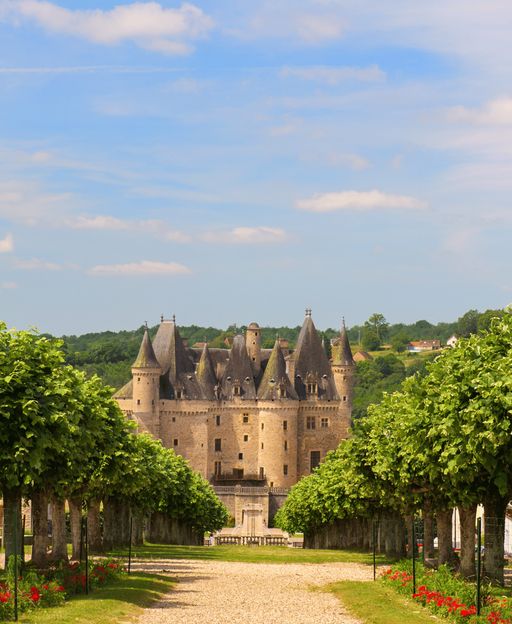
You see the roofline first. A cluster of lead pepper towers rising above the treetops, topped with fantastical creatures — cats, dogs, winged beasts — cast in dark metal against the Dordogne sky. No other château in France looks quite like this one. But it is not the roofline that makes Jumilhac unforgettable. It is the small room inside one of those towers, and the woman who spent years locked inside it.
Built to Impress, Built to Last
Château de Jumilhac-le-Grand sits in the Périgord Vert — the Green Périgord — in the northeastern corner of Dordogne, where the Isle River winds through dense oak woodland.
The site has medieval origins, but it was Antoine de Jumilhac who gave it the face it wears today. In the early 17th century, newly wealthy from iron foundries and close enough to Cardinal Richelieu to matter, he set about transforming the old castle into something extraordinary.
He added tower after tower, each one capped with a steep lead dome. He commissioned intricate dormer windows, carved to a standard you rarely see outside the Loire Valley. And he ordered the lead sculpture menagerie for the rooftops — an assembly of animals and mythical figures that catches your eye from a mile away.
Jumilhac was built to say one thing: this man has arrived.
The Accusation That Changed Everything
Like many powerful men of his era, Antoine was often absent. Campaigns, court obligations, the relentless business of maintaining influence in Paris. And while he was gone, rumours reached him.
His wife, the story goes, had taken a lover.
The man was said to be a local — some accounts name a gardener, others describe a young man who was seen too often near the château grounds. By the time Antoine returned, whatever truth lay beneath the gossip had been lost. What remained was his fury.
He could not undo what had happened — real or imagined. But he could remove her from sight entirely. She would be locked in the tower. Indefinitely.
The Woman in the Tower
The room is still there. Small, plain, with a single window looking out onto the garden below.
Local tradition says she was given a spinning wheel. That she spent her years of captivity working the wool, giving herself something to hold onto while time moved slowly outside the walls.
She became known as La Fileuse. The Spinner.
The stories that gathered around her grew more elaborate with each generation. She scratched her lover’s face into the stonework with a hairpin. She stood at the window watching the garden path below, waiting for him to pass. She folded notes into pieces of cloth and lowered them to the ground.
Whether any of it happened, no one can prove. But the legend has survived in this valley for four centuries. That alone says something.
Enjoying this? 7,000 France lovers get stories like this every week. Subscribe free →
The Weight of That Story
The châteaux of Dordogne tend to tell stories of power — who built the walls, who besieged them, whose portrait hangs in the grand hall. Jumilhac tells a different kind of story.
Its most enduring legacy is not the towers or the rooftop sculptures. It is the account of a woman with no voice in her own fate, locked into a beautiful building that had no beauty left for her.
La Fileuse has become the conscience of the château. Walk through the grand hall, admire the carved fireplaces, take in the formal gardens. Then go back to that tower room.
The contrast is hard to shake. It is meant to be.
Visiting Jumilhac Today
The château is open to visitors from spring through autumn and is one of the most rewarding in the whole of Dordogne. It draws far fewer visitors than the famous castles along the Dordogne river further south, which means you can explore it at your own pace.
The Périgord Vert around it is worth more than a day — rolling oak hills, quiet river valleys, villages that feel entirely untouched. If you are building a Dordogne itinerary, the medieval villages along the Dordogne river are a natural companion. For another remarkable French château story — one rooted in the Second World War — this estate in the Dordogne became a wartime escape route during the German Occupation.
Planning your trip? Start with the France Planning Hub for everything you need before you go.
She has been gone for centuries. But something of her stays in that small room at the top of the tower. Stand there long enough and you stop looking at the view. You start thinking about what she must have watched for.
Join 7,000+ France Lovers
Every week, get France’s hidden gems, seasonal guides, local stories, and the art of la vie française — straight to your inbox.
Love more? Join 65,000 Ireland lovers → · Join 43,000 Scotland lovers → · Join 30,000 Italy lovers →
Free forever · One email per week · Unsubscribe anytime
Leave a Reply