
This Bordeaux travel guide covers everything you need to plan a visit to one of France’s most complete cities. Bordeaux sits on the Garonne River in south-west France, roughly three hours from Paris by high-speed train. It is a UNESCO World Heritage Site with elegant 18th-century stone architecture, one of the world’s most prestigious wine regions at its doorstep, and a food scene built around oysters, duck, and pastry. Most visitors are surprised by how much there is to do beyond wine.
Love France? Join 7,000+ readers on our free newsletter → lovetovisitfrance.substack.com
Getting to Bordeaux from the US
Flying from the US
There are no direct flights from the US to Bordeaux. Most American travellers fly into Paris Charles de Gaulle, then continue by train. That is the simplest route and the one that works best.
Budget airlines such as Ryanair and easyJet run seasonal routes into Bordeaux-Mérignac Airport from several UK and European cities. This can be useful if you are combining Bordeaux with London or another European stop.
Paris to Bordeaux by Train
The TGV from Paris Montparnasse to Bordeaux Saint-Jean takes around two hours and four minutes. Trains run every one to two hours during peak times.
Book through SNCF Connect or Trainline. Buying six to eight weeks ahead cuts costs significantly. If you are flexible on timing, off-peak trains are noticeably cheaper than peak-hour departures.
When to Visit Bordeaux
Bordeaux is a year-round destination. Here is what each season offers:
- Spring (April–May): Mild weather, fewer crowds, and the vineyards coming back to life. One of the best months to visit.
- Summer (June–August): Hot, sunny, and lively. The city fills with visitors. Book accommodation well ahead.
- Harvest (September–October): The vendange transforms the wine country. This is the most atmospheric time to visit châteaux. Temperatures remain warm and comfortable.
- Winter (November–March): Quieter, cooler, and cheaper. Tastings run year-round. A good option for wine-focused visits on a budget.
September and October stand out for wine lovers. If that is your priority, plan around the harvest. For full guidance on timing your France trip, see our complete guide on when to visit France.
What to See and Do in Bordeaux City
Place de la Bourse and the Water Mirror
The Place de la Bourse is an 18th-century neoclassical square that faces the Garonne River. In front of it sits the Miroir d’Eau — a large, shallow reflecting pool that mirrors the stone façade of the square. At dusk, with warm light on the honey-coloured stone, it is one of the most photographed spots in France.
The square and mirror are free to visit and are a short walk from Bordeaux Saint-Jean station. Start here and walk north along the Quais — the regenerated riverside promenade that stretches for five kilometres and forms the social spine of the city.
The Cité du Vin
The Cité du Vin is a dedicated wine museum and cultural centre housed in a striking, curved building near the riverbank. It opened in 2016 and contains eighteen permanent galleries exploring wine’s history and role in civilisation worldwide.
Allow two to three hours for a full visit. Entry includes a glass of wine served at the panoramic belvedere on the top floor, with views across the city and river. This is a good stop for first-time visitors who want to understand the Bordeaux wine system before heading out to the châteaux.
Cathédrale Saint-André and Tour Pey-Berland
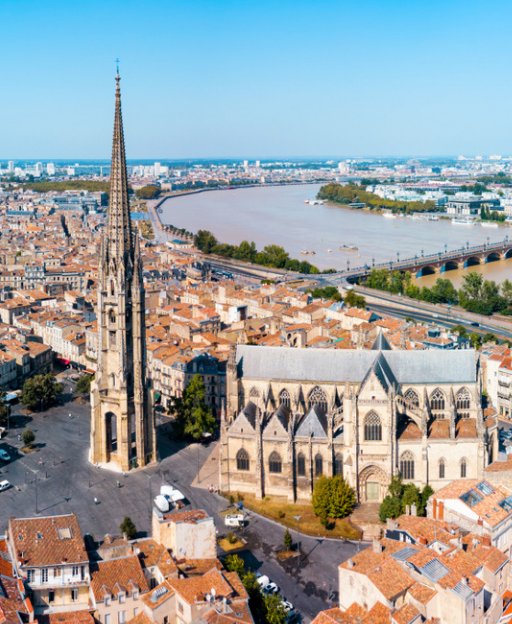
The Cathédrale Saint-André dominates the old town. Construction began in the 11th century and continued for four hundred years. The result is a layered building with Romanesque foundations and Gothic additions.
Next to the cathedral stands the Tour Pey-Berland — a free-standing Gothic bell tower. You can climb it. The view from the top takes in the cathedral roof, the city rooftops, and on a clear day, the surrounding countryside.
The Chartrons Quarter
The Chartrons was historically the wine merchant’s quarter on the left bank of the Garonne. Today it is one of the most pleasant neighbourhoods in Bordeaux for an afternoon. The streets hold wine merchants, independent bookshops, antique dealers, and good cafés.
The Cours du Médoc runs through the Chartrons and hosts an organic market on Sunday mornings. Walk north along the riverbank from Place de la Bourse and you reach it within fifteen minutes.
The Bordeaux Wine Region: Day Trips Worth Making
Bordeaux city is compelling on its own. But the wine country surrounding it is the reason most people make the trip.
Saint-Émilion
Saint-Émilion is forty minutes east of Bordeaux by train and one of the most visited wine towns in France. The village sits on a limestone plateau, with vines running right up to the church walls. The monolithic church — carved entirely from rock — dates to the 12th century and is one of the most unusual structures in the region.
The village is small and walkable. Wine tastings are available at dozens of properties in and around the commune. Saint-Émilion Grand Cru is one of France’s most celebrated appellations. Several smaller producers in the surrounding vineyards welcome visitors without appointments. The large châteaux often require booking ahead.
Trains run several times daily from Bordeaux Saint-Jean. It makes an easy half-day or full-day trip.
The Médoc Peninsula
The Médoc stretches north of Bordeaux along the Gironde estuary. This is the heartland of Bordeaux wine — home to the appellations of Pauillac, Margaux, Saint-Julien, and Saint-Estèphe, and to some of the most famous wine estates in the world.
Driving is the best way to explore. The D2 road — known as the Route des Châteaux — passes directly in front of the major estates. Several châteaux open for tastings, though the most famous require advance booking and are rarely available at short notice. Smaller estates throughout the Médoc offer high-quality wines and much easier access.
Sauternes
Sauternes lies forty-five minutes south of Bordeaux. The region produces the finest sweet wine in the world, made from botrytised grapes that concentrate sugars and add extraordinary complexity. Château d’Yquem is the most famous producer. The landscape is gentle and the villages are quiet.
It is worth a half-day trip if sweet wines interest you. For a deeper look at what makes this region exceptional, see our guide to Sauternes wine.
Where to Eat in Bordeaux
Canelés
The canelé is Bordeaux’s signature pastry. It is a small, fluted cake with a caramelised, almost crunchy exterior and a soft custard interior flavoured with rum and vanilla. They are sold all over the city.
Buy them fresh from a bakery or a specialist shop. The best canelés come straight from the mould, still warm. Avoid pre-packaged versions from tourist shops — they are not the same thing.
Marché des Capucins
Les Capucins is the main covered market in Bordeaux, open Tuesday to Sunday mornings. Locals call it the belly of Bordeaux. Stalls sell oysters from the Arcachon basin, cheese, charcuterie, fresh vegetables, and fish.
Arrive early. Several stalls have standing bars where you can eat oysters with a glass of white Bordeaux for a few euros. This is one of the best-value meals in the city — and one of the most local.
Dining Out
The Rue Saint-Rémi and surrounding streets in the old town are the main restaurant district. For a more local feel, the Chartrons neighbourhood has independent wine bars and bistros. Many restaurants offer a set lunch menu (formule) — typically a starter plus main, or main plus dessert. This is how Bordeaux locals eat well without spending a lot.
How Long to Spend in Bordeaux
Two days gives you enough time to explore the old town, visit the Cité du Vin, and make a half-day trip to Saint-Émilion.
Three to four days lets you explore more of the wine country. Add the Médoc for a full day’s drive, and a half-day in Sauternes. Spend the evenings eating well and walking the Quais at dusk.
Bordeaux pairs naturally with the Dordogne. The Dordogne Valley is about an hour and a half east by car, with medieval villages, cliff-top castles, and prehistoric caves. If you are road-tripping south-west France, combining both regions makes an excellent ten-day itinerary.
Practical Tips for Visiting Bordeaux
- Currency: Euro. Cards are accepted everywhere in the city and at most wine estates.
- Language: Some English is spoken in tourist areas, but less so in the wine country. A few French phrases go a long way.
- Getting around the city: Bordeaux has an excellent tram network. Buy a day pass for unlimited travel. The main sights are all reachable by tram or on foot.
- Hiring a car: Essential if you plan to explore the wine country independently. Hire from the airport or station. Most châteaux are not reachable by public transport.
- Where to stay: The old town and the Chartrons give the best access to sights and restaurants. Book early for September and October harvest season.
For a full breakdown of what France costs — including food, accommodation, and transport — see our France travel budget guide. To start planning the rest of your trip, visit our France trip planning hub.
FAQs About Visiting Bordeaux
What is the best time to visit Bordeaux?
September and October are the best months for wine lovers — the harvest (vendange) transforms the wine country and temperatures remain warm. Spring (April–May) is also excellent, with fewer crowds and mild weather.
How do I get from Paris to Bordeaux?
The TGV from Paris Montparnasse takes around two hours and four minutes to Bordeaux Saint-Jean. Trains run every one to two hours. Book through SNCF Connect or Trainline six to eight weeks ahead for the best prices.
Do I need a car to visit the Bordeaux wine country?
For Saint-Émilion, no — trains run regularly from Bordeaux Saint-Jean. For the Médoc and Sauternes, a car is the most practical option. Public transport to the smaller châteaux is limited.
Is Bordeaux worth visiting without an interest in wine?
Yes. The UNESCO old town, the Miroir d’Eau, the Cité du Vin, the Chartrons neighbourhood, and the food scene all stand on their own. Wine adds depth to the visit, but the city has plenty to offer beyond the vineyards.
You Might Also Enjoy
- Dordogne Travel Guide: What to See, When to Go and Where to Stay
- When to Visit France: The Best Time for Every Season and Region
- France Travel Budget: What a Trip to France Really Costs in 2026
Plan Your France Trip
Ready to start planning? Our complete France trip planning guide covers everything from visas and packing to the best regions for every travel style. It is the best place to start.
Join 7,000+ France Lovers
Three times a week, get France’s hidden gems, local recipes, and travel inspiration — the kind you won’t find in any guidebook.
Subscribe free — enter your email:
🇫🇷 Discover the France Most Tourists Never Find
Get our free guide to 25 hidden villages of France — then join 7,000+ readers for weekly stories about places most guidebooks never mention.
Get Your Free Village Guide →Love more? Join 64,000 Ireland lovers → · Join 43,000 Scotland lovers → · Join 30,000 Italy lovers →
Thinking about it seriously?
If you’ve started actually planning a move, our complete our complete Moving to France guide walks through every step, every cost, and the paperwork that catches most people out.
Free forever · · Unsubscribe anytime
Tours & experiences you might love


Powered by Viator. Some links are affiliate links — we may earn a small commission at no extra cost to you.

Leave a Reply