
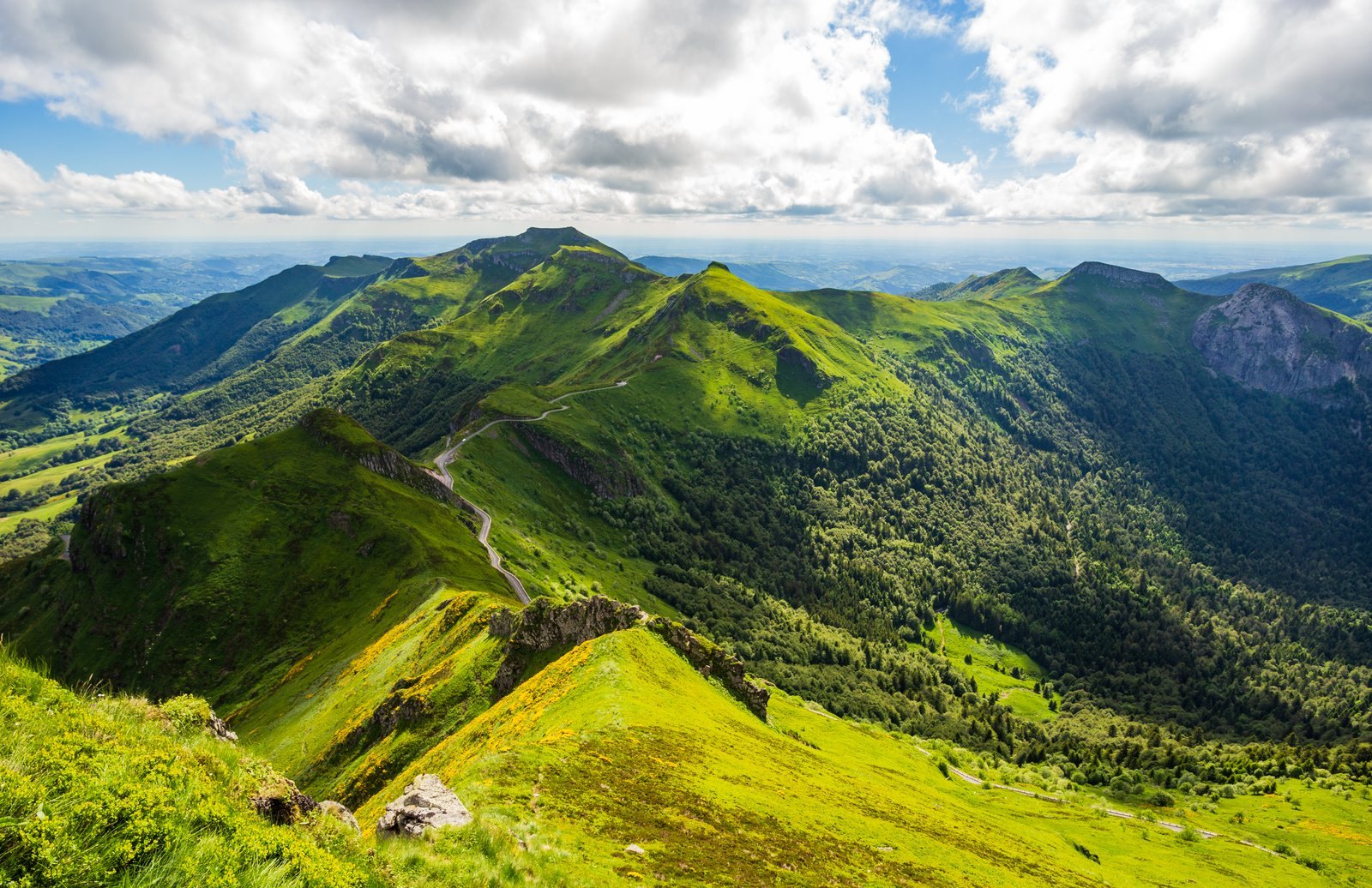
Auvergne sits at the very centre of France. Ancient volcanoes shaped its hills. Celtic warriors once called it home. For centuries, its people spread across France — carrying their surnames with them. If your family tree leads to this region, you carry one of the oldest heritages in France.
What’s your name in French? 🇫🇷
Your French Name — type any first name for the French equivalent, with meaning and regional notes.
This guide covers 20 of the most common French surnames of Auvergne: their origins, meanings, and what they reveal about the ancestors who first bore them. Whether your forebears were cattle farmers in Cantal or charcoal makers near Clermont-Ferrand, their name tells a story worth knowing.
Auvergne: The Volcanic Heart of France
The old region of Auvergne covers four departments: Puy-de-Dôme, Cantal, Haute-Loire, and Allier. Its landscape is unlike anywhere else in France. Dormant volcanic domes — called puys — rise from wide green valleys. The Massif Central forms the region’s backbone. This is the geographical and emotional heart of rural France.
Auvergne takes its name from the Arverni — a Celtic tribe who lived here more than 2,000 years ago. Their most famous leader was Vercingetorix. He united the Gauls against Julius Caesar in 52 BC. Caesar defeated him at the Battle of Alesia. But the Arverni left their mark. Their influence shaped Auvergne’s place names, its dialects, and the people who came after them.
The region’s geography shaped its people. Thick forests, deep gorges, and high plateaux kept communities apart. Each valley developed its own dialect and way of life. That separation gave Auvergne its distinctive surnames — names rooted in specific landscapes, trades, and small communities. For a closer look at the landscape, see our guide to the hidden medieval villages of Auvergne.
How Auvergnat Surnames Were Formed
Most French surnames became fixed between the 13th and 16th centuries. Before that, people used a single given name. As communities grew, families needed a way to tell each other apart. Four patterns emerged across Auvergne.
Trade names came from what a person did. A baker became Fournier. A charcoal maker became Charbonnier. A cattle herder became Vacher. These names tell you exactly what your ancestor’s work was.
Place names came from where a family lived or what grew nearby. Dumont meant someone who lived by a hill. Lavergne described an alder tree. Chazal described a small, isolated house in the hills.
Nickname names described appearance or character. Roux meant red-haired. Brun meant dark. Morel came from the Latin maurus, meaning dark-complexioned.
Patronymic names came from a father’s first name. Pascal came from Pascale — a child born at Easter. Vidal came from the Latin vita, meaning life.
Auvergne also had strong Occitan influence. The southern departments used Occitan versions of common names. That is why you find Faure here rather than Lefèvre, and Peyrou rather than Pierre. To learn about this linguistic heritage, read our piece on the ancient Occitan language France tried to ban.
20 French Surnames of Auvergne: Meanings and Origins
Landscape and Place Names
1. Dumont / Du Mont — “From the mountain” or “from the hill.” Auvergne has hundreds of volcanic hills and ridges. Families who lived near one took this name. The Dumont family was tied to the land itself.
2. Lavergne — From the Occitan word for alder tree. Alders grew along streams and river banks across Auvergne. The name marks where your ancestor’s family first settled — beside running water.
3. Chazal — From the Occitan casal, meaning a small house or isolated hamlet. Common in Auvergne’s hills, where families lived apart from the nearest village. Spelling variants include Chazet and Chassagne.
4. Peyrou / Peyrat — From the Occitan peyra, meaning stone or rock. A name for families who lived near rocky outcrops in Cantal or Haute-Loire.
5. Clausel — From the Latin clausus, meaning enclosed. A name for families living near a narrow valley pass or a walled enclosure between hills.
Trade and Craft Names
6. Fournier — The baker. From the Old French four, meaning oven. The Fournier operated the communal bread oven. In medieval Auvergne, the village baker held real authority in the community.
7. Charbonnier — The charcoal maker. Auvergne’s thick forests made charcoal production a major trade. Families named Charbonnier supplied the fuel that kept iron forges and homes warm across the region.
8. Vacher — The cattle herder. Cantal has raised cattle for over 2,000 years. Cantal AOP cheese — one of the oldest cheeses in France — still comes from local herds. A Vacher moved livestock between mountain pastures each summer.
9. Faure — The blacksmith. This is the Occitan version of the northern French Lefèvre. Blacksmiths served every village. The Faure family was usually one of the most respected in the community.
10. Masson — The stonemason. Auvergne is a region of stone — volcanic basalt, granite, and dark sandstone. Masons shaped the region’s distinctive dark churches and farmhouses. The name remains common across all four departments.
🇫🇷 Enjoying this? 7,000 France lovers get stories like this every week. Subscribe free →
Appearance and Character Names
11. Morel — From the Latin maurus, meaning dark or Moorish in complexion. A name given to dark-haired or dark-eyed people. Very common across southern and central France.
12. Brun / Lebrun — Brown or dark-haired. One of the most widespread French surnames. In Auvergne, it appears across all four departments. Variants include Lebrun and Debrun.
13. Roux / Le Roux — Red-haired. Red hair appears more often in France’s western and central regions. Auvergne’s Celtic heritage — the Arverni — may explain why Roux is so common here.
14. Malet / Mallet — Possibly from the Old French for hammer, or from mal, meaning unlucky or ill-tempered. Some families took this name for a craft; others for a character trait.
15. Achard — From the Germanic achard, meaning hard blade or determined one. The Franks and Visigoths who settled in Auvergne after the fall of Rome left Germanic names like this one behind.
Faith and Personal Names
16. Pascal / Paschal — Born at Easter. The name came from the Hebrew Pesach, through the Latin Paschalis. Deeply Catholic Auvergne gave this name to many children born during the Easter season.
17. Vidal — From the Latin vita, meaning life. A name given to children born strong. Very common in southern France and throughout Auvergne.
18. Jourdan / Jordan — From the River Jordan. Crusaders who made the pilgrimage brought this name back to France. Haute-Loire lies on one of France’s great pilgrimage routes — the Way of Le Puy to Santiago de Compostela — which explains its presence here.
Patronymic Names
19. Guyot — A shortened form of Guy, from the Germanic wido, meaning wood or guide. A father’s name that became the family name. Variants include Guyon and Guyard.
20. Riom — A rare surname taken from the town of Riom, which served as the medieval administrative capital of Auvergne. Families from Riom sometimes took the town’s name as their own. It remains rare but distinctive — and entirely Auvergnat.
The Auvergnats Who Left: Migration and the Paris Connection
Auvergne sent more young people to Paris than almost any other French region. From the 17th century, Auvergnats left their mountain villages for the capital. Many arrived as porteurs d’eau — water carriers — serving a city with no running water. They were reliable, frugal, and determined. Over time, many saved enough to open cafés or coal shops.
The word bougnat became Parisian slang for an Auvergnat. By 1900, Auvergnats ran a large share of Paris’s neighbourhood cafés. The famous café-charbon — a shop selling coffee and coal — was an Auvergnat invention. Families named Fournier, Vacher, and Charbonnier built new lives in the heart of the French capital.
Many Auvergnats also went to French Canada. Quebec records show Auvergnat surnames from the 17th century: Roux, Pascal, Fournier, Vidal, and Brun all appear in early colonial registers. Some families moved further south into Louisiana and the Caribbean. Today, Auvergnat descendants live from Montreal to New Orleans. To explore the broader story of French emigration, see our full guide to tracing your French ancestry.
How to Find Your Auvergnat Ancestors Today
Each of Auvergne’s four departments holds its own archive. All four have digitised large parts of their historical records. Many are free to search online.
- Puy-de-Dôme: archives63.fr — civil records from 1792, parish records from the 1600s, and military lists.
- Cantal: The Archives Départementales du Cantal hold records going back to the 12th century. Many registers are searchable online.
- Haute-Loire: archives43.fr — strong collection of parish records, including pilgrimage route registers.
- Allier: archives03.fr — civil and parish records, plus land registry documents.
For French-Canadians searching for Auvergnat roots, start with FamilySearch.org. Its French collection covers millions of records from all departments. Filae.com is a French specialist site with indexed records — search by surname and department. A surname appearing often in one department is a strong sign of local roots.
If you plan to research your family in person, read our full guide to planning a French heritage trip to your ancestral village.
Where to Visit in Auvergne Today
Clermont-Ferrand is the regional capital. Its cathedral stands in dark volcanic stone — one of the most unusual Gothic buildings in France. The old quarter of Montferrand preserves medieval streets almost unchanged.
Riom was Auvergne’s medieval capital. Its 14th-century streets hold ornate mansions, a Gothic chapel, and civic records that go back further than those of Clermont itself.
Le Puy-en-Velay is one of France’s most dramatic cities. Two volcanic plugs rise from the valley floor. A Romanesque chapel sits on top of one. The famous Way of Le Puy — a pilgrimage route to Santiago de Compostela — begins here.
Château de Val in Cantal is a medieval castle surrounded by the waters of Lac de Bort-les-Orgues. It is one of the most photogenic places in all of Auvergne — and a reminder of the region’s long feudal history.
Thiers is the knife-making capital of France — a medieval town above the Durolle river valley. If your ancestors worked in the cutlery trade, Thiers is where many of them lived and worked.
Frequently Asked Questions About Auvergne Surnames
What are the most common surnames in Auvergne?
The most common surnames in Auvergne include Fournier, Morel, Brun, Roux, and Vidal. These names appear across all four departments and reflect the region’s farming, craft, and religious heritage.
Why do many Auvergne surnames have Occitan spellings?
The southern departments of Cantal and Haute-Loire were part of the Occitan-speaking world for centuries. Occitan — the language of medieval southern France — used different sounds and spellings to northern French. Names like Faure, Peyrou, and Lavergne reflect this southern heritage.
How do I find out if my surname comes from Auvergne?
Start with the departmental archives for the four Auvergne departments: Puy-de-Dôme, Cantal, Haute-Loire, and Allier. All four have online databases. FamilySearch.org and Filae.com both let you search by surname and department. A surname appearing often in one department is a strong sign of local roots.
Did Auvergnat families emigrate to Canada?
Yes. Many Auvergnat families went to New France (Quebec) from the 17th century. Common Auvergnat surnames — Fournier, Roux, Vidal — appear in early Quebec parish records. French-Canadians searching for Auvergnat ancestry should check both French departmental archives and Quebec civil records at Bibliothèque et Archives nationales du Québec (BAnQ).
You Might Also Enjoy
- The Medieval Villages of the Auvergne That France Has Somehow Kept to Itself
- French Surnames of Languedoc: Origins, Meanings and Family Heritage
- The Acadians: Expelled from Nova Scotia, Forever French
Plan Your France Trip
Ready to visit Auvergne or explore more of France? Start with our complete planning hub: Start Here — Planning Your Trip to France. It covers everything from transport and budgets to the best regions to visit.
Join 7,000+ France Lovers
Every week, get France’s hidden gems, seasonal guides, local stories, and the art of la vie française — straight to your inbox.
Subscribe free — enter your email:
🇫🇷 Discover the France Most Tourists Never Find
Get our free guide to 25 hidden villages of France — then join 7,000+ readers for weekly stories about places most guidebooks never mention.
Get Your Free Village Guide →Free forever · One email per week · Unsubscribe anytime
Tours & experiences you might love


Powered by Viator. Some links are affiliate links — we may earn a small commission at no extra cost to you.

Leave a Reply