
In 911 AD, a Viking warlord shook hands with a French king. That moment changed Europe forever.
The man was Rollo. He had sailed from Scandinavia, raided the Seine valley, and besieged Paris. He had no interest in leaving. So Charles the Simple, King of France, did something bold. He gave Rollo the land. In exchange, Rollo swore loyalty, converted to Christianity, and agreed to protect France from other Vikings.
That deal created the Duchy of Normandy. It also created a people called the Normans.
Over the next 150 years, the Normans became one of the most ambitious forces in medieval history. They conquered England. They carved out a kingdom in Sicily. They launched crusades, built cathedrals, and left their mark on three continents. And it all started on a strip of coastline in northern France.
From Vikings to Normans: A New Identity Forged in France
Rollo’s people were Norse. But within two generations, they were speaking French.
They adopted the local language, the local faith, and the local customs. They married into Frankish families. They built monasteries and funded the church. They were no longer Vikings in the old sense. They were Normans — from Northmanni, the Latin for “men of the north.”
Yet they kept something of their ancestors’ drive. A hunger for land. A talent for war. An appetite for building things that lasted.
The Viking roots showed in their place names. Harcourt, Vareville, and Torigni-sur-Vire all carry echoes of Old Norse. Even some of the French surnames of Normandy carry traces of this Norse past. Names like Turgis, Anquetil, and Osmond are not French at all — they are Viking names in French clothing.
The Norman duchy grew powerful. By the 11th century, it was one of the wealthiest lordships in France. A duke named William was about to make it famous.
William the Conqueror: The Duke Who Took England
William was born in 1028 in Falaise, in the heart of Normandy. His father was Duke Robert I. His mother was Herleva, a tanner’s daughter. He was never going to have an easy life.
Robert died when William was seven years old. His nobles turned against him. Several of his guardians were murdered. He survived through luck, cunning, and sheer stubbornness.
By the time he reached adulthood, William had turned Normandy into a military machine. He kept his barons in line. He built castles. He forged alliances across northern France.
Then, in January 1066, Edward the Confessor, King of England, died without an heir. Harold Godwinson, the most powerful earl in England, grabbed the crown. William believed it was his by right. Harold had sworn an oath. William would not forget that.
William gathered his forces. He built a fleet. In September 1066, he crossed the Channel with around 7,000 men.
On 14th October 1066, Harold and William met at Hastings, in East Sussex. The battle lasted most of the day. Harold died — possibly from an arrow, possibly cut down by Norman knights. England’s Anglo-Saxon royal line ended on that field.
On Christmas Day, 1066, William was crowned King of England at Westminster Abbey.
The conquest did not end at Hastings. William spent years crushing English resistance. He built castles across the country — including the Tower of London. He replaced English lords with Norman nobles. He introduced Norman French as the language of the court.
English was never quite the same again. Roughly 10,000 French words entered the language after 1066. “Beef” comes from the Norman bœuf. “Justice” from justice. “Parliament” from parlement. “Conquest” from conquête. Norman conquerors ate the beef; English peasants still called it a cow.
The Normans in Southern Italy: An Even More Unlikely Story
While William was eyeing England, a different group of Normans was heading somewhere even more surprising.
In the 1030s and 1040s, Norman knights began drifting south into Italy. Some came as pilgrims returning from Jerusalem. Some came as mercenaries looking for work. Southern Italy was a patchwork of Lombard duchies, Byzantine territories, and Muslim-controlled Sicily. It was unstable, violent, and full of opportunity.
The Hauteville family led the charge. Robert Guiscard and his brother Roger arrived in southern Italy in the 1040s with almost nothing. They hired out their swords. They fought for local lords. Then they started taking land for themselves.
By the 1060s, Robert Guiscard controlled much of the Italian south. His brother Roger began the conquest of Sicily — then ruled by the Kalbid dynasty. It took 30 years. But in 1091, the last Muslim stronghold fell. Sicily was Norman.
🇫🇷 Enjoying this? 7,000 France lovers get stories like this every week.
Thinking about it for retirement? If you’ve started thinking seriously about retiring there, our complete our full Retire in France guide covers the visa, healthcare, cost-of-living, and the regions worth shortlisting.
The Kingdom of Sicily: Europe’s Most Remarkable Court
Roger II, Roger’s son, went further. In 1130, he united Sicily, southern Italy, and Malta into a single kingdom — the Kingdom of Sicily. Pope Anacletus II crowned him king on Christmas Day. The date echoed William’s coronation 64 years earlier. The Normans liked their Christmas crownings.
Roger’s court in Palermo was unlike anything else in medieval Europe. Muslim scholars worked alongside Christian bishops. Arab geographers mapped the world in Arabic. Greek monks copied manuscripts. Jewish merchants traded openly.
The palace chapel — the Cappella Palatina, still standing today — blends Byzantine mosaics, Arabic muqarnas ceilings, and Norman stone arches into one room. It is one of the strangest and most beautiful spaces in Europe.
Roger II commissioned one of the finest geographic works of the 12th century. His court geographer, al-Idrisi, created a map of the world so detailed it remained in use for centuries. A Muslim scholar working for a Norman king in a city that had changed hands between Arabs, Byzantines, and Normans within living memory.
That was the Norman gift. They did not destroy the cultures they conquered. They absorbed them, reshaped them, and built something entirely new.
The Norman Legacy: Three Continents, One People
The Normans left their mark on three languages, three legal systems, and dozens of architectural traditions.
In France, you can walk through their legacy. Rouen Cathedral, where the Dukes of Normandy are buried, still dominates the city skyline. The Abbaye aux Hommes in Caen was founded by William himself. The Bayeux Tapestry — a 68-metre embroidered chronicle of the conquest — is one of the most extraordinary documents of the Middle Ages.
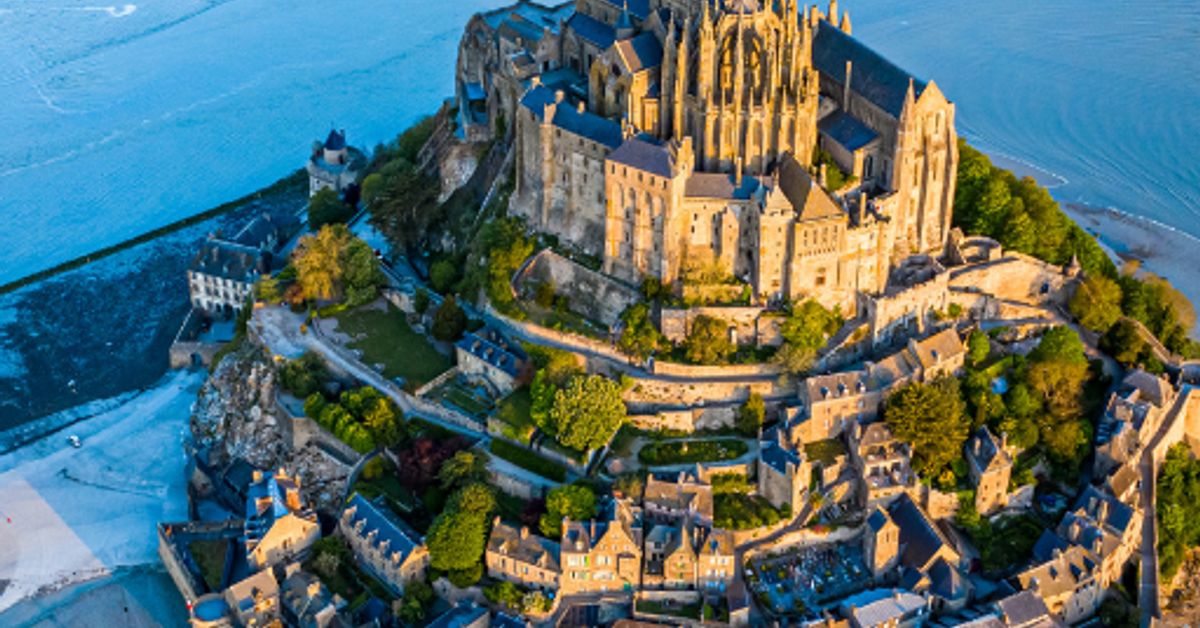
Mont-Saint-Michel has stood off the Normandy coast since 966 AD, when Duke Richard I gave the island to Benedictine monks. The Normans expanded and fortified it. It became a place of pilgrimage and a symbol of Norman power. It remains one of France’s most visited landmarks today.
In England, Norman castles still stand at Windsor, Rochester, and the Tower of London. The Domesday Book, which William commissioned in 1086, remains one of the most complete records of medieval society anywhere in the world.
In Sicily, Palermo Cathedral and the Cefalù Cathedral still carry the Norman-Arab-Byzantine style that made the kingdom unique. Nowhere else in Europe looks quite like it.
Do You Have Norman Blood?
If your family is English, there is a real chance you carry Norman ancestry.
After 1066, thousands of Norman knights and administrators settled in England. Their children married into English families. Their descendants spread through the British Isles and, eventually, to North America, Australia, and South Africa. Surnames like Montgomery, Percy, Mortimer, Beaumont, and Ferrers all have Norman French roots.
If your family is French-Canadian, Norman ancestry is especially likely. Normandy was one of the main source regions for settlers in New France in the 17th century. Thousands of colonists in Quebec and Acadia came from the towns and villages of the old duchy.
Tracing Norman ancestry often means tracing French ancestry first. Our step-by-step guide to tracing your French ancestry walks through the archives, records, and online tools that can help you find your roots.
And if you’re ready to visit in person, our French heritage travel guide explains how to plan a trip to your ancestral village. Normandy has strong local archives, a well-developed heritage tourism network, and more than a few castles worth seeing along the way.
Where to See Norman History in France Today
Normandy is the obvious starting point. Here are the places that bring Norman history to life.
Rouen is where the Norman duchy was born. The old city has magnificent architecture built on Norman foundations. Rouen Cathedral, Monet’s most-painted subject, dates to the 12th century. The city’s old streets still carry a medieval feel.
Falaise is where William was born. The castle still stands on the cliff above the town. Inside, a gallery of statues shows the European kings and queens who descended from William — a surprisingly long list.
Bayeux is home to the famous tapestry. Allow at least two hours. It is longer, more detailed, and more moving than most people expect.
Caen has two great Norman abbeys. The Abbaye aux Hommes was William’s own foundation. The Abbaye aux Dames was founded by his wife Matilda. Both are still in use today.
Mont-Saint-Michel stands on a tidal island at the border of Normandy and Brittany. It has been a place of pilgrimage for over a thousand years. Go at low tide if you can. Walk the causeway on foot. The approach across the bay is unforgettable.
If you want to follow the Normans to Sicily, Palermo’s Cappella Palatina is worth a flight on its own. But start in Normandy. That is where the story began.
Frequently Asked Questions About the Normans
Who were the Normans and where did they come from?
The Normans were descendants of Viking (Norse) settlers who received land in northern France in 911 AD. Their leader, Rollo, made a deal with the French king Charles the Simple. Within two generations, the Norse settlers had adopted the French language, Christian faith, and local customs, becoming a distinct people known as Normans — from the Latin Northmanni, meaning “men of the north.”
When did the Normans conquer England?
The Norman conquest of England took place in 1066. Duke William of Normandy defeated King Harold II at the Battle of Hastings on 14th October 1066. William was crowned King of England at Westminster Abbey on Christmas Day, 1066. The conquest introduced Norman French vocabulary, feudal law, and castle architecture to England.
Why did the Normans go to Sicily?
Norman knights first went to southern Italy in the 1030s and 1040s as mercenaries and pilgrims. The region was politically fragmented, and the Normans used that instability to carve out territory. The Hauteville family led the conquest of Sicily from the ruling Kalbid dynasty between 1061 and 1091. In 1130, Roger II united these territories into the Kingdom of Sicily, one of medieval Europe’s most cosmopolitan states.
What Norman heritage sites can I visit in France?
Normandy is full of Norman heritage sites. The Bayeux Tapestry in Bayeux tells the story of the 1066 conquest in 68 metres of embroidered linen. William the Conqueror’s birthplace castle stands at Falaise. The Abbaye aux Hommes in Caen was founded by William himself. Mont-Saint-Michel, which Duke Richard I gave to Benedictine monks in 966, is one of France’s iconic landmarks. Rouen, the old Norman capital, has Romanesque and Gothic buildings that date to the Norman era.
How do I trace Norman or French-Norman ancestry?
Tracing Norman ancestry usually begins with French genealogy records. French civil records (état civil) go back to 1792. Parish records (registres paroissiaux) go back much further — some to the 16th century. The archives départementales for Normandy (Seine-Maritime, Calvados, Manche, Orne, Eure) are available online, many free of charge. Our full French ancestry guide covers the main resources step by step.
You Might Also Enjoy
- French Surnames of Normandy: Origins, Meanings and Family Heritage — Discover the surnames that trace back to Viking settlers and Norman lords.
- The Huguenots: France’s Great Exodus and Its Global Legacy — Another story of a French people who changed the world by leaving it.
- The Acadians: Expelled from Nova Scotia, Forever French — The story of the French settlers who carried Normandy’s spirit to the New World.
Plan Your France Trip
Ready to follow the Normans through France? Our France travel planning hub has everything you need — from heritage itineraries to practical travel tips. Start there and work your way to Normandy.
Join 7,000+ France Lovers
Every week, get France’s hidden gems, seasonal guides, local stories, and the art of la vie française — straight to your inbox.
Subscribe free — enter your email:
Love more? Join 64,000 Ireland lovers → · Join 43,000 Scotland lovers → · Join 30,000 Italy lovers →
Free forever · One email per week · Unsubscribe anytime
Tours & experiences you might love


Powered by Viator. Some links are affiliate links — we may earn a small commission at no extra cost to you.

Leave a Reply