
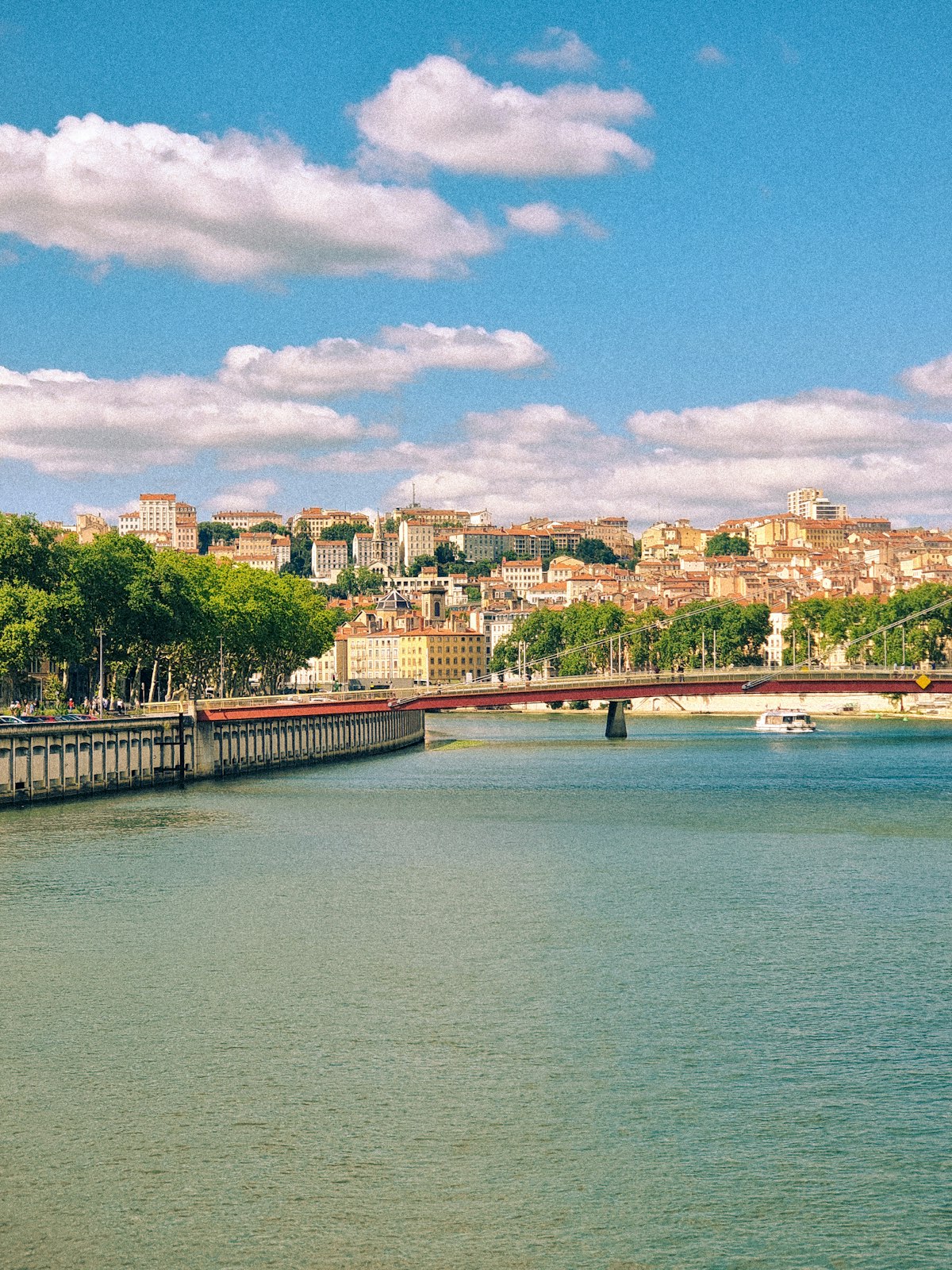
Lyon has two rivers, a Roman hilltop, a world-class food scene, and more than 2,000 years of history packed into one city. But one of its most photographed spots is a simple pedestrian bridge painted red. The Passerelle du Collège spans the Saône river near the edge of Vieux Lyon, and it rewards early risers with one of the city’s best morning views.
This guide covers what the footbridge actually is, how to get there, the best time to visit, and what else is worth your time in the surrounding area.
Love France? Get weekly stories, local tips, and travel ideas straight to your inbox.
Subscribe to our free France newsletter →
What Is the Passerelle du Collège?
The Passerelle du Collège is an iron pedestrian bridge crossing the Saône in the 5th arrondissement of Lyon, close to the old town quarter of Vieux Lyon. It is one of several footbridges that cross the Saône between the Presqu’île peninsula and the slopes of Fourvière hill, but it is the one that draws the most photographers — largely because of its bold red paintwork and its position at the edge of the UNESCO-listed old town.
The bridge links the rue de la Quarantaine on the Presqu’île side with the rue de l’Antiquaille and the old town streets to the west. It is strictly for pedestrians and cyclists, which means it stays quiet even when the streets around it are busy.
Iron footbridges like this were built across Lyon’s rivers throughout the 19th and early 20th centuries as the city expanded. The current structure is a later replacement, but the design is consistent with the functional iron bridge-building of the era — no grand ornament, just clean engineering and a coat of red paint that stands out hard against the stone façades of Vieux Lyon behind it.
Why Go in the Morning?
The short answer: the light and the quiet.
Lyon faces east across the Saône, which means the old town buildings and the Fourvière basilica catch the morning sun directly. Between about 07:00 and 09:00 in summer (slightly later in winter), the warm light falls across the bridge and the traboule entrances and shuttered windows of Vieux Lyon in a way you will not get at any other point in the day.
By mid-morning the area starts to fill with school groups, tour parties, and day visitors. The narrow streets of Vieux Lyon — already tight — feel noticeably more cramped by 10:30. If you want to stand on the bridge without anyone walking through your line of sight, aim for 07:30 to 08:30 on a weekday, or 07:00 to 08:00 at the weekend when the streets are even quieter.
In winter, the mist that settles over the Saône in the early hours often lifts slowly, and the bridge can look exceptional in low fog with the red ironwork emerging from grey air. It is worth checking the forecast the night before — a clear overnight followed by a cool morning often produces the best conditions.
How to Get There
The Passerelle du Collège is easy to reach on foot from the city centre. From the Place Bellecour — Lyon’s main square and the usual starting point for first-time visitors — it is about a 10 to 12 minute walk heading south-west along the quays of the Saône. You will pass the Passerelle Saint-Georges and several other riverside spots on the way.
If you are coming by metro, the closest station is Vieux Lyon – Cathédrale Saint-Jean on line D, which deposits you directly at the base of Fourvière hill, a short walk from the Saône bank. From there it is about five minutes on foot to reach the footbridge, walking south along the river.
There is no car park at the footbridge itself. Street parking in Vieux Lyon is extremely limited, and this is one area of the city where driving simply does not pay. The metro and the city’s Vélo’v bike-share scheme are both better options. Bike stations are positioned throughout the Presqu’île, and the quays of the Saône have a flat cycle path running along them.
Planning a trip to France? Our free newsletter covers the best of French travel — from city breaks to rural escapes.
Sign up free here →
What to See Nearby
The Passerelle du Collège is a good anchor point for a half-day in Vieux Lyon and around Fourvière. Here is what is within easy walking distance.
Vieux Lyon
Vieux Lyon is the largest Renaissance quarter in France outside of Paris, and it is a UNESCO World Heritage site. The streets immediately east of the footbridge — particularly rue Saint-Jean and rue du Boeuf — are lined with pastel-coloured townhouses from the 15th and 16th centuries. These were built by wealthy silk merchants during the period when Lyon was one of the most important commercial cities in Europe.
One thing genuinely worth doing here is finding a traboule. These are covered passageways that cut through the interior courtyards of Vieux Lyon’s buildings, connecting one street to another. They were originally used by silk workers to transport goods under cover, and later by Resistance fighters during the Second World War. Many are now open to the public during daytime hours — look for small plaques by the doors.
The Fourvière Basilica
The Basilique Notre-Dame de Fourvière sits on the hill directly above Vieux Lyon. It was built between 1872 and 1884, and its distinctive white stone silhouette — heavily ornate, with towers and turrets — is visible from much of central Lyon. From the esplanade in front of the basilica, you get a full panoramic view over the city, both rivers, and on clear days towards Mont Blanc to the east.
You can reach it by foot (steep climb, about 20 minutes) or by the Ficelle — a funicular that runs from the Vieux Lyon metro station. The funicular is free with a standard TCL metro ticket. The basilica itself is open daily and entry is free.
The Roman Theatres
At the top of Fourvière hill, next to the basilica, are two Roman theatres: the Grand Théâtre and the Odéon. The Grand Théâtre is one of the oldest in France, dating from around 15 BC. Both are well-preserved and open for free. They host the Nuits de Fourvière festival each summer — an outdoor arts and music event that runs from June through August and is well worth checking if you are visiting during that period.
Musée Gadagne
Located in a Renaissance mansion in Vieux Lyon, Musée Gadagne houses two museums under one roof: the Lyon History Museum and the World Puppetry Museum. The building itself is worth a look — built between the 15th and 17th centuries, it is one of the finest examples of Renaissance architecture in the city. Entry is around €8 for adults.
Practical Information
The Passerelle du Collège is open at all hours and is always free to cross. There are no entrance fees, no ticket offices, and no guided tours specific to the bridge itself.
The footbridge connects to a network of riverside paths on both banks of the Saône, so it works well as part of a longer walk. If you continue south along the Presqu’île bank after crossing, you will reach the Parc des Hauteurs trail, which follows the ridge of Fourvière along a green corridor with city views.
For food and coffee in the morning, the Vieux Lyon streets have several boulangeries open from around 07:00. The rue Saint-Jean has the highest concentration of cafés, though prices in this tourist area tend to be slightly higher than in the Presqu’île. If you cross back via the footbridge after your morning visit, the quays of the Presqu’île have more neighbourhood-style cafés at better prices.
Getting around Lyon: The TCL transport network covers bus, metro, tram, and funicular on one ticket type. A standard single fare (as of 2025) is €2.00, and a 24-hour pass costs around €6.00. The Vélo’v bike-share costs €1.80 for a day pass, with the first 30 minutes of each ride free.
Worth the Journey
The Passerelle du Collège is not a monument in the conventional sense. There is no entry fee, no audio guide, no queue. It is just a red bridge over a French river, in a city that deserves more attention than it usually gets from international visitors.
What makes it worth seeking out is the combination of factors that come together on a clear morning: the red ironwork, the still water, the stone facades of Vieux Lyon in the background, and the near-silence before the city fully wakes up. Lyon is not the easiest city to slow down in — it runs at a serious pace — but the footbridge in the morning is one of those spots where it is easy to just stand still for a few minutes and take it in.
If you are heading to Lyon and have not been before, give yourself at least two full days. The city rewards slow exploration far more than a rushed half-day stop on the way to the Alps or the south. Start at the footbridge early, then work your way up Fourvière, back down through the traboules, and across to the Presqu’île for lunch. That half-day alone will give you a solid sense of what Lyon is about.
More from France: We send a free weekly newsletter with travel ideas, local picks, and things to do across France. No spam — just France.
Join the newsletter →
Image: Saône river and bridges, Lyon, France. Photo by Godefroy Boutet via Unsplash.
Thinking about it seriously?
If you’ve started actually planning a move, our complete our complete Moving to France guide walks through every step, every cost, and the paperwork that catches most people out.
Tours & experiences you might love


Powered by Viator. Some links are affiliate links — we may earn a small commission at no extra cost to you.

Leave a Reply