
Brittany is France’s most distinct region. It has its own ancient Celtic language, a coastline unlike anywhere else in Europe, and a food culture built on buckwheat, butter, and the Atlantic. If you are planning a trip to France, Brittany often surprises travellers who expected something similar to Paris or Provence — and then finds itself top of their list.
Love France? Join 7,000+ readers on our free newsletter → lovetovisitfrance.substack.com
Why Brittany Feels Different From the Rest of France
🇫🇷 Free: The Perfect Provence & South of France Road Trip
A free 10-day itinerary covering Avignon, the Luberon villages (Gordes, Roussillon, Bonnieux), Marseille, Cassis, Aix-en-Provence, and the Camargue — with practical route notes most travel guides leave out.
Get the Free Itinerary →Walk into any Breton market and you will notice something unusual. Signs appear in two languages — French and Breton. The Breton language is Celtic, closely related to Welsh and Cornish. Around 200,000 people still speak it today. Brittany was an independent duchy until 1532, and it has never entirely forgotten that.
The landscape reinforces the sense of difference. Brittany’s interior is covered in heathland, ancient forests, and standing stone sites that predate the Roman Empire. Its coastline stretches for over 2,700 kilometres — more than any other French region. In some places you will find dramatic granite cliffs. In others, you will find long sandy beaches and shallow tidal flats. The sea is never far away.
For American travellers, Brittany offers something valuable: a version of France that feels genuinely off the tourist circuit. Most visitors fly into Paris and head south or east. Brittany goes northwest, and that small choice makes an enormous difference.
The Best Places to Visit in Brittany
Saint-Malo
Saint-Malo is Brittany’s most famous port town, and it earns the reputation. The old walled city (the intra-muros) sits on what was once an island. Its ramparts are almost completely intact. You can walk the full circuit along the top in under an hour, looking out over the Atlantic and the tidal islands beyond.
The town was almost entirely rebuilt after the Second World War, but the reconstruction was careful. The streets inside the walls still feel like a seventeenth-century corsair city. Saint-Malo was home to privateers who had royal permission to raid enemy ships. The city’s most famous son, Jacques Cartier, sailed from these docks to explore Canada in 1534.
The Pink Granite Coast
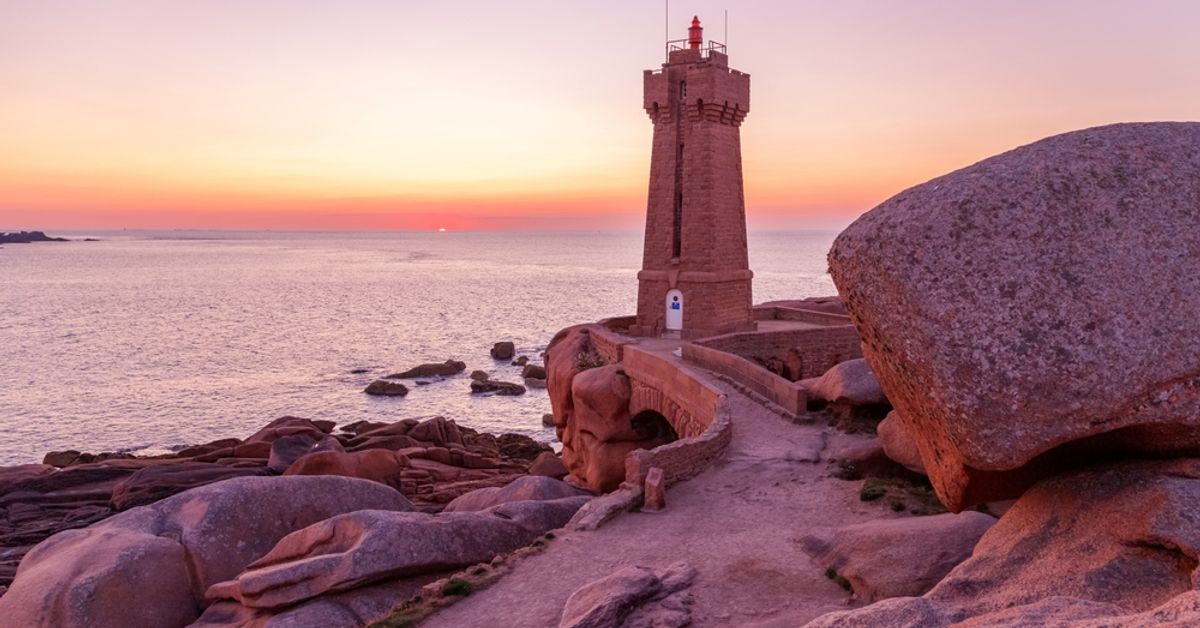
The Pink Granite Coast (Côte de Granit Rose) runs between Paimpol and Trébeurden, near the town of Perros-Guirec. The rocks here are genuinely pink — the colour comes from the high feldspar content in the local granite. At sunrise and sunset, they glow orange and red against the blue of the sea.
The Ploumanac’h lighthouse stands at the heart of the coast. The walking path around the rocks is one of the most photographed routes in France. Most boulders have been shaped by the sea into smooth, organic forms — some the size of a small car, others as tall as a house. Visit early in the morning or in May to September to avoid the summer crowds.
Dinan
Dinan is one of the best-preserved medieval towns in France. It sits above the Rance estuary, about 30 kilometres south of Saint-Malo. The old town has timber-framed houses, a fourteenth-century castle, and ramparts that offer long views over the river valley. The cobbled streets in the Jerzual district are steep and lined with artisans’ workshops and crêperies.
Dinan is quiet, even in summer. It receives far fewer visitors than comparable medieval towns in the Loire Valley or Normandy. That makes it an ideal place to spend a half-day or a full day at a slower pace.
Carnac and the Standing Stones
Carnac is one of the most significant prehistoric sites in the world. The town has over 3,000 standing stones arranged in parallel alignments stretching for several kilometres. They were erected between 4,500 and 3,300 BC — which means Carnac predates both Stonehenge and the Egyptian pyramids.
The largest alignment, the Ménec alignment, contains 1,169 stones arranged in eleven parallel rows. Access to the main alignments is carefully managed to protect the site. Guided visits depart from the Le Ménec visitor centre. The nearby Musée de Préhistoire de Carnac holds a strong collection of excavated artefacts. Carnac is in the Morbihan department of southern Brittany, about two hours from Saint-Malo by car.
Concarneau
Concarneau is a working fishing port in Finistère, in the far west of Brittany. Its walled town (Ville Close) occupies a small island connected to the harbour by a bridge. The walls date to the fourteenth century. Inside, narrow lanes lead past crêperies, seafood restaurants, and a fishing museum documenting the Atlantic sardine trade.
Concarneau is also one of France’s largest tuna fishing ports. The fish market operates early each morning. If you want to see Brittany’s working fishing industry, this is the place to visit.
What to Eat and Drink in Brittany
Brittany’s food culture rests on two foundations: the buckwheat galette and the Atlantic Ocean. A galette is a savoury crêpe made from buckwheat flour, filled with ham, egg, cheese, or anything else on the menu. It is a proper meal, not a snack. Crêperies are serious restaurants here, not tourist traps.
The sweet crêpe — made with white wheat flour — comes after. Brittany produces most of France’s butter, and you will taste that in everything. The region’s signature pastry, kouign-amann, is a round caramelised butter cake from the town of Douarnenez. It is rich, golden, and deeply satisfying.
Brittany produces around 40% of France’s oysters. The Belon and Cancale oysters are the most celebrated. Moules marinières, langoustines, and crab are sold at harbourside restaurants for a fraction of the price you would pay in Paris. Breton cider — dry, cloudy, and made from local apples — is the traditional drink alongside a galette, not wine.
When to Visit Brittany
The best months are May, June, and September. The weather is mild, the coastal paths are at their greenest, and the main sites are not crowded. June offers long daylight hours — sunset on the Pink Granite Coast after 10pm is not unusual.
July and August bring peak summer. Beaches fill quickly, especially around the Morbihan Gulf and the Crozon Peninsula. Accommodation becomes expensive and books up months in advance. That said, summer is also when Brittany’s Fest-Noz festivals take place. These traditional night festivals centre on Breton music and group dancing. They happen in village squares across the region and are free to attend.
October through March is quiet. Many smaller restaurants and hotels close, especially in coastal villages. The weather can be wet and windy. For walkers, the off-season has real appeal — the GR34 coastal footpath is spectacular on a clear October day with no other walkers in sight. For a month-by-month breakdown of the whole country, see our guide to the best time to visit France.
How to Get to Brittany From Paris
The TGV from Paris Montparnasse to Rennes takes 1 hour 25 minutes. Rennes is Brittany’s regional capital and a good base for exploring the eastern part of the region. From Rennes, you can reach Saint-Malo in about 50 minutes by train or car.
Brest, at the far western tip of Brittany, takes about 3 hours 45 minutes from Paris by TGV. Quimper takes roughly 4 hours. If you hire a car — which gives you much more flexibility for the coastline — the drive from Paris takes 3.5 to 4.5 hours, depending on your destination. There are no motorway tolls once you enter Brittany itself.
Brittany’s airport at Brest Bretagne is served by Ryanair and Volotea from several European cities, but no direct transatlantic flights exist. Most American travellers fly into Paris and connect by train or car.
Planning a Trip to France?
Every week, Love France sends one email with the hidden corners, local recipes, and practical tips that most guidebooks miss. Free, and you can unsubscribe any time.
Join 7,000+ France Lovers Free →How Long to Spend in Brittany
Five to seven days gives you time to see the highlights without rushing. With five days, you could base yourself in Saint-Malo for two nights, drive the Pink Granite Coast from a small hotel near Perros-Guirec for two nights, and spend your final day in Dinan before returning to Paris.
A week allows you to add southern Brittany — Carnac, the Morbihan Gulf, and Concarneau. The Gulf of Morbihan (the name means “little sea” in Breton) contains over 40 islands. You can take boat tours from Vannes or Auray, and the sheltered waters are warm enough for swimming in July and August.
Two weeks suits travellers who want to walk sections of the GR34 coastal footpath, which traces the entire coastline of Brittany for 1,800 kilometres. Most walkers complete a three to five day section rather than attempting the full route at once.
Combining Brittany With Other French Regions
Brittany pairs well with Normandy or the Loire Valley. From Saint-Malo, Mont-Saint-Michel is under an hour away. The abbey sits on the border between Brittany and Normandy and is one of the most visited sites in France. It is straightforward to build a loop that takes in both regions in a single trip.
Travellers who combine Brittany with a Normandy D-Day trip often call it one of the most moving combinations in France. The beaches and memorials take a full day. Saint-Malo, just two hours from Bayeux by road, adds a completely different dimension — the living character of the Atlantic coast in peacetime.
The Loire Valley is about two hours from Rennes. A logical route from Paris goes Paris to the Loire Valley and then across to Brittany, or the same in reverse. This contrast between château country and the wild Atlantic coast works particularly well on a first extended trip to France.
For full itinerary help, visit our France trip planning hub.
Frequently Asked Questions About Visiting Brittany
What is Brittany best known for?
Brittany is best known for its Celtic heritage, its dramatic Atlantic coastline, and its food — particularly buckwheat galettes, oysters, and salted butter caramel. It is also famous for the Carnac standing stones, one of the largest prehistoric monuments in Europe, and for the walled port city of Saint-Malo.
How many days do you need in Brittany, France?
Five to seven days gives you time to see the main highlights — Saint-Malo, the Pink Granite Coast, Dinan, and sections of the coastline. A full week allows you to add southern Brittany, including Carnac and the Morbihan Gulf. Two weeks suits walkers who want to complete a section of the GR34 coastal footpath.
Is Brittany worth visiting for American travellers?
Yes, absolutely. Brittany offers a very different France from the version most American visitors expect. Its Celtic history, its prehistoric sites (Carnac predates the Egyptian pyramids by centuries), its outstanding seafood, and its wild coastline make it one of the most rewarding regions for travellers who want to go beyond Paris. It is also significantly less crowded than southern France in summer.
What language do people speak in Brittany?
French is the main language. The Breton language — a Celtic language related to Welsh and Cornish — is still spoken by around 200,000 people, mainly in the western half of the region. You will see bilingual signage throughout Brittany, particularly on road signs and in market towns.
You Might Also Enjoy
- Mont-Saint-Michel France Travel Guide — everything you need to plan your visit to France’s most iconic island abbey
- Normandy D-Day Trip: The Complete Guide for American Travellers — beaches, cemeteries, memorials, and how to plan the day
- Loire Valley Road Trip: France’s Perfect Château Route — a self-drive itinerary through the valley of the kings
Plan Your France Trip
For help planning your full France itinerary — from choosing which regions to include to working out how many days you need — visit our France Trip Planning Hub. It covers everything from transport and timing to packing and the best time to go.
Join 7,000+ France Lovers
Every week, get France’s hidden gems, local recipes, and travel inspiration — the kind you won’t find in any guidebook.
Subscribe free — enter your email:
Love more? Join 64,000 Ireland lovers → · Join 43,000 Scotland lovers → · Join 30,000 Italy lovers →
Free forever · One email per week · Unsubscribe anytime
Tours & experiences you might love


Powered by Viator. Some links are affiliate links — we may earn a small commission at no extra cost to you.

Leave a Reply