
What’s your name in French? 🇫🇷
Your French Name — type any first name for the French equivalent, with meaning and regional notes.
The surnames that came out of Île-de-France are some of the most travelled names in the world. Families named Dupont, Martin, Leclerc, or Leroy left the Paris basin centuries ago and carried those names to Québec, Louisiana, Martinique, and beyond. If you have French ancestry and your family came from the heartland of France, there is a good chance their name traces back to this region — the ancient core of the French kingdom.
Île-de-France surrounds Paris on all sides. It includes the Seine valley, the royal forests of Fontainebleau and Rambouillet, the cathedral city of Chartres to the south-west, and the medieval town of Meaux to the east. For nearly a thousand years, it was the engine of French political life, the seat of the Capetian kings, and the source from which French language, law, and culture spread outward across the country. The surnames that formed here reflect all of that history.
How French Surnames Formed in the Paris Region
Surnames in France did not become fixed until the 16th century, though many had been in use informally since the 12th. In Île-de-France, four main patterns produced most of the surnames still common today.
Occupational surnames were the most common in urban Paris. The city’s guilds gave us names like Leclerc (the clerk or notary), Lefebvre or Lefèvre (the blacksmith), Masson (the stonemason, essential in a city of cathedrals), Charpentier (the carpenter), and Boucher (the butcher). Paris was a merchant city, and its surnames show it.
Patronymic surnames came from a father’s given name. The son of a man named Martin became Martin. The son of a man named Bernard became Bernard. These names were already common before the Norman Conquest and spread across the French-speaking world unchanged.
Topographic surnames described where a family lived. Dubois meant the family from the woods — and the forests of Île-de-France were vast. Dupont meant the family near the bridge. Fontaine pointed to a spring or well. Laval indicated a valley. These names were practical and local.
Descriptive surnames noted a physical feature or personal quality. Petit meant small or young. Roux meant red-haired. Blanc meant fair. Brun meant dark. Morin, one of the most common names in Paris, likely derived from Maurus, a Latin name associated with dark colouring.
The Most Common Île-de-France Surnames and What They Mean
These are the surnames that came from the Paris basin and its surrounding towns. Many of them rank among the most frequent French surnames in Canada, the United States, and the Caribbean today.
Martin is the single most common French surname. It comes from the Latin Martinus, a name associated with Saint Martin of Tours — the patron saint of France. Martin was already widespread in Île-de-France before surnames became hereditary, and it spread with French settlers to every colony.
Dupont (also Du Pont or Depont) literally means “from the bridge.” The Paris region had dozens of river crossings over the Seine, the Marne, and the Oise. Families who lived near a bridge became Dupont. The name appears in early Quebec records and was common among French settlers in Louisiana.
Dubois means “from the woods.” The royal forests of Fontainebleau, Rambouillet, and the Bois de Vincennes surrounded medieval Paris. Families settled on the edges of those forests carried this name. It is one of the top ten French surnames in Québec today.
Leclerc (also Le Clerc or Leclercq in northern variants) meant the literate man — the clerk, notary, or church official. Paris was a city of writing, contracts, and law. Clerks were essential, and their descendants kept the name. French-Canadian records from the 17th century show Leclerc families from the Paris region settling around Montréal.
Leroy meant “the king.” It did not mean the family was royal — it usually meant they worked in the royal household, held land in the king’s name, or lived near a place associated with the crown. Given that Île-de-France was the seat of French kings for centuries, this name is especially concentrated in this region.
Chevalier meant “the knight.” In the medieval period around Paris, many families with military service used this title. As surnames solidified, Chevalier stuck. You find it in the records of New France, where it sometimes appears as an aspirational name adopted by settlers who wanted to signal status.
Thibault (also spelled Thibaut or Thibault) comes from the Germanic Theudebald — “people bold.” It was one of the most popular given names in medieval Île-de-France and became hereditary as a surname. You find it in Champagne and Brie, just east of the Paris basin.
Renard comes from the Germanic Reginhard — “counsel + hard.” It means something close to “strong counsel,” though in French it also became the word for fox, partly because of the medieval fable character Renard the Fox, who was enormously popular in 13th-century France. Families named Renard often came from the Paris region or the nearby Berry.
Lambert derives from Germanic Landberht — “land bright.” It was a common baptismal name in Frankish Île-de-France and became a widespread surname. The Lamberts of Paris appear in early city records as merchants and craftsmen.
Bourgeois literally meant “townsperson.” In medieval France, a bourgeois was someone with the legal right to live in a town — a significant status above a rural peasant. Île-de-France, with Paris at its centre, was the most urban region in France. The name Bourgeois is intensely concentrated here.
Morin is one of the most common Parisian surnames. It derives from the Latin Maurus, a name given to dark-haired or dark-complexioned people in the early medieval period. Over time it lost any descriptive meaning and became simply a name. Paris records from the 13th century onward are full of Morin families.
Petit meant “small” or “young.” In families with multiple sons sharing the same given name, the younger or shorter one became Petit. It is an extremely common surname across France, but particularly concentrated in urban areas like Paris, where written records first fixed such nicknames into permanent surnames.
Fontaine meant “the spring” or “the fountain.” In a region criss-crossed by small rivers and springs, families near a reliable water source took this name. It appears in Québec records as early as the 1630s, carried by settlers from the Paris basin.
Beaumont means “beautiful hill.” Several towns in Île-de-France carry this name — Beaumont-sur-Oise to the north of Paris is the most notable. Families from these towns took the place-name as their surname.
Bernard comes from the Germanic Bernhard — “bear hard” or “brave as a bear.” It was among the most popular given names of the Frankish nobility and became a widely used patronymic surname across northern France. Bernard families appear throughout early Paris records.
🇫🇷 Enjoying this? 7,000 France lovers get stories like this every week. Subscribe free →
Île-de-France Surnames and the French-Canadian Connection
The link between Île-de-France and French Canada is direct and well-documented. Between 1608 and 1760, the majority of settlers who came to New France — the territory that became Québec — came from a handful of French provinces. Normandy contributed the most settlers overall, but Île-de-France was the second largest source, particularly of settlers who arrived in the early 17th century.
Many of those settlers came from Paris itself, or from the towns that surrounded it: Meaux, Melun, Corbeil, Versailles, Chartres. They brought surnames like Martin, Dupont, Leclerc, Morin, and Fontaine. In Québec, those names multiplied. Today, any French-Canadian with one of those surnames has a reasonable chance of finding their ancestral line traced back to the Paris basin.
If your family name appears in this article and you have French-Canadian ancestry, the Archives nationales du Québec (BAnQ) holds an enormous collection of parish records from the 1600s onward. Many are now available online and free to search. The Drouin Collection on Ancestry is another key resource — it includes baptismal, marriage, and burial records from Québec parishes going back to the founding of the colony.
For families that left Île-de-France for Louisiana, the story is a little different. Louisiana settlers came in two main waves: the early French colonial period (1700s) and the Acadian deportation (after 1755), when displaced Acadians from Nova Scotia moved south. Some of those Acadians had Île-de-France roots going back several generations. Louisiana French surnames like Dupont, Martin, and Bourgeois appear in both waves.
Spelling Variations in Île-de-France Surnames
When French settlers landed in Québec or Louisiana, their names went through a second round of change. Church records were hand-written in a hurry, often by priests who had never met the family before and could only guess at the spelling. Leclerc became Le Clerc or Leclair. Dupont became Dupond or Depont. Thibault became Thibodeau in Acadian communities.
Regional accents also played a role. In some parts of Île-de-France, the final consonants in names like Dupont were pronounced strongly. In others, they were not. Over generations, spelling drifted to match how the name was actually spoken.
When searching genealogical records, always try multiple spellings. The name you use today may not be the spelling your great-great-grandparent used in 1690. A good genealogical database will search phonetically as well as literally, but checking variants by hand often turns up records that automated searches miss.
Where to Find Your Île-de-France Ancestors
The two most important archives for Île-de-France family history are in Paris.
The Archives nationales de France on the Rue des Quatre Fils in the Marais holds civil and notarial records from across the old French kingdom. If your ancestor was a bourgeois of Paris — a craftsman, merchant, or professional — there is a good chance they appear in a notarial act here: a contract, a will, a marriage agreement.
The Archives de Paris on the Boulevard Sérurier holds the civil registration records (état civil) for Paris from 1792 onward, as well as the older parish records going back to the 16th century for many Parisian churches. A significant portion of these have been digitised and are available free through the Paris municipal archives website.
For towns outside Paris but within Île-de-France — Meaux, Melun, Pontoise, Versailles, Étampes — the relevant archives are the Archives départementales of Seine-et-Marne, Val-de-Marne, Essonne, Yvelines, Val-d’Oise, Hauts-de-Seine, and Seine-Saint-Denis. Each department has its own archive, and many have digitised their pre-revolutionary parish records. FamilySearch has indexed a substantial portion of French departmental records and provides free access.
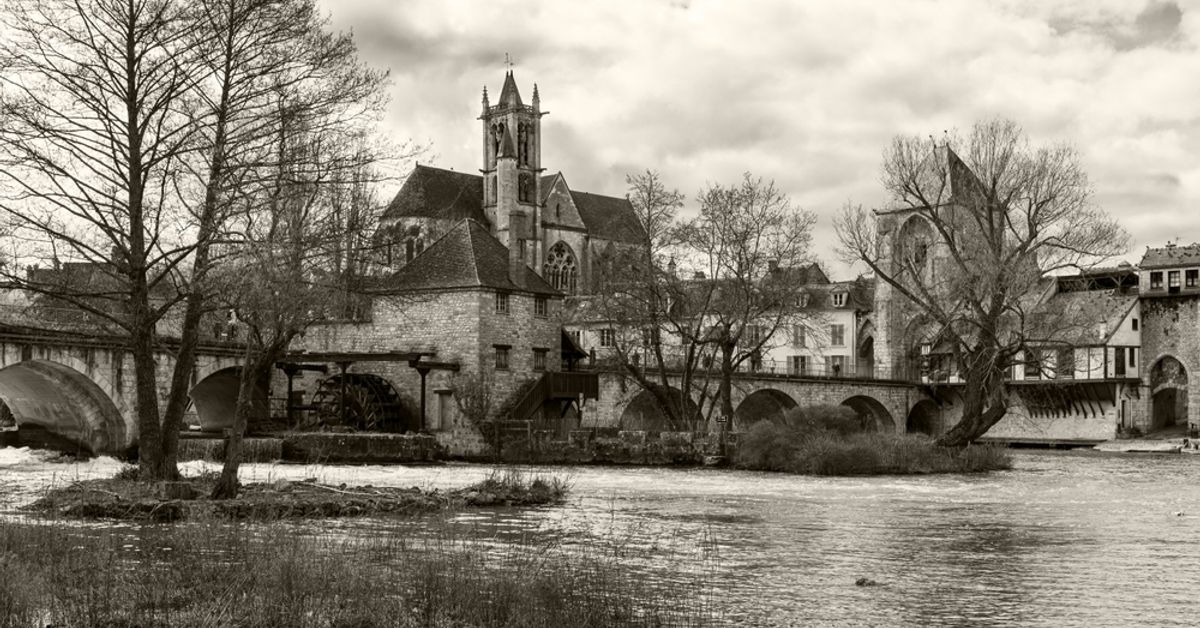
If you plan a visit in person, the medieval town of Meaux to the east of Paris makes an excellent base. Its cathedral chapter kept extensive records, and the town’s market history means that surnames like Fontaine, Dubois, and Martin appear frequently in its old registers. Read our guide to planning a French heritage trip before you go.
The Surnames of the Île-de-France Nobility
Not all Île-de-France surnames were peasant or merchant names. The Paris basin was the centre of the French feudal system, and its noble families had surnames that reflect their estates and titles.
Capet was the name of the dynasty that ruled France from 987 to 1328. Hugh Capet — the first Capetian king — gave his name to his line, though the origin of “Capet” itself is debated. Some scholars link it to the Latin caput (head), suggesting a leader or senior official. The Capetians ruled from Paris, and the name became synonymous with the French monarchy.
Montmorency comes from a town north of Paris. The Montmorency family was one of the oldest and most powerful noble houses in France, with roots going back to the 10th century. Their seat gave France some of its most celebrated military commanders. Families with this surname in French Canada often have a noble Île-de-France connection.
Villiers meant “from the village” or “from the country estate.” It appears in dozens of place-names in Île-de-France — Villiers-sur-Marne, Villiers-le-Bel — and became a common surname for families associated with those estates.
Frequently Asked Questions
What are the most common surnames from Île-de-France?
Martin, Dupont, Dubois, Leclerc, Morin, Petit, Fontaine, and Leroy are among the most common surnames from the Île-de-France region. Many spread to French Canada and Louisiana during the 17th and 18th centuries and remain widespread in those communities today.
How can I tell if my French surname comes from Île-de-France specifically?
The best way is to trace your family line back through parish records to a specific town of origin. If the earliest record you can find places your ancestor in the Paris basin — including the surrounding towns of Meaux, Melun, Chartres, or Versailles — your name has Île-de-France roots. FamilySearch and the BAnQ (for Québec ancestors) are the best starting points.
Why did so many French families from Île-de-France emigrate to Canada?
The French colonial company that settled New France recruited heavily in the Paris region in the early 1600s. Paris was the largest city in France and a hub of trade and migration. Many of the settlers who built Québec City and Montréal came from Île-de-France towns, drawn by promises of land and a fresh start in the colony.
Do the Archives de Paris have records available online?
Yes. The Archives de Paris has digitised a large portion of its civil registration records and many pre-revolutionary parish records. These are searchable free on the Paris municipal archives website. For older records going back to the 15th or 16th century, a visit in person may be necessary, though the archive’s staff are helpful and many records have finding aids in English.
You Might Also Enjoy
- How to Trace Your French Ancestry – A Step-by-Step Guide for Canadians and Americans
- French Surnames of Normandy: Origins, Meanings and Family Heritage
- How to Plan a French Heritage Trip to Your Ancestral Village
Plan Your France Trip
Ready to explore France? Our complete France travel planning guide covers everything from getting there to the best time to visit, region by region.
Join 7,000+ France Lovers
Every week, get France’s hidden gems, seasonal guides, local stories, and the art of la vie française — straight to your inbox.
Subscribe free — enter your email:
Love more? Join 64,000 Ireland lovers → · Join 43,000 Scotland lovers → · Join 30,000 Italy lovers →
Free forever · One email per week · Unsubscribe anytime
Tours & experiences you might love


Powered by Viator. Some links are affiliate links — we may earn a small commission at no extra cost to you.

Leave a Reply