
Honfleur sits at the mouth of the Seine in Normandy. It is not a large town. The old harbour — the Vieux Bassin — is roughly 100 metres across. Yet between the 1820s and the 1890s, almost every major French painter of the period came here, set up an easel, and stayed longer than they planned. Some came back for decades. Monet returned again and again. Courbet painted here. Corot, Daubigny, Jongkind — the list reads like a roll call of 19th-century French art.
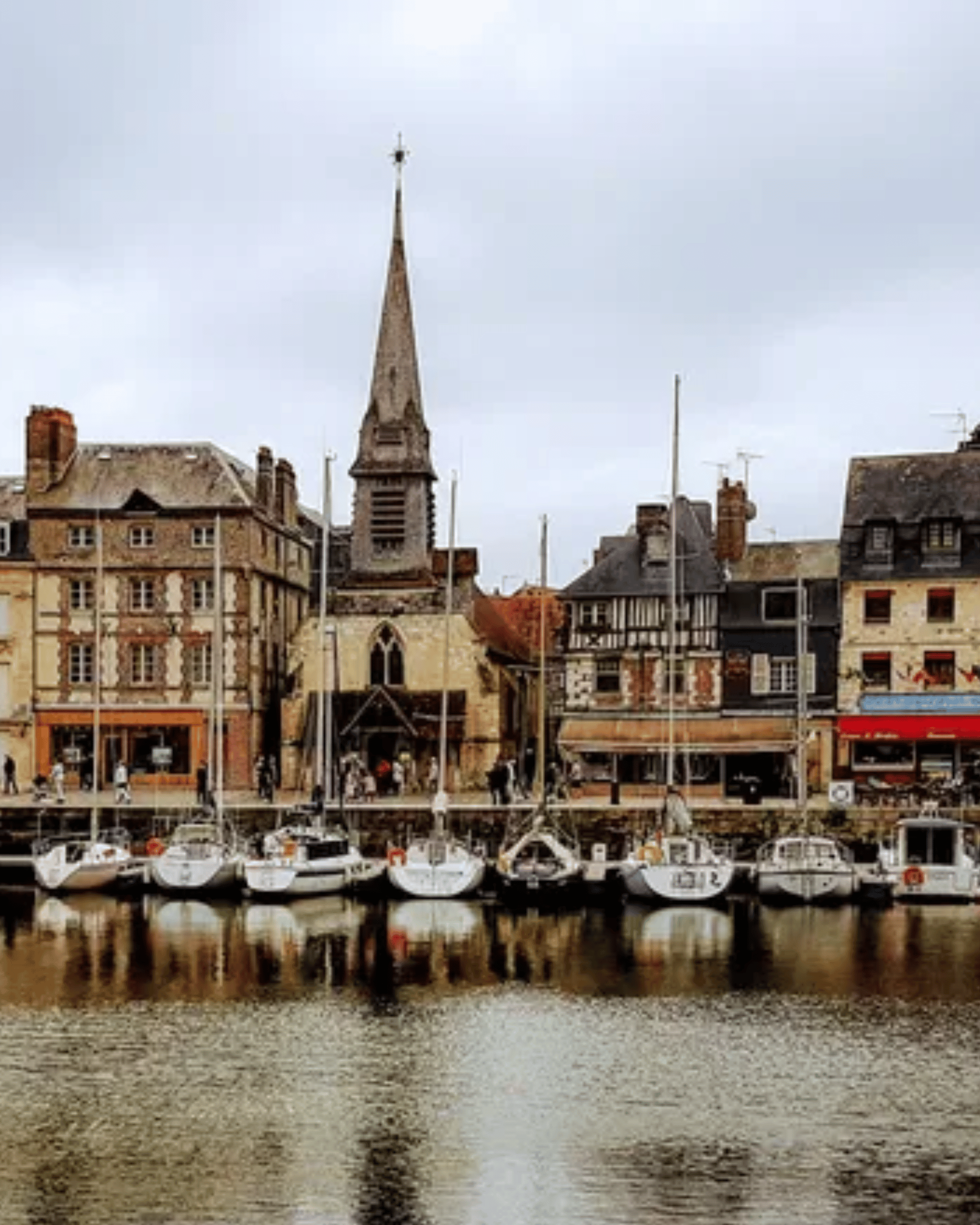
The harbour has not changed much. The tall, slate-fronted buildings still ring the water. The church steeple still rises above the rooftops. Boats still tie up along the quay. If you sit at one of the café tables on the Quai Sainte-Catherine on a grey afternoon with light breaking through the clouds, you are seeing more or less exactly what those painters saw. That is not common. Most of France has been rebuilt, widened, or modernised. Honfleur survived.
This article explains what drew the painters here, what they found when they arrived, and what you will find if you go today.
[newsletter_cta]
Want more like this? Subscribe to our free France newsletter — practical guides, hidden places, and what’s worth your time.
The Light That Started It All
Eugène Boudin was born in Honfleur in 1824. He grew up watching the weather come in off the estuary — fast-moving clouds, the particular silver quality of light reflecting off the water, skies that changed from minute to minute. He never really left. Even when he had a Paris studio, he came back to Normandy to paint outdoors.
Boudin believed that painting outside — en plein air — was the only honest way to capture light. “Three brushstrokes of sky are enough,” he once said, “if they are the right three.” He was obsessed with the sky above the Seine estuary. He made hundreds of studies of it. Other painters who came to visit noticed what he had found.
The light at Honfleur has a specific quality that comes from geography. The town sits where the Seine meets the sea. The water is wide, the sky is big, and the atmosphere carries a fine coastal mist that diffuses direct sunlight. On overcast days — and there are many — the light becomes even and soft, with no harsh shadows. For painters working with colour and tone, this was ideal. You could paint for hours without the light shifting dramatically. On clear days the effect was different but equally useful: bright reflections off the water, deep shadows under the slate roofs, strong contrasts.
Johan Jongkind, the Dutch painter who worked alongside Boudin in the 1860s, described Honfleur’s skies as the most paintable he had encountered anywhere in Europe. Monet, who met both Boudin and Jongkind at this stage of his life, later credited them both as the artists who taught him how to look at light. All three were working, for significant periods, in and around Honfleur.
The Ferme Saint-Siméon
A short walk up the hill above the harbour, along the Rue Adolphe-Marais, there is now a luxury hotel called the Ferme Saint-Siméon. In the 1850s and 1860s it was a farmhouse inn run by a woman named Mère Toutain. She was known for providing cheap meals, cider, and a place to sleep. Painters found it and word spread.
At various points in the 1860s, Courbet, Corot, Daubigny, Boudin, Jongkind, and Monet all stayed or ate at the Ferme Saint-Siméon. It functioned as an informal gathering point — a place to talk about work, argue about technique, and compare what each painter had produced that day. The art historian Joëlle Barreau has described it as “the first Impressionist meeting place,” predating the more famous Café Guerbois in Paris by several years.
The farmhouse had an orchard. Several of the most recognisable paintings of this period show apple trees in bloom on the Honfleur hillside, with the estuary visible below. These were painted from the Saint-Siméon grounds. Today the hotel preserves a small museum with some prints and period documentation. It is worth a brief visit if you are curious about the history, though the rooms and restaurant are expensive. You do not need to stay there to understand what it was.
The Vieux Bassin: What the Painters Actually Painted
The Vieux Bassin — the Old Basin — is the harbour at the centre of Honfleur. It was constructed in the 17th century during the reign of Louis XIV. The buildings around it went up in the late 17th and 18th centuries: tall, narrow houses, many of them six or seven storeys high, faced in slate tiles that give them a distinctive grey-blue colour in the rain.
These buildings are unusual. Slate facing of this kind was common in certain parts of Normandy, but the concentration around the Vieux Bassin is exceptional. The effect, especially when the slate is wet and reflecting the harbour light, is visually striking and unlike anything else in northern France. This is what painters came to paint. The composition practically arranged itself: tall buildings, their reflections in the still harbour water, boats in the middle ground, sky above.
Monet painted the harbour at Honfleur several times in the 1860s. One of his most reproduced works from this period, painted around 1865, shows the jetty at the harbour mouth on a rough day. Another shows the boats reflected in the inner basin. He was working fast, trying to capture the effect of the moment rather than building up a careful composition over weeks. This approach — which would later define Impressionism — was partly developed here, on the Honfleur quayside, in the early 1860s.
You can still stand in almost exactly the positions where those paintings were made. The Lieutenance — a 16th-century gatehouse at the harbour entrance — is still there. The quays are still in the same place. The slate buildings are still standing. Most of what you see now would be recognisable to someone who last visited in 1870.
Enjoying this? Join our free France newsletter for weekly guides to the places most visitors miss.
Église Sainte-Catherine: The Church the Shipbuilders Made
On the square just behind the harbour there is a church unlike any other in France. The Église Sainte-Catherine is the largest timber church in the country. It was built in the 15th century, not by stonemasons but by shipbuilders. After the Hundred Years’ War, the town’s craftsmen were more skilled with wood than stone. They built two parallel naves, side by side, using the same joinery techniques they applied to hulls and keels. The result looks like the inside of two upturned boats.
The bell tower stands separately from the church, across a small lane. This was deliberate — a separate structure meant that if lightning struck the tower, it would not set the timber church on fire. The arrangement is unusual and worth noticing.
This church appears in the background of several Honfleur paintings from the 19th century. It is one of the things that gives the town’s skyline its distinctive look — the steeple rising above the rooftops to the right of the harbour. Entry is free. It takes about twenty minutes to look around properly.
The Musée Eugène Boudin
The town has a museum dedicated to Boudin and the wider Honfleur school of painters. The Musée Eugène Boudin holds a substantial collection of his work — sky studies, beach scenes at Trouville, harbour compositions — along with paintings by Jongkind, Courbet, and others who worked in the area. There is also a separate room dedicated to Impressionist and modern work acquired by the museum over the decades.
The Boudin collection is the main reason to visit. His sky studies in particular are worth spending time with. They are small, rapid oil sketches — some only the size of a sheet of A4 paper — and they demonstrate exactly what he meant about capturing the moment. Dates, times, and weather conditions are often written on the back. He treated them as data as much as art.
The museum is open every day except Tuesday, from 10am to 6pm in summer. Tickets are around €8 for adults. It is a twenty-minute walk from the train station, or a short walk from the Vieux Bassin.
Practical Information for Visiting Honfleur
Getting there: Honfleur is not on a main rail line. The most convenient approach from Paris is to take the train to Deauville or Lisieux, then a bus or taxi for the final section. By car from Paris it is about two hours on the A13 motorway. The Pont de Normandie, the cable-stayed bridge visible from the harbour mouth, connects Honfleur to Le Havre across the Seine. From Le Havre, a bus crosses the bridge into town.
When to go: The town is busy in July and August. The harbour cafés are crowded, parking is difficult, and accommodation prices rise sharply. Spring and autumn are better. The light in October is excellent — clearer than summer, with long golden afternoons — and the tourist trade has thinned out. The cafés and restaurants are still open. Weekdays in September are often near-empty.
Where to eat and drink: The restaurants directly on the Quai Sainte-Catherine are convenient but not especially good value. Better options are one street back, on the Rue de la République and the streets around the Vieux Bassin’s eastern side. La Cidrerie, a few minutes from the harbour, serves Norman food at reasonable prices. For a coffee with the harbour view, the terrace cafés on the Quai Sainte-Catherine are fine — you are paying partly for the position, but the position is worth it on a clear day.
Where to stay: The town has a range of options from small B&Bs to the expensive Ferme Saint-Siméon. For most visitors, a small hotel or chambres d’hôtes within walking distance of the Vieux Bassin is the practical choice. Booking in advance is necessary from May to September.
Why the Painters Kept Coming Back
The question in the original Facebook post is worth answering directly: why did they never leave? The short answer is that they found what they were looking for. The light was right. The subject matter was concentrated in a small area. The costs were low. Other painters were there, which meant conversation, criticism, and the stimulus of seeing someone else’s work.
But there is another factor. Honfleur is a working harbour, not a decorative one. In the 19th century it was a serious commercial port, with fishing boats, coastal traders, and the regular traffic of a river mouth. It smelled of fish and tar. The painters were not painting a picturesque backdrop — they were painting a functioning place. That gave the work a ground truth that purely scenic painting lacks. Boudin’s beach scenes at Trouville have the same quality: real people, real weather, real light. The subject happened to be beautiful, but beauty was not the point. Accuracy was the point.
Honfleur today is more self-consciously picturesque than it was in Monet’s time. There are galleries selling prints and souvenir shops near the harbour. But the fundamental structure of the place — the light, the buildings, the water — is unchanged. Stand on the Quai Sainte-Catherine in the late afternoon as the clouds come in off the estuary, and it is not difficult to understand why painters came here, and why they found it so hard to leave.
Discover more of France’s hidden history. Sign up for our free weekly newsletter — the France most guidebooks skip.
Tours & experiences you might love


Powered by Viator. Some links are affiliate links — we may earn a small commission at no extra cost to you.

Leave a Reply