
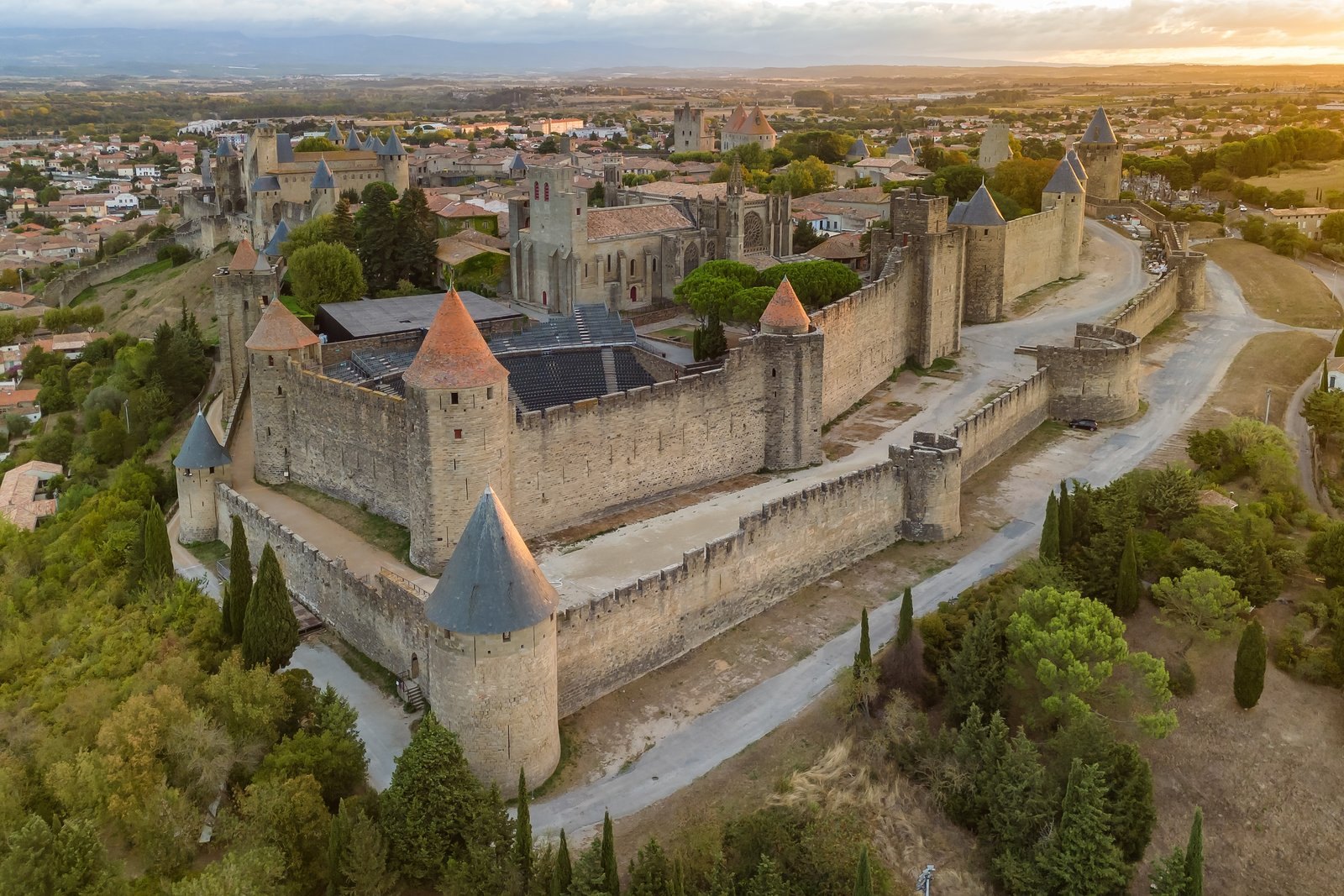
The Cité de Carcassonne in southern France is one of the best-kept walled towns in Europe. It is ringed by two lines of crenellated walls, so anyone who broke through the first still faced the second. Between them runs a cobbled path, and round towers with slate conical roofs step along the ramparts. This guide covers what you will see, a little of the history, and the practical details for planning a visit.
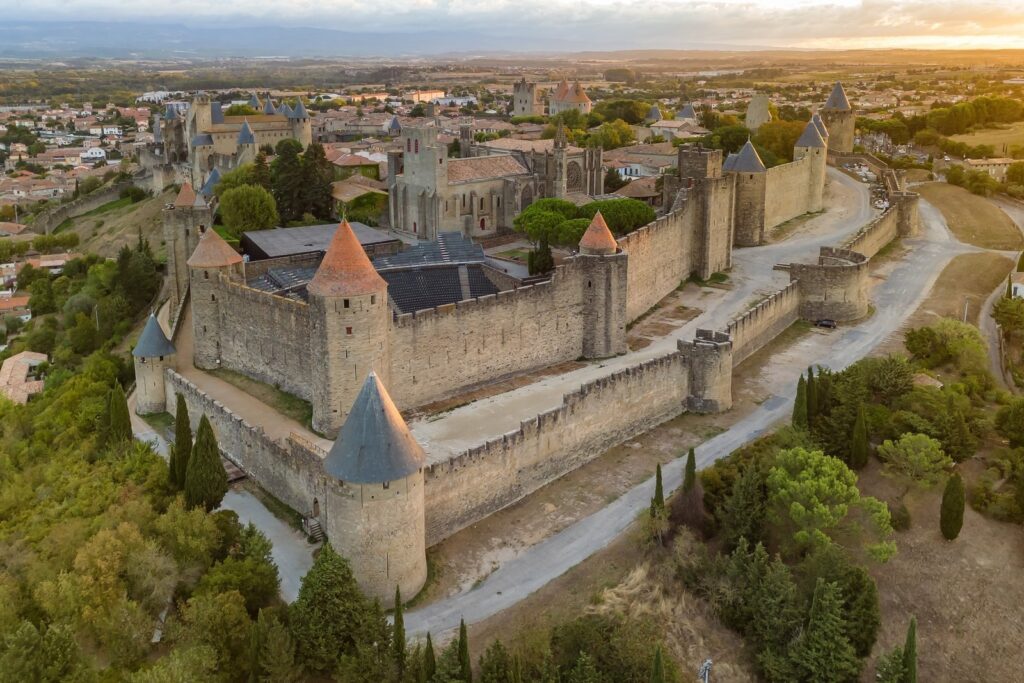
Why Carcassonne’s double walls matter
Many old towns had one wall. Carcassonne has two, and that is the whole idea. An attacker who got past the outer wall did not reach the town. He reached a narrow strip of ground with the taller inner wall rising above him, and defenders firing down from the top.
The two lines together run for roughly three kilometres and include around 52 towers. The strip between them is called the “lices” in French. In the Middle Ages it was used for training and, when needed, for fighting. Today it is a peaceful path where you can stroll and look up at the stonework.
The site has been a UNESCO World Heritage Site since 1997. It stands on a hill above the River Aude, and the position gave defenders a clear view of anyone approaching.
A short history of the fortress
People have lived on this hill for thousands of years. The Romans fortified it, and parts of the inner wall still contain Roman-era stonework. Later rulers, including the Visigoths, added to it. The bulk of what you see now was built or rebuilt in the 12th and 13th centuries.
In 1209 the city was besieged during the Albigensian Crusade, a conflict between northern French forces and the Cathar-linked lords of the south. Carcassonne fell after a short siege, and the area later came under the French crown. The kings then built the strong outer wall in the 13th century, which is how the double ring came about.
The fortress lost its military value after the Treaty of the Pyrenees in 1659 moved the border with Spain further south. It slowly fell into disrepair, and by the 19th century there were plans to pull parts of it down.
Local people and writers argued for saving it. From 1853 the architect Eugène Viollet-le-Duc led a long restoration. He is also known for his work on Notre-Dame in Paris.
The slate roofs
The pointed slate roofs on the towers were part of that 19th-century work. Viollet-le-Duc used a northern French style of roof, and historians still argue about whether the south would have had them originally. Whatever the debate, they give the skyline its famous look. Just know that what you are seeing is a mix of medieval walls and Victorian-era restoration.
Love France? Join thousands of other readers and get our free newsletter for more places like this.
What to see inside the Cité
The ramparts
Walking the walls is the main reason to come. Parts of the ramparts can be visited with a ticket to the castle, and you can also walk the lices path between the walls for free. From above, you look down on the lanes of the old town on one side and the countryside, the Aude valley and, on clear days, the Pyrenees in the distance on the other.
Château Comtal
The Count’s Castle sits inside the inner wall and works as a fortress within the fortress. It has its own moat and gatehouse. The ticket usually includes a guided or self-guided visit and access to a stretch of the ramparts. Check the current opening hours and prices on the official site before you go, as they change by season.
Basilica of Saints Nazarius and Celsus
This church is worth ten minutes of your time even if you are short of time. Its Romanesque nave is plain and strong, while the Gothic choir has fine stained glass. The glass is some of the oldest and best in the region.
The Porte Narbonnaise and the old lanes
The Porte Narbonnaise is the main eastern gate and the most common way in. It is a good place to see how the defences were built, with twin towers, a drawbridge position and a narrow passage that slows anyone entering. Beyond it, the lanes are lined with shops. Some sell good local products, such as cassoulet, a slow-cooked stew of beans and meat that the area is known for. Others sell plastic swords, so choose with care.
How to plan your visit
Getting there
- By train: Carcassonne has a station in the lower town. Trains from Toulouse take about 35 to 50 minutes. From the station it is around a 30-minute walk to the Cité, or a short taxi or bus ride.
- By air: Carcassonne has a small airport, and Toulouse and Perpignan are larger options within roughly an hour or two by road or rail.
- By car: The A61 motorway runs past the town. Parking near the Cité is available but fills up in summer, so arrive early.
When to go
July and August are busy and hot, and the narrow lanes can feel crowded by midday. April to June and September to October are more comfortable, with milder weather and fewer people. Winter is quiet and some shops close, but the walls look striking in low light. On 14 July the Cité is known for a large fireworks display, which draws big crowds.
What to wear and bring
The streets and ramparts are cobbled and uneven, and there are steps. Wear comfortable shoes with a good grip. Bring water in summer, because shade is limited on the walls. A hat and sunscreen help too.
How long to stay
You can see the main sights in half a day. A full day lets you walk the whole circuit, visit the castle and the basilica, and have a relaxed lunch. If you stay overnight, you will see the Cité after the day visitors leave. The walls are lit in the evening and the lanes are far quieter.
Old Cité and lower town
Carcassonne is really two places. The Cité is the hilltop fortress on the right bank of the Aude. Across the river is the Bastide Saint-Louis, the lower town, laid out on a neat grid in the 13th century. It has a big central square, markets and everyday cafés where locals eat.
The two are linked by the Pont Vieux, an old stone bridge. Walking across it gives you one of the best views of the walls, especially in the late afternoon when the light turns the stone gold. Many visitors stay in the lower town because hotels and restaurants are cheaper there, and then walk up to the Cité.
The Canal du Midi also passes through the lower town. It is another UNESCO site and has towpaths for cycling or an easy walk. A boat trip on the canal is a calm way to spend an afternoon after the climb up to the ramparts.
Eating and drinking
Cassoulet is the local dish and you will see it on almost every menu. It is hearty, so it suits cooler days better than a hot August afternoon. Expect white beans, sausage and duck or pork. Ask whether the cassoulet is made in house, since quality varies, especially inside the busiest part of the Cité.
The wider Languedoc region produces plenty of wine. Look for local reds and whites from the Cabardès and Limoux areas nearby. Limoux is known for sparkling wine, which makes a pleasant aperitif. Eating in the lower town is usually cheaper and quieter than eating at a table beside the ramparts, though the setting inside the walls has its own appeal.
Tips to get the most from the walls
- Arrive early or stay late. The main gates are busiest between about 11am and 4pm.
- Walk the lices path first. It is free and shows you the double-wall design properly.
- Buy castle tickets in advance in peak season to skip the queue.
- Look up as well as ahead. Details such as arrow slits, wooden hoardings and the different stone styles tell the story of each rebuilding.
- Keep an eye on your belongings in crowded lanes, as you would in any popular tourist spot.
- Check access before you go if you use a wheelchair or pushchair. The cobbles and steps make parts of the site hard to reach.
Is Carcassonne worth visiting?
For anyone who likes history, yes. Few places in Europe let you see medieval defence design so clearly, and the double wall makes the logic obvious within minutes. It is touristy, particularly in summer, but the scale of the fortress and the views from the ramparts are well worth the crowds.
It also fits neatly into a wider trip through southern France. Toulouse, the Canal du Midi, the Cathar castles in the hills and the Mediterranean coast are all within easy reach.
Want more guides to the places that make France special? Subscribe to our free newsletter today.
Would you like to walk its walls? Pick a quiet morning, wear good shoes and take your time on the path between the two lines of stone.
Tours & experiences you might love


Powered by Viator. Some links are affiliate links — we may earn a small commission at no extra cost to you.

Leave a Reply