
There are castles in southern France that most visitors never notice. They sit on clifftops so high they seem to belong to the sky rather than the land. Locals pass beneath them every day without looking up. And behind each one is a story that most French history books barely mention.
Who Were the Cathars?
In the 12th and 13th centuries, a distinct civilisation flourished in what we now call the south of France. This was Occitania — a region with its own language, its own poetry, and its own way of life. It was closer in spirit to northern Spain than to Paris.
At the heart of this world was a Christian movement known as Catharism. The Cathars believed in a life of simplicity: no wealth, no violence, no attachment to the material world. They called their spiritual leaders the Bons Hommes — the Good Men — and the Bonnes Femmes — the Good Women.
They were weavers, farmers, and teachers. They ran schools for girls at a time when most of Europe denied women any formal education. They cared for the sick and the poor. They spread across hundreds of villages in the Languedoc, welcomed by local nobles who admired their honesty and their rejection of Church wealth.
By the early 1200s, Catharism was not a fringe movement. It was the faith of a significant portion of southern France — and that was precisely the problem.
Why Rome Declared War on Its Own Kingdom
The Cathars rejected the authority of the Catholic Church. They refused to pay tithes. They rejected the sacraments. They called Catholic priests corrupt — and in many cases, they were not wrong. The Church had been trying to bring the Cathars back into the fold for years through preaching missions. None of it worked.
In 1208, a papal legate was assassinated in the Languedoc. Pope Innocent III used the moment to act. The following year, he launched what became known as the Albigensian Crusade. It was not aimed at the Holy Land. It was aimed at France itself.
Thousands of knights from northern France and beyond marched south — drawn by promises of land, absolution, and the wealth of the Languedoc. What followed was one of the bloodiest episodes in medieval French history. Towns that sheltered Cathars were burned. Populations were massacred. A civilisation that had produced remarkable art, literature, and architecture was systematically dismantled.
The war dragged on for decades. By the 1240s, most Cathar strongholds had fallen. The Inquisition moved in behind the armies, hunting down those who had survived.
The Last Fire at Montségur
The end came on a mountainside in the Ariège in 1244. The remaining Cathar community had retreated to the fortress of Montségur — a castle perched on a spike of rock more than a thousand metres above the valley floor. For ten months, a small garrison and a community of Cathar faithful held out against a besieging army.
When the fortress finally fell, the terms were simple: renounce your faith, or die. A two-week truce was granted to allow people time to decide. On the final day, around 220 Cathars — men and women both — walked down the mountain together. They had refused to convert. They were burned alive in a field at the base of the rock.
The field is still there. A simple stone marker stands where the pyre once burned. The castle still watches over it from above, its walls open to the wind, its silence complete.
What Was Lost — and What Could Not Be Erased
The fall of Montségur effectively ended Catharism as a living faith. The Inquisition spent the following decades hunting down the last survivors. By the early 14th century, when the last known Cathar perfectus — a man named Guillaume Bélibaste — was burned at the stake, the movement was over.
But some things could not be destroyed. The Occitan language — the tongue of the troubadours, of courtly love poetry, of an entire culture distinct from the French north — still has living speakers today. There are radio stations, schools, and road signs in Occitan across this region. The troubadour tradition, which flourished in the same courts that sheltered the Cathars, gave Europe the very concept of romantic love as we understand it.
And the castles remain. Dozens of them, strung across the hills and clifftops of the Aude, the Ariège, and the Hérault. Abandoned, crumbling, open to the sky — each one a reminder that this corner of France was once its own world, with its own beliefs and its own way of being.
🇫🇷 Discover the France Most Tourists Never Find
Get our free guide to 25 hidden villages of France — then join 7,000+ readers for weekly stories about places most guidebooks never mention.
Get Your Free Village Guide →The Cathar Trail Today
Southern France has mapped out a tourist route called the Circuit Cathare, linking the main fortresses and historical sites across the region. It runs through countryside that few international visitors ever reach — green river valleys, limestone gorges, and hilltop villages where the pace of life has barely changed in centuries.
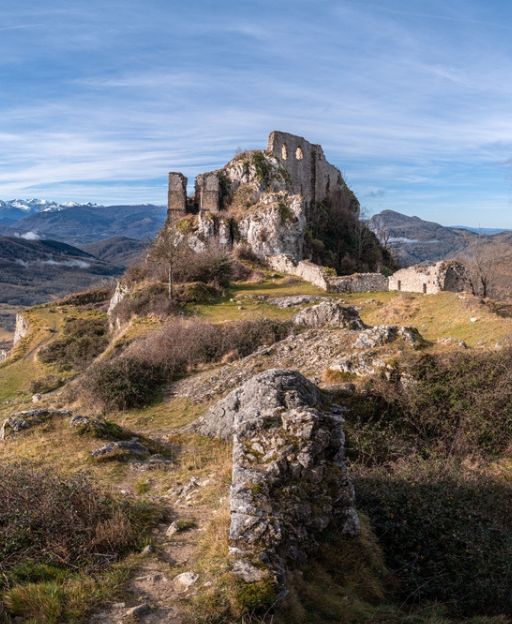
The most dramatic sites are the castles. Peyrepertuse is the largest — a double fortress spread across a ridge so narrow that in places the walls drop straight to the cliff edge on both sides. Quéribus balances on a single spike of rock above the plain. Roquefixade looks across to the Pyrenean peaks. Each one is different. Each one is worth the climb.
All of them are accessible to reasonably fit walkers. Some involve steep paths over rough terrain. None require special equipment. And all of them reward the effort with views that make the rest of the world feel very far away.
If you are planning your trip to France, Cathar country is one of the most undervisited regions in the entire country. Spring and early autumn are the best times to visit — summer in the gorges can be punishingly hot. Carcassonne makes a good base and is well connected by train from Toulouse. The medieval walled city of Carcassonne gives you a vivid sense of what this region looked like when the Cathars were alive.
The Silence Up There
There is something specific about standing inside one of these ruined castles. The roofs are long gone. The walls are broken. What remains is stone — stairs cut directly into rock, arches open to the wind, rooms that once sheltered families now exposed to the sky.
On a clear day from Roquefixade, you can see the full length of the Pyrenees stretched along the southern horizon — a line of white peaks running from east to west. It is exactly the view the last Cathars would have had. The mountains they looked at are unchanged. The sky above them is the same.
You do not need to be religious, or even particularly interested in medieval history, to feel the weight of these places. Something happened here that is rare in the story of civilisations: an entire people, with their own language and faith and art, were deliberately erased. And yet they left their bones behind — sticking up out of the hillsides, impossible to ignore.
Most visitors to France never get this far south. Most never look up at the clifftops and think to ask what those ruins are. That, perhaps, is exactly why it is worth going.
🇫🇷 Join 7,000+ France Lovers
Get hidden gems, food secrets, and travel stories every week. Free forever.
Love France? So Do We.
Join our free newsletter and get the best of France — travel tips, hidden villages, food traditions, and cultural stories — straight to your inbox every week.
Free. No spam. Unsubscribe anytime.
📥 Free Download: France Travel Planning Guide
Itineraries, insider tips, and the places you must not miss on your next trip to France.
🇫🇷 You Might Also Love
Tours & experiences you might love


Powered by Viator. Some links are affiliate links — we may earn a small commission at no extra cost to you.

Leave a Reply