
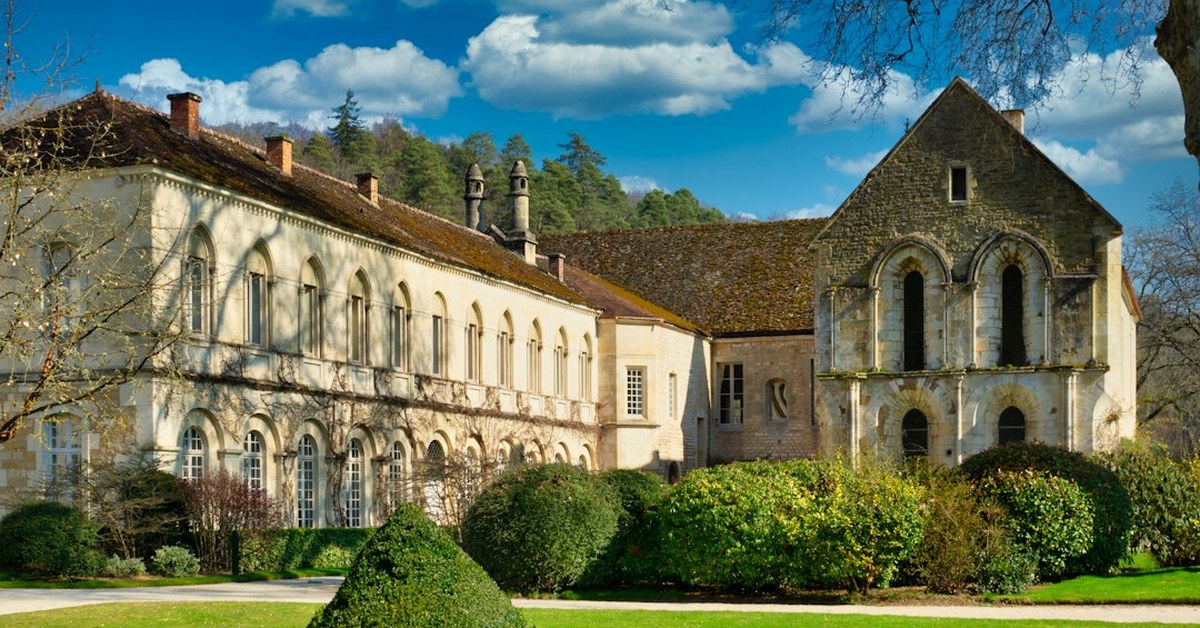
Fontenay Abbey sits in a quiet wooded valley in northern Burgundy. No busy village crowds around it. No traffic hums nearby. You find only stone, water and trees.
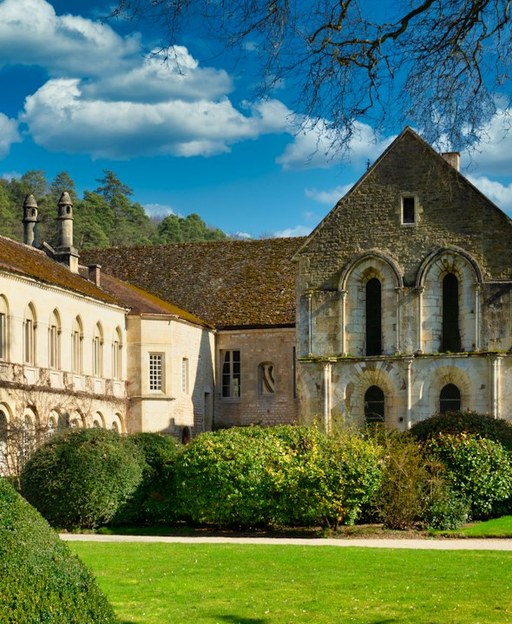
This is a Cistercian abbey, and it is among the best preserved in Europe. The abbey itself says it is the oldest surviving Cistercian abbey in the world. Monks have not lived here since 1790. Yet the buildings still feel ready for the next service.
How Fontenay Abbey Began
Saint Bernard of Clairvaux founded Fontenay in 1118. He was the leading voice of the Cistercian order. His monks first settled in a valley a few miles from Montbard. In 1130 they moved to the site you visit today. It lies where two valleys meet.
The Cistercians wanted a plainer life than the great Benedictine houses offered. They chose remote valleys. They worked the land with their own hands. They valued silence, prayer and simplicity. Our story of Cluny Abbey shows the grand world that these reformers wished to leave behind.
An unexpected guest soon arrived. In 1139, Ebrard, Bishop of Norwich, came to live at Fontenay. He fled the troubles he faced in England. His fortune helped to pay for the abbey church.
A Church Built for Silence
Pope Eugene III consecrated the abbey church in 1147. The date matters. It tells us the church is early, and it is still Romanesque in style.
Step inside and you notice what is missing. There are no carved figures and no bright paint. Light falls on bare stone. The plain walls and round arches give the nave a calm, even weight.
That bareness was a choice. The Cistercians believed rich decoration pulled the mind from prayer. Bernard wrote sharply about showy carvings in monastic cloisters. Fontenay shows what his ideal looked like in stone.
The Cistercian Plan, Perfectly Preserved
All Cistercian abbeys follow the same basic layout. The church stands beside a central cloister. The monks’ rooms spread around that square. Work buildings stand apart from the spaces for prayer.
Fontenay keeps this plan almost whole. Historians now think it may have served as a model for later abbeys of the order. That is partly because the site survived in such fine shape.
You can still walk through most of the monks’ world. The cloister is here. So are the chapter house, the warming room and the long dormitory. Each space has a clear purpose. Each one explains a part of the daily round.
The warming room mattered most in winter. It held the only fire in the monastery, apart from the kitchen. Monks came here to thaw their hands before they copied books.
🇫🇷 Enjoying this? 7,000 France lovers get stories like this every week. Subscribe free →
The Forge: Where Monks Made Iron
Prayer was only half of Cistercian life. Work was the other half. At Fontenay, that work included iron.
The forge dates from the late 12th century. It is more than 50 metres long. Strong buttresses line its walls. They hint at the heat and noise within.
Archaeologists who studied the forge and the nearby iron mines call it one of the oldest metalworking sites in Europe. The monks used water power to drive heavy hammers. They sold the iron and earned a large income for the abbey. A modern copy of one hydraulic hammer now shows how it worked.
From Abbey to Paper Mill
Hard times came for Fontenay. English soldiers under Edward III looted it in 1359. In 1547 the king began to name its abbots. The monks lost the right to choose their own leaders.
The French Revolution ended monastic life here. The last eight monks left in 1790. In 1791 the revolutionaries sold the abbey. The buyer turned it into a paper mill.
That sounds like a disaster. In fact, it saved the abbey. Many monasteries became quarries for stone. Fontenay became a factory, and the old buildings stayed standing.
In 1820 Élie de Montgolfier bought the site. His family had links to the inventors of the hot air balloon. He grew the paper business. The scientist Marc Seguin, who built early suspension bridges, lived here in 1838. The mill closed in the early 1900s.
The Rescue of Fontenay
Édouard Aynard, a banker and art patron from Lyon, bought Fontenay in 1906. He had married into the Montgolfier family. He set out to strip away the factory and restore the medieval abbey. That work ran until 1911.
His family still owns the abbey today, according to the official site. The owners say that, apart from a few large restorations, the abbey gets no state or World Heritage subsidy. Your ticket helps to keep the stones standing.
The French state listed the abbey as a historic monument in the 19th century. UNESCO added it to the World Heritage List in 1981. It was one of the first French sites to join. UNESCO honoured the buildings and their wooded setting together.
Visiting Fontenay Abbey
Fontenay lies near Montbard, in the Côte-d’Or department of northern Burgundy. The address is Marmagne. Most visitors drive. Dijon and Auxerre both lie within reach for a day trip.
Opening days and hours change with the season. Prices change too. Check the official Fontenay Abbey website before you go. It also lists guided and self-guided tours. We checked it in November 2026.
Allow two hours for the visit. The tour covers most of the monastic buildings, the gardens and a small stone museum. Walk slowly. This is a place that rewards quiet.
Pair Fontenay with other Burgundy stops. The hilltop basilica at Vézelay makes a fine second visit. Our Burgundy travel guide helps you plan the whole region. For a southern Cistercian contrast, read about Sénanque Abbey in Provence.
Fontenay and Your Family Roots
Cistercian abbeys owned land, mills and farms across the countryside. Local families farmed that land for generations. Tenants, millers and ironworkers all appear in monastery records.
Many of those records now sit in French archives. You will not find them in a quick online search. Start with parish and civil registers for your ancestral village. Then move to the departmental archives. Our step-by-step guide to tracing French ancestry explains each stage.
If your family came from northern Burgundy, an abbey may have shaped their lives. Stand in the cloister and think of them. They may have worked in these fields or heard these bells.
Fontenay Abbey FAQ
Who founded Fontenay Abbey?
Saint Bernard of Clairvaux founded Fontenay in 1118. He led the Cistercian order. The monks settled at the present site in 1130.
Is Fontenay Abbey a UNESCO site?
Yes. UNESCO listed Fontenay Abbey as a World Heritage Site in 1981. The listing covers the abbey and its wooded valley.
Why did Fontenay Abbey survive the Revolution?
Buyers turned it into a paper mill after the sale in 1791. The factory use kept the old buildings standing. Later owners then restored them.
Where is Fontenay Abbey?
It lies in northern Burgundy, near Montbard. The address is Marmagne, in the Côte-d’Or. Most visitors come by car.
How long should I spend at Fontenay Abbey?
Plan about two hours for the abbey and gardens. Add time for the stone museum and shop. Check the official site for tour options.
You Might Also Enjoy
- Vézelay: the hilltop basilica
- Fontevraud Abbey and the Plantagenet tombs
- Gothic cathedrals of France
Plan Your France Trip
Ready to turn history into a trip? Our planning hub, Start Here: Planning Your Trip to France, brings the key guides together in one place.
Join 7,000+ France Lovers
Every week, get France’s hidden gems, seasonal guides, local stories, and the art of la vie française — straight to your inbox.
Subscribe free — enter your email:
Free forever · One email per week · Unsubscribe anytime

Leave a Reply