
The Gothic cathedrals of France changed what a building could be. Medieval builders took heavy stone and made it feel light. They lifted roofs higher than anyone had dared. They filled the walls with coloured glass. Eight centuries on, these churches still stop visitors in the doorway.
Where the Gothic Style Began
Gothic began near Paris in the 12th century. The Île-de-France was the royal heartland, and it had money, ambition and skilled masons.
The key moment came at Saint-Denis. Abbot Suger rebuilt the royal abbey church there. His new choir was consecrated in 1144. It used pointed arches, ribbed vaults and large windows. Builders across northern France copied the idea within a generation.
Notre-Dame de Paris followed in 1163. It set the pattern for the great city cathedral. It has stood for over eight centuries. That includes the fire of April 2019.
The word “Gothic” came later. Italian writers of the Renaissance used it as an insult. They thought the style looked crude. People in France knew it as opus francigenum, the French work.
Why a Cathedral Could Be So Tall
Three ideas made the height possible. Each one solved a problem that Romanesque builders could not.
The first is the pointed arch. It pushes weight down rather than outwards. The second is the ribbed vault. Stone ribs carry the roof, so the panels between them can be thin.
The third is the flying buttress. This is a stone arm that stands outside the wall. It catches the sideways push of the vault and sends it to the ground.
The wall no longer had to hold up the roof. So builders opened it up. They filled the gaps with stained glass. Light poured in, and the inside glowed in red and blue.
Medieval people read the glass like a picture book. Few could read words. Windows told the stories of the Bible and the saints.
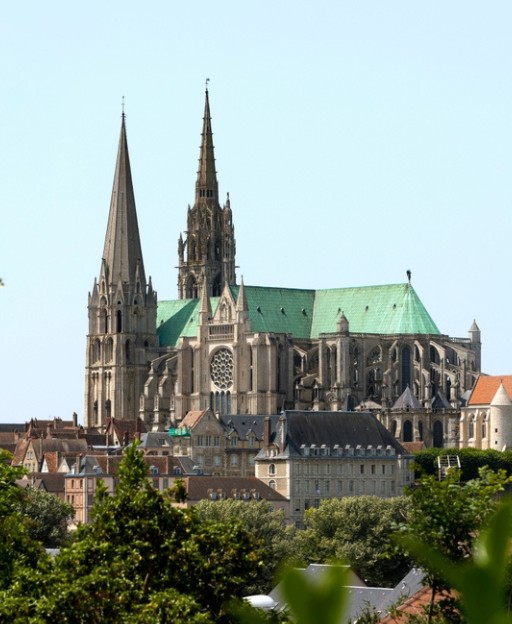
Chartres: The Cathedral Built in a Generation
Chartres sits about 80 km south-west of Paris. A fire in 1194 destroyed most of the older church. Builders started again at once.
The new cathedral rose fast for its time. Most of it was finished within about thirty years. That speed gave it a rare unity of style. It was consecrated in 1260.
The glass is the great treasure. Chartres holds well over a hundred medieval windows. Many are still in their original frames. The deep blue has a name of its own, bleu de Chartres. You can read more in our piece on the medieval colour at Chartres.
The two spires differ. The older one on the south side is plain. The north spire is later and more ornate. Together they make the skyline of the town. Visit times and any special openings are on the official Chartres cathedral website.
Reims: Where France Crowned Its Kings
Reims mattered because of what happened inside it. French kings were crowned here for centuries. The tradition linked the monarchy to the early Christian history of France.
Work on the present building began in 1211. It is famous for its carved figures. More than two thousand statues fill the west front. One of them is the smiling angel of Reims.
Joan of Arc stood in this cathedral in 1429. She watched Charles VII receive his crown. Her story is told in our article on Joan of Arc. Plan your visit with the official Reims cathedral website.
🇫🇷 Enjoying this? 7,000 France lovers get stories like this every week. Subscribe free →
Amiens, Strasbourg and the Race Upwards
By 1220 the cities of northern France were competing. Each wanted the tallest and finest church. Civic pride drove the building as much as faith.
Amiens began in 1220. Its nave vault rises about 42 metres. The proportions feel calm and exact. Many experts see Amiens as the most complete High Gothic design. See the official Amiens cathedral website for visitor details.
Strasbourg took a different path. Builders worked in pink Vosges sandstone from 1176 to 1439. The single spire reaches 142 metres. From 1647 until 1874 it was the tallest building in the world. Our Strasbourg travel guide shows how to see it.
Some builders went too far. At Beauvais, the choir vault reached about 48 metres. It collapsed in 1284. The town never finished the nave. Beauvais shows where the limit lay.
Gothic Cathedrals and Your Family Story
These churches are also family history. Every town with a cathedral kept records. Baptisms, marriages and burials were written down in its parish.
Many French-Canadian and American families come from these towns. Their ancestors may have been baptised under these very vaults. Standing inside can make the past feel close.
To begin your search, read our guide to tracing your French ancestry. The cathedral town is often a good first stop. The departmental archives hold the registers.
Gothic Beyond the Big Names
The style spread across the whole country. Each region gave it a local twist.
At Mont-Saint-Michel, builders added the Merveille in the early 13th century. These Gothic halls cling to the rock above the sea. Our Mont Saint-Michel guide explains how to visit.
In the south, Albi chose red brick. Work on Sainte-Cécile began in 1282. It looks like a fortress, because the region was still tense after the Cathar wars. You can read that story in our piece on the Cathars of Languedoc.
Small town churches matter too. Many village churches copy the great ones on a smaller scale. Look for pointed windows and slim stone ribs. You will start to spot Gothic everywhere.
How to Visit the Gothic Cathedrals of France
Go early in the day. The light is soft and the crowds are thin. Stained glass looks best when the sun is low.
Chartres and Reims both work as day trips from Paris by train. Allow at least two hours inside each one. Bring binoculars for the high carvings.
Dress with respect. These are working churches. Services take place, and some areas close during them. Always check the official site for the day you plan to go.
Want an older, quieter kind of church? Try Saint-Savin Abbey. It shows the Romanesque world that Gothic replaced.
Frequently Asked Questions
What is the oldest Gothic cathedral in France?
The royal abbey church of Saint-Denis is usually named as the first Gothic building. Its choir was consecrated in 1144. Notre-Dame de Paris followed from 1163.
Which Gothic cathedral is best for stained glass?
Chartres is the usual answer. It keeps well over a hundred medieval windows. Many are in their original place.
Where were the kings of France crowned?
Most were crowned at Reims Cathedral. The tradition ran for centuries. Charles VII was crowned there in 1429 with Joan of Arc beside him.
How long did it take to build a Gothic cathedral?
It varied a great deal. Chartres rose in about thirty years. Strasbourg took until 1439. Some cathedrals were never fully finished.
Can you visit Gothic cathedrals from Paris in a day?
Yes. Chartres and Reims are both easy day trips by train. Check train times and cathedral opening hours on the official sites first.
You Might Also Enjoy
- Mont Saint-Michel Travel Guide
- The Church Bells That Define the French Village
- Walking the Double Walls of Carcassonne
Plan Your France Trip
Ready to turn this into a real journey? Our planning hub for your trip to France covers regions, seasons and routes.
Join 7,000+ France Lovers
Every week, get France’s hidden gems, seasonal guides, local stories, and the art of la vie française — straight to your inbox.
Subscribe free — enter your email:
Free forever · One email per week · Unsubscribe anytime
Tours & experiences you might love


Powered by Viator. Some links are affiliate links — we may earn a small commission at no extra cost to you.

Leave a Reply