
Every November, Marseille’s Old Port fills with little clay people. Bakers, fishwives, shepherds, a mayor in a top hat, and one wide-eyed man with both arms in the air. They are santons, the “little saints” of Provence, and they exist because the French Revolution took the Christmas crib out of the churches.
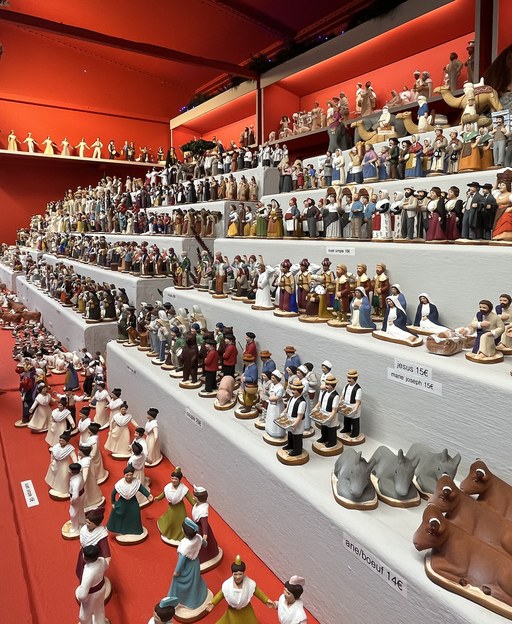
When the cribs left the churches
The Christmas crib came to Provence long before the Revolution. The Marseille tourist office traces it back to Saint Francis of Assisi, who set up the first nativity scene in Italy in 1223. Franciscan monks then carried the custom to Provence.
For centuries the crib lived in church. Then came the French Revolution. Nativity scenes in churches were banned, and Christmas as people knew it was suddenly out of reach.
The people of Marseille did not give it up. They built their cribs at home instead. Families needed small figures they could afford, and that need started a whole craft.
Jean-Louis Lagnel and the first moulds
Earlier crib figures were made from all sorts of things: breadcrumbs, plaster, wax, even spun glass. The figure we know today, a small statue of plain unfired clay, is credited by the Marseille tourist office to one man, Jean-Louis Lagnel (1764-1822).
The trick was the mould. Press clay into a plaster mould, let it dry, paint it, and you can make the same shepherd again and again. The tourist office dates the first moulds to 1798. Suddenly a crib was something every household in Marseille could own.
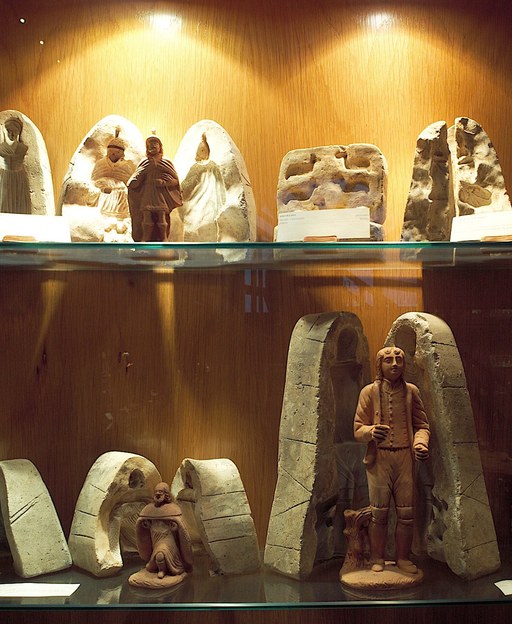
The name came from the local language. In Provençal, santoun means “little saint”, says the French national dictionary centre CNRTL. French turned it into santon.
A whole village around the stable
A Provençal crib starts with the figures you would expect: Mary and Joseph (the baby Jesus joins them on 25 December), the ox and the donkey, the three kings, the angel Gabriel, and a shepherd with his sheep.
Then Provence adds a whole village. There is the mayor, Lou Conse, in his tricolour sash with a top hat and an umbrella. There is the blind man and his son, the priest, the monk, the tambourin player and the farandole dancers. There is Pistachié, the farm servant everyone in Provence knows, plus the baker, the butcher and many more trades.
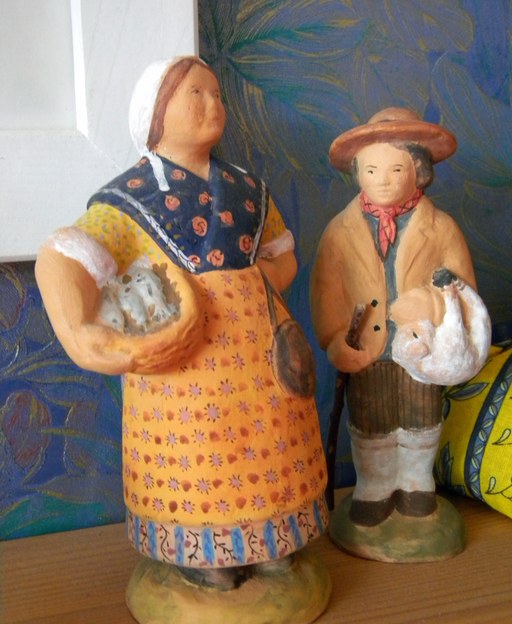
Santon makers still add new faces. The tourist office mentions a santon of the actor Lino Ventura, and scenes from Marcel Pagnol’s Provence stories in clay.
The Ravi: the man with nothing to give
Our favourite is the Ravi. You spot him at once: both arms flung up in the air. He is the village simpleton, or rather the man who is simply amazed. He is poor and has no gift to bring the child, so he brings the only things he has, his joy and his smile.
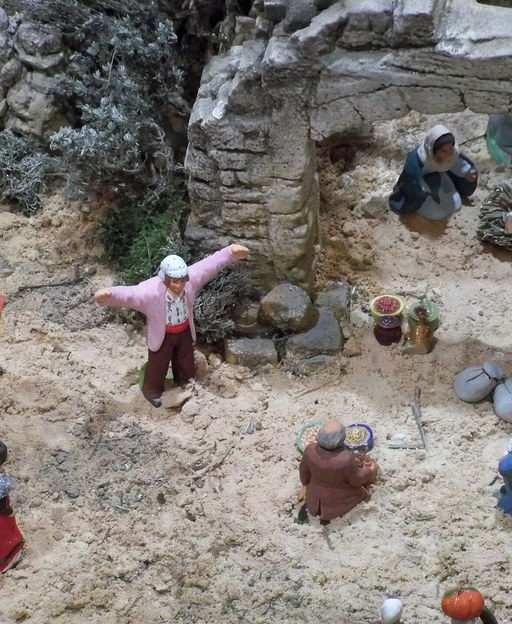
He gave French a phrase. Call someone le ravi de la crèche, “the Ravi of the crib”, and you mean a person who is delighted by very little.
The fair that started in 1803
Once every home wanted a crib, the makers needed a market. In 1803 the first santon fair opened in Marseille, on the Cours Saint-Louis. It has moved several times since, to the Allées de Meilhan, Place Général de Gaulle and the Vieux-Port. It is the oldest santon fair in Provence.
The fair still opens each year with a mass said in Provençal, followed by tambourins and folk groups in costume. The stall holders follow strict rules: santons made in Provence, from clay, and there is even a “Fabrication Provence” certification.
Today, around 120 workshops make santons between Marseille, Aubagne and Aix-en-Provence. Many open their doors so visitors can watch the work.
See the santons yourself this Christmas
The 224th Foire aux Santons de Marseille runs from 14 November 2026 to 3 January 2027 on the Quai du Port at the Vieux-Port, with 21 santon makers. Opening hours differ between sources, so check the fair’s own site before you go. The nearest metro stop is Vieux-Port on line 1.
In Aubagne, just east of Marseille, Le Petit Monde de Marcel Pagnol shows about 200 santons made by local makers, set out as a Provençal village.
Look for the Ravi with his arms in the air, and the mayor with his umbrella. And if you bring one home, you will be carrying on a habit Marseille families started more than two hundred years ago.
Checked November 2026 against the Marseille tourist office, the official Foire aux Santons site and CNRTL.
Tours & experiences you might love


Powered by Viator. Some links are affiliate links — we may earn a small commission at no extra cost to you.

Leave a Reply