
Hot ham, nutty Gruyère, a blanket of béchamel and a golden, bubbling top: the croque monsieur is what a French café brings you when you want something hot, fast and filling. The name means roughly “crunch, mister”, and nobody agrees on who served the first one. We went looking for the real trail, from a Boulevard des Capucines café to a seaside hotel in Proust, and then worked out how to make one at home.
A Café on the Boulevard des Capucines
The story most people repeat is that the croque monsieur was first served in 1910 in a Paris café on the Boulevard des Capucines. The question-and-answer service of the Bibliothèque municipale de Lyon, which looked into it for a reader, gives exactly that version, but with care: the name “probably” comes from such a café, and the origin of the sandwich, it says, remains unclear. As for the name, it suggests that croque simply evokes biting into something with gusto. It also notes that in some French provinces a “croque” is bread dipped in beaten egg and grilled, which hints at where the word may have come from.
The Name Is Older Than 1910
Here the trail gets more interesting. A word-history site, Word Histories, has gathered the earliest times the name appears in print. It finds a character in an 1891 serialized novel saying “let’s make croque-monsieur”, though we cannot tell from the quote what they meant. In 1893, a newspaper article lists “croque-monsieur béarnaise” among the dishes at rich people’s dinners, which sounds nothing like a café snack. In 1908, a London paper’s Paris column printed a cookery-school menu with “Croque Monsieur” on it, and the correspondent admitted having no idea what it was.
The earliest recipe on that list is in a Belgian cookbook published in New York in 1915, and it is a surprise: rounds of bread with ham and grated cheese, fried in butter. So the sandwich we bake and broil today may once have been a fried one. The 1910 café is a popular date, not a proven first.
Proust Ordered One
The sandwich also turns up in literature. In Marcel Proust’s À l’ombre des jeunes filles en fleur, published in 1919, the grand Mme de Villeparisis tells the narrator she has ordered “Croque Monsieur” and eggs in cream for them at the hotel. The Lyon library quotes the passage. If a grand lady in a novel could order one at a hotel, it was clearly already a respectable thing to eat.
What Makes It a Croque, Not a Grilled Cheese
It comes down to the béchamel, the white sauce of butter, flour and milk. It goes between the layers and over the top, so the sandwich comes out creamy inside and golden outside. The cheese is Gruyère in nearly every recipe we read, and Tasting Table says Comté and Gruyère are the most common choices. BBC Good Food infuses the milk and cream with bay, onion and garlic first. Cook’s Country makes the sauce with Gruyère and Parmesan stirred in, and PBS Food serves its version with cornichons on the side. Our recipe below keeps the method simple, with Dijon mustard under the ham and Gruyère in the sauce and on top.
Mustard matters too. Dijon goes under the ham in the BBC Good Food and PBS Food versions, and BBC Good Food also serves a little Dijon-and-mayonnaise mix on the side for dipping. At home we would bring it to the table the way the café does, hot from the oven with a crisp green salad.
Put a fried egg on top and you have a croque madame, the one you will see next to it on most café menus.
Ordering One in France
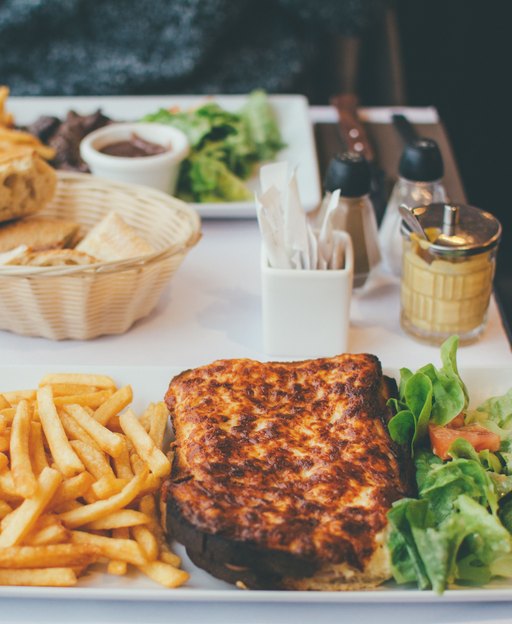
The photo above shows the classic café plate: a croque monsieur with fries and a green salad. If you are planning a trip and want to feel confident in a café, our Café & Bistro Etiquette guide covers how to order, sit and pay, and our piece on the real Paris café experience in Saint-Germain-des-Prés shows what a long café lunch looks like. For more French mornings, see the French towns where every morning starts at the boulangerie.
How to Make Croque Monsieur at Home
Bread, ham, Gruyère and a quick white sauce. The sauce is the part that makes it a croque, and it takes about ten minutes.
Croque Monsieur
Ingredients
Equipment
Method
- Make the béchamel. Melt the 28 g (2 tbsp) butter in a small saucepan over medium heat, add the flour and whisk for 1 minute. Gradually whisk in the milk and bring to a gentle bubble, stirring, until thick and smooth, 2 to 3 minutes. Take it off the heat and stir in 50 g (½ cup) of the Gruyère, 1 tsp of the Dijon, the nutmeg, the salt and the pepper. Set aside to cool a little.
- Heat the broiler (grill) to medium-high. Brush both sides of all 8 bread slices with the melted butter, set them on a baking sheet and toast under the broiler until golden, 1 to 2 minutes per side. Watch them closely.
- Heat the oven to 220°C / 200°C fan / 425°F / gas 7.
- Lay 4 slices on the baking sheet. Spread each with 1 tsp Dijon, then 1 tablespoon of béchamel. Divide 75 g (¾ cup) of the Gruyère and the ham between them, then top with the other 4 slices.
- Spread the rest of the béchamel over the tops, covering the edges, and sprinkle with the remaining Gruyère.
- Bake for 10 to 15 minutes, until golden and bubbling. If you want more colour, slide them under the broiler for a minute, watching closely. Serve hot, with a green salad.
Notes
Sources
- Guichet du Savoir (Bibliothèque municipale de Lyon): Origine du croque-monsieur
- Word Histories: croque-monsieur, meaning and origin
- BBC Good Food: Croque monsieur
- Tasting Table: Classic croque monsieur
- PBS Food: Croque monsieur
- America’s Test Kitchen, Cook’s Country: Croque monsieur
Frequently Asked Questions
Which cheese should I use?
Gruyère is the classic. Tasting Table names Comté as the other usual choice. In an American grocery store, look for Gruyère at the cheese counter or buy a block and grate it yourself.
What bread is best?
Recipes differ: BBC Good Food calls for white sourdough or crusty white bread, PBS Food uses country bread, and Cook’s Country uses hearty white sandwich bread. PBS Food slices its bread a quarter inch (6 mm) thick. Whatever you pick, choose a sturdy loaf so it holds the sauce.
Baked, broiled or fried?
Every recipe we compared that gives oven instructions bakes the sandwiches, and some finish them under the broiler to brown the top. Fried versions are older, as the 1915 recipe shows, but a hot oven gives the melted-cheese crown most people expect.
What kind of ham?
The sources vary. BBC Good Food uses thin slices of smoked ham, PBS Food suggests a baked ham such as prosciutto cotto, and Cook’s Country uses Black Forest ham. Choose a thin-sliced cooked ham you like the taste of.
What is a croque madame?
The same sandwich with a fried egg on top.
Tours & experiences you might love


Powered by Viator. Some links are affiliate links — we may earn a small commission at no extra cost to you.

Leave a Reply