
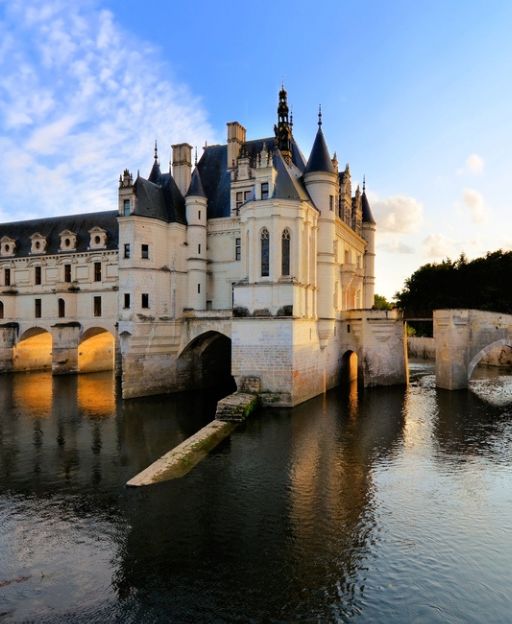
There is a castle in the Loire Valley that stretches across a river like a stone bridge. It has towers, formal gardens, and a long gallery running over the water. But what makes Château de Chenonceau unlike any other castle in France is not how it looks — it is who built it, who ruled it, and what happened inside it during the darkest years of the 20th century.
Built on an Old Mill — by a Woman
In 1513, a royal tax collector named Thomas Bohier bought a mill on the River Cher and decided to build a castle on its foundations. He was a busy man — away on royal business for long stretches at a time — so the entire project fell to his wife, Katherine Briçonnet. She managed the design, the workforce, and every decision that shaped the building.
One of her boldest choices was the central staircase. Most castles of the period used spiral stairs, which were practical but dark. Katherine chose a straight double staircase — one of the first in France. It flooded the entrance hall with light and gave the whole interior a sense of openness that was genuinely new.
When the castle was finished in 1521, Thomas returned to find something extraordinary waiting for him. His wife had effectively designed one of France’s finest Renaissance châteaux. Historians now credit Katherine Briçonnet as one of France’s earliest female architects — though the title would not have applied to women at the time. She simply did the work, without the credit.
The Bohier family did not keep Chenonceau for long. When Thomas died, debts to the Crown meant the castle was seized by King Francis I. It became royal property — and soon, the stage for one of France’s most complicated love stories.
The Mistress, the Queen, and the Bridge
In 1547, King Henry II gave Chenonceau to his mistress, Diane de Poitiers. She was twenty years older than the king and every bit his match in intelligence, ambition, and style. At court, she was known for her beauty, her cold discipline, and her willingness to swim in rivers at dawn into her sixties — an almost theatrical rejection of frailty.
At Chenonceau, Diane commissioned the arched bridge that would carry the castle across the River Cher. She planted the east garden in geometric patterns. She transformed a comfortable residence into something genuinely grand. The bridge was not just beautiful — it was a statement of permanence, a way of anchoring herself to the Loire forever.
When Henry II died in 1559 — struck by a lance through the visor during a jousting tournament — the ground shifted instantly. His widow, Catherine de Medici, had long resented Diane’s position. She moved without sentiment. Diane was ordered to hand over the keys to Chenonceau and retire to the Château d’Anet, a lesser estate. It was a clean and public humiliation.
Catherine moved in and made the place entirely her own. She commissioned a two-storey gallery built on top of Diane’s bridge — the long, arched corridor that still stretches across the river today, its reflections shivering in the current below. She threw parties here so elaborate that guests fired fireworks from the roof while actors performed on illuminated boats on the water.
The Ladies of Chenonceau
Historians call it the Château des Dames — the Ladies’ Castle. And rightly so. Over five centuries, this place was built, expanded, defended, and rescued by women, each leaving something of herself in the stone.
After Catherine, the castle passed to Louise de Lorraine, who came here in mourning after her husband, Henry III, was assassinated. She draped a room in black velvet and spent years here in prayer and grief. The château absorbed her sadness the way old buildings do — quietly, permanently.
In the 18th century, Louise Dupin held one of the most celebrated intellectual salons in France at Chenonceau. Philosophers, scientists, and writers came here to argue and exchange ideas. The young Jean-Jacques Rousseau worked as her secretary. He later wrote that his time at Chenonceau was among the happiest of his life — warm rooms, good conversation, the river always visible from the windows.
Madame Dupin’s generosity towards local villagers may have saved the château from the Revolution. When Revolutionaries came to seize noble estates, the people of the surrounding area spoke up for her. Chenonceau was one of very few Loire châteaux left completely untouched. A small act of loyalty, with enormous consequences.
Enjoying this? 7,000 France lovers get stories like this every week. Subscribe free →
Two Wars, One Château
The Menier family — the famous French chocolate dynasty — purchased Chenonceau in 1913. Within a year, Europe was at war. They immediately converted the gallery over the river into a military hospital, funding the entire operation themselves. More than 2,200 wounded soldiers were treated in those elegant rooms between 1914 and 1918. The gallery that Catherine de Medici had designed for banquets became lined with metal cots.
The Second World War brought a different kind of crisis. When France fell in June 1940, the country was split in two. The Germans occupied the north. The south became the so-called Free Zone, under Vichy French administration. Separating the two was the demarcation line — a border that families, fugitives, and soldiers risked their lives to cross.
That line ran along the River Cher.
Which meant that Château de Chenonceau — straddling the river — had one entrance in occupied France, and one exit in the Free Zone.
The Escape Route Across the River
The Menier family understood exactly what this position meant. People who desperately needed to cross — Jewish families fleeing deportation, Resistance fighters, escaped prisoners of war — could enter the château on the occupied north bank and walk through the gallery to the south bank exit. In and out. Invisible to the Germans on the road.
It was hidden in plain sight. A famous monument, used to move people to safety. Simone Menier, who managed the estate during the occupation, is recorded as having helped organise these crossings. The precise number of people who walked to freedom through that gallery is not known. Documents were not kept. That was rather the point.
Today, the gallery is walked by thousands of tourists every day. They stop to take photographs of the river below. They admire the flower arrangements that Chenonceau’s staff change every week — a tradition that has run unbroken for decades. Most visitors do not know what else this corridor has carried.
Visiting Château de Chenonceau Today
Château de Chenonceau is the second most visited castle in France, after Versailles. The difference is that Chenonceau feels human in scale. You can walk every room without losing yourself. The formal gardens — one on each bank, one belonging to Diane, one to Catherine, still planted separately after five centuries — are at their finest in late spring and early summer.
The château is easily reached by train from Tours, which is the natural base for exploring Loire Valley château country. If you are planning a first trip, Chenonceau pairs beautifully with Chambord to the east and Villandry to the west — a full day of history without covering more ground than a comfortable drive.
France has no shortage of castles with remarkable pasts. If this story has caught your imagination, you might also enjoy reading about the medieval French castle that became an island by accident — another Loire legend with an unexpected twist. And when you are ready to start planning, our France trip planning hub has everything you need in one place.
Join 7,000+ France Lovers
Three times a week, get France’s hidden gems, seasonal guides, local stories, and the art of la vie française — straight to your inbox.
Subscribe free — enter your email:
Love more? Join 65,000 Ireland lovers → · Join 43,000 Scotland lovers → · Join 30,000 Italy lovers →
Free forever · Unsubscribe anytime
There is something about Chenonceau that stays with you long after you leave. Maybe it is the way the river moves silently beneath your feet as you walk the gallery. Maybe it is the weight of everything that corridor has carried — grief, celebration, escape, survival. Or maybe it is simply the knowledge that this extraordinary place was, from the very first stone, a woman’s work.
🇫🇷 Want More Hidden France?
Join 7,000+ subscribers who discover France’s best-kept secrets every week.
Subscribe Free — Join the Community →
Free forever · Unsubscribe anytime · No spam
📥 Free Download: France Travel Planning Guide
Itineraries, insider tips, and the places you must not miss on your next trip to France.
🇫🇷 You Might Also Love
Tours & experiences you might love


Powered by Viator. Some links are affiliate links — we may earn a small commission at no extra cost to you.

Leave a Reply